Hubble Finds Four Concealed White Dwarfs Within 65 Light‑Years, Masked by Red Dwarfs
New research reveals that some nearby white dwarfs have eluded detection, hiding in plain sight despite earlier assumptions.

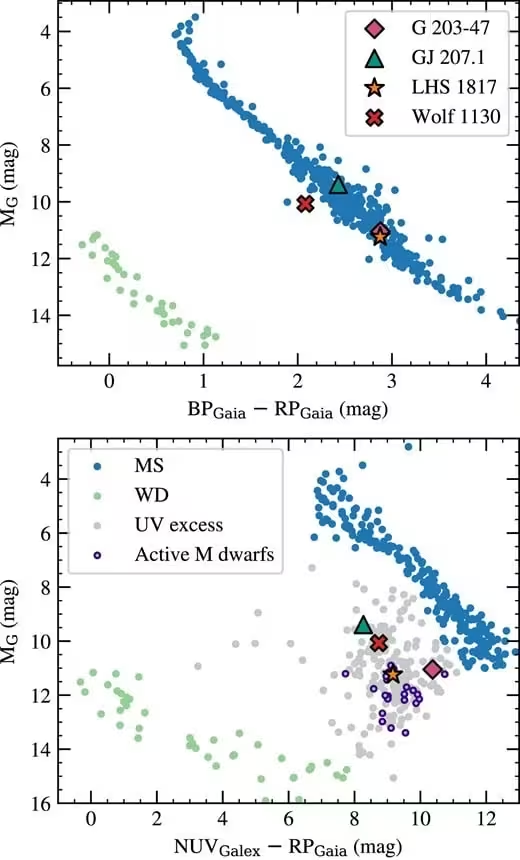
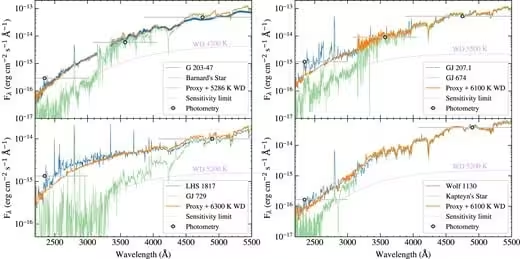
A team of astronomers has identified four previously unseen white dwarfs lying within roughly 20 parsecs (about 65 light‑years) of the Sun. In each case the faint remnant is eclipsed by a brighter red dwarf, whose glare masks the white dwarf in ordinary optical observations.
The finding delivers the first direct evidence for a scarce type of binary system known as post‑common‑envelope binaries (PCEBs) and supplies fresh data to test models of binary‑star evolution. The results, detailed in Monthly Notices of the Royal Astronomical Society, rely on spectroscopic measurements obtained with the Hubble Space Telescope.
Isolated white dwarfs are typically straightforward to locate, but the four objects reported here were hidden behind the light of their red‑dwarf partners, causing them to masquerade as solitary stars and elude earlier surveys.
Hubble Spectroscopy Reveals Concealed Companions
Instead of imaging the white dwarfs directly, the researchers inferred their presence from the subtle orbital motion imposed on the neighboring red dwarfs. The study describes how each white dwarf induces a slight wobble in its companion as the pair orbits a shared centre of mass.
These minute oscillations imprint a faint Doppler pattern on the red dwarf’s spectrum: one limb moves toward Earth while the opposite limb recedes, creating alternating blueshift and redshift signals. The Space Telescope Imaging Spectrograph (STIS) aboard the Hubble Space Telescope captured the delicate velocity shifts.
“Nearby isolated white dwarfs are usually easy to find, but we couldn’t see these four stars directly in visible wavelengths because their red dwarf companions were drowning out their light,” he said. “It’s a reminder that even in our own cosmic neighbourhood, we can still find surprises if we look in the right way, at the right wavelengths.”
All four systems belong to the post‑common‑envelope binary category, where a white dwarf and a main‑sequence red dwarf have survived a phase in which both stars shared a common gaseous envelope.
Binary Evolution Scenarios Gain New Evidence
Clarifying how PCEBs form is a priority for researchers studying stellar evolution. As noted in Monthly Notices of the Royal Astronomical Society, detailed observations of these binaries help refine theoretical frameworks that describe the life cycles of close stellar pairs.
The paper outlines two plausible pathways. The first involves Roche‑lobe overflow, where an expanding giant transfers mass to its companion, creating a shared envelope that is later expelled, leaving behind the exposed white dwarf and its red dwarf companion.
The alternative pathway invokes tidal instability. In this scenario the secondary spirals into the giant’s envelope before Roche‑lobe overflow commences, and the ensuing interaction ejects the envelope, producing a PCEB via a different evolutionary route.

One system, G 203‑47, displays an unusual configuration: its red dwarf rotates once every more than 100 days while completing an orbit around the white dwarf in 14.9 days. Most comparable binaries are tidally locked, making this rotation rate noteworthy.
“What’s fascinating is that G 203‑47 shouldn’t be rotating this slowly if it formed the same way as similar systems. This suggests that these binaries have had very different evolutionary histories.”
Survey Aligns With Predicted Binary Population
Prior models estimated that four or five close white‑dwarf/red‑dwarf pairs should exist within a 20‑parsec radius of the Sun. The detection of four such systems now provides empirical support for those forecasts.
Professor Pier‑Emmanuel Tremblay of the University of Warwick cautioned that only about 30 percent of nearby red dwarfs have undergone systematic searches for concealed white‑dwarf companions.
Tremblay estimates that nine or ten additional post‑common‑envelope binaries could be lurking in the local stellar neighborhood, awaiting discovery through a more extensive radial‑velocity survey of nearby M dwarfs.
This article has been fact checked for accuracy, with information verified against reputable sources. Learn more about us and our editorial process.
Last reviewed on .
Article history
- Latest version
Reference(s)
- <https://academic.oup.com/mnras/article/550/2/stag1195/8733147?login=false>.
- “Space Telescope Imaging Spectrograph.” STScI <https://www.stsci.edu/hst/instrumentation/stis>.
- Belleville, Michelle. “Hubble Space Telescope - NASA Science.”, May 10, 2023 NASA <https://science.nasa.gov/mission/hubble/>.
- “Roche-lobe Overflow | COSMOS.” <https://astronomy.swin.edu.au/cosmos/r/Roche-lobe+Overflow>.
- “Pier-Emmanuel Tremblay.” <https://warwick.ac.uk/fac/sci/physics/research/astro/people/tremblay/>.
Cite this page:
- Posted by Karan Das