Four Hidden White Dwarfs Unveiled in Nearby Binary Stars, Including One Only 25 Light‑Years Away
Astronomers discover four hidden white dwarfs close to the Sun, showing our stellar neighborhood still holds major surprises.

A team of astronomers has identified four white dwarfs that were hidden within nearby binary systems, expanding the inventory of stellar remnants in the Sun’s immediate vicinity. The results, detailed in MNRAS, indicate that additional compact objects may still be lurking undetected around familiar stars.
Undetected White Dwarf Partners Revealed in Nearby Binaries
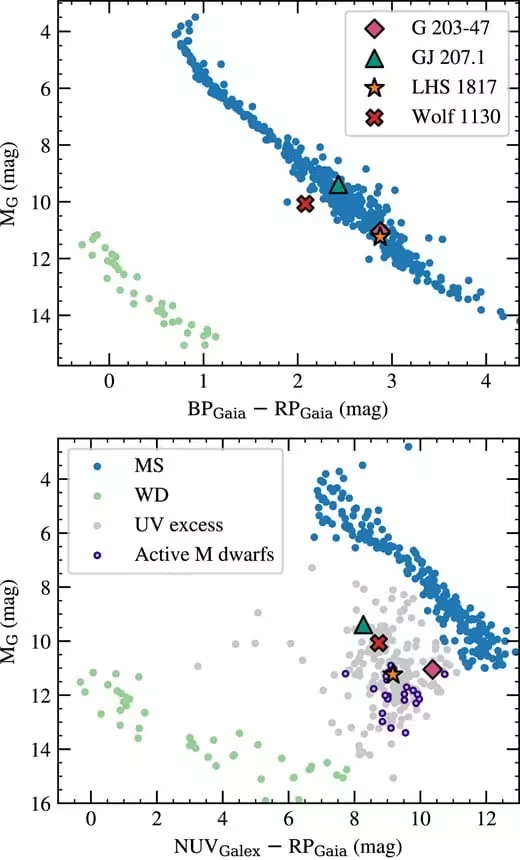
Extensive surveys of stars within a few dozen light‑years of the Sun have long been thought to provide a near‑complete picture of the local Milky Way neighborhood. However, each of the newly found white dwarfs orbits a bright red‑dwarf companion whose glare masks the faint ultraviolet signature of the compact star, causing the systems to appear as single‑star sources in optical observations.
The breakthrough emerged after researchers scrutinized ultraviolet data from the Hubble Space Telescope. While UV imaging makes white dwarfs more conspicuous, energetic flares from the red dwarfs can mimic the same signal. By applying a set of bespoke calibration techniques, the team succeeded in disentangling the two contributions and confirming the presence of the hidden companions. The study, published in MNRAS, underscores the value of multi‑wavelength observations for uncovering objects missed by conventional surveys.
First author Dr. Mairi O’Brien, a research fellow at the University of Warwick, explained,
“Nearby isolated white dwarfs are usually easy to find, but we couldn’t see these four stars directly in visible wavelengths because their red dwarf companions were drowning out their light. It’s a reminder that even in our own cosmic neighborhood, we can still find surprises if we look in the right way, at the right wavelengths.”
A Nearby Binary Defies Conventional Spin‑Orbit Expectations
One of the systems, designated G 203‑47, lies only about 25 light‑years away, making its white dwarf the ninth‑closest to the Sun. The companion’s existence resolves a 27‑year‑old mystery that began with a subtle radial‑velocity wobble hinting at an unseen massive object. Yet the pair continues to intrigue astronomers because the orbital period of the red dwarf (14.9 days) and its rotation period (exceeding 100 days) are markedly out of sync, contrary to the tidal locking commonly observed in close binaries.
Such a discrepancy suggests that G 203‑47 experienced a distinct evolutionary trajectory, preserving clues about mass transfer, angular‑momentum loss, and binary interaction over billions of years.

Co‑author Dr. David Wilson, a research associate at the University of Colorado Boulder, noted,
“What’s fascinating is that G 203-47 shouldn’t be rotating this slowly if it formed the same way as similar systems. This suggests that these binaries have had very different evolutionary histories. Some underwent violent, prolonged interactions early on that locked them tidally. Others, like G 203-47, experienced gentler, briefer encounters that left them in this unusual state.”
Implications for the Local White Dwarf Population
Beyond adding four objects to the nearby catalog, the findings provide critical benchmarks for models of stellar evolution, binary dynamics, and the Galactic star‑formation record. Prior theoretical work predicted the existence of roughly four to five close white‑dwarf/red‑dwarf pairs within 20 parsecs (≈ 65 light‑years) of the Sun. The newly confirmed binaries align closely with these expectations, reinforcing the underlying calculations.
Nevertheless, the study highlights gaps in existing surveys: only a limited subset of nearby red dwarfs has been examined for concealed white dwarf companions. Since red dwarfs dominate the Milky Way’s stellar census, a systematic search could substantially refine estimates of the solar neighborhood’s composition.
Professor Pier‑Emmanuel Tremblay of the Astronomy and Astrophysics Group at the University of Warwick emphasized,
“Only about 30% of red dwarfs within 20 parsecs have been systematically surveyed for hidden white dwarf companions. We think there could be as many as nine or 10 additional binary systems in our local stellar environment that we haven’t found yet. If we put more targeted effort into observing red dwarfs, perhaps we will find more surprises like this.”
This article has been fact checked for accuracy, with information verified against reputable sources. Learn more about us and our editorial process.
Last reviewed on .
Article history
- Latest version
Cite this page:
- Posted by Farah Siddiqui