SpaceX Falcon 9 Twilight Launch Turns Evening Sky Into a Glowing Jellyfish
SpaceX Falcon 9 launch lit the night sky with a glowing space jellyfish, creating one of 2023’s most stunning launch visuals.
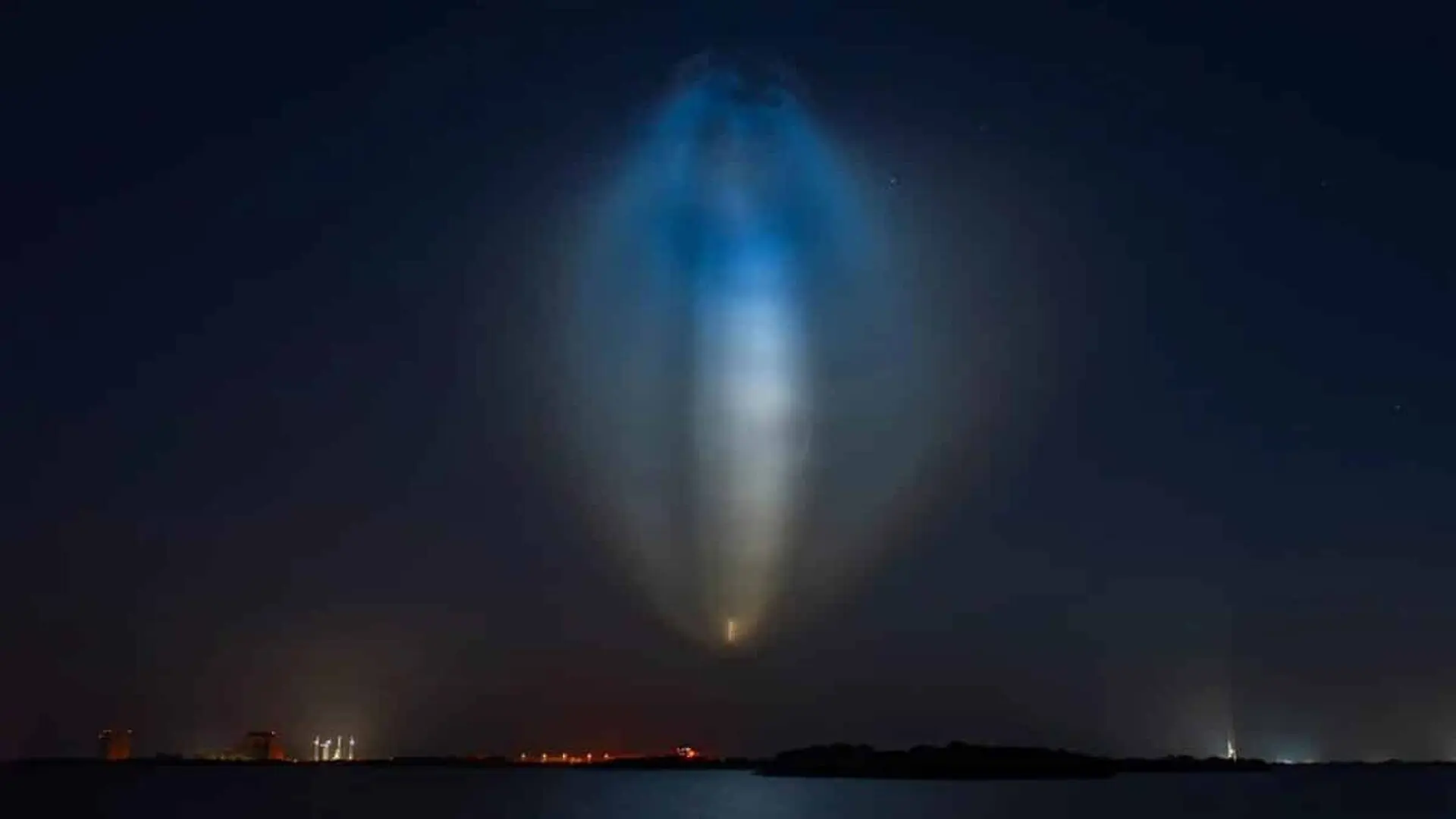
When a SpaceX Falcon 9 lifted off on a routine mission, its exhaust painted the twilight horizon with a vivid, jelly‑like cloud that could be seen for dozens of miles. The unexpected visual treat captured the imagination of observers and photographers, underscoring how launch events can generate striking atmospheric effects beyond their technical goals.
What Generated the Unusual Night‑Sky Glow
The eye‑catching “space jellyfish” is a well‑understood result of rocket exhaust expanding in the thin upper atmosphere. As the vehicle ascends, hot gases spread rapidly, and when the Sun sits just below the horizon, the plume reflects and scatters sunlight, producing shades of blue, white, pink and orange that are visible to people on the ground in darkness.
— John Kraus (@johnkrausphotos) July 9, 2026
The phenomenon arises when the launch reaches high altitude during twilight, allowing the rocket to remain bathed in sunlight while the lower atmosphere has already entered night. Under these lighting conditions, the expanding exhaust forms an enormous, glowing cloud that stretches across the sky, taking on a bell‑shaped core with trailing streams that resemble jellyfish tentacles.
Because of its size and vivid colors, the plume is sometimes mistaken for an unusual weather pattern or even an unidentified flying object. In reality, it is a predictable outcome of propulsion interacting with the upper layers of the atmosphere; every launch produces exhaust, but only a narrow window of illumination turns that exhaust into a spectacular display.
Observers Capture a Fleeting Celestial Spectacle
Hundreds of skywatchers recorded the event, documenting how the luminous cloud evolved minute by minute. Unlike a fixed astronomical object, the plume continuously reshaped as high‑altitude winds stretched and dispersed the gases, transitioning from a compact bright core to broad, translucent layers that gradually faded.
The appeal lies in the fusion of human engineering with natural atmospheric conditions. While the rocket itself is visible for only a brief moment, the illuminated exhaust can linger for several minutes, offering a dynamic celestial scene that varies with weather, launch trajectory, altitude and the Sun’s position below the horizon.
Images and videos of the “space jellyfish” quickly spread across social platforms, prompting amazement at the unexpected colors and shape. Similar displays have accompanied launches from other spaceports worldwide, yet each occurrence remains relatively rare because it requires precise timing between sunrise or sunset and the rocket’s ascent into sunlight.
SpaceX Missions Keep Delivering Visual Treats
Beyond the visual spectacle, the launch pursued its primary objectives. SpaceX has conducted hundreds of Falcon 9 missions in recent years, cementing the vehicle’s reputation as a reliable workhorse for orbiting communications satellites, scientific payloads and cargo. Many of these missions occur at dawn or dusk, raising the likelihood of future twilight‑induced sky shows.
According to Space.com, the reusable Falcon 9 continues to support a diverse mix of commercial, governmental and scientific payloads while showcasing rapid launch cadence and booster recovery. Although engineering milestones dominate headlines, twilight launches occasionally remind the public that spaceflight can also generate awe‑inspiring natural phenomena visible far beyond the launch site.
These atmospheric displays have emerged as an unexpected avenue for public engagement with space exploration. People who might not normally follow launch schedules are drawn in by striking photographs and videos, prompting curiosity about both the underlying physics and the missions themselves.
This article has been fact checked for accuracy, with information verified against reputable sources. Learn more about us and our editorial process.
Last reviewed on .
Article history
- Latest version
Reference(s)
- Gohd, Chelsea. “SpaceX launch creates colorful 'jellyfish' in the night sky | Space photo of the day for July 10, 2026.”, July 10, 2026 Space <https://www.space.com/space-exploration/spacex-launch-creates-colorful-jellyfish-in-the-night-sky-space-photo-of-the-day-for-july-10-2026>.
Cite this page:
- Posted by Farah Siddiqui