Astronomers Observe Interstellar Turbulence Twisting and Distorting Light Across Our Galaxy
Researchers have documented compelling proof showing how chaotic gas movements in our galaxy distort light emanating from a quasar situated 10 billion light-years distant.
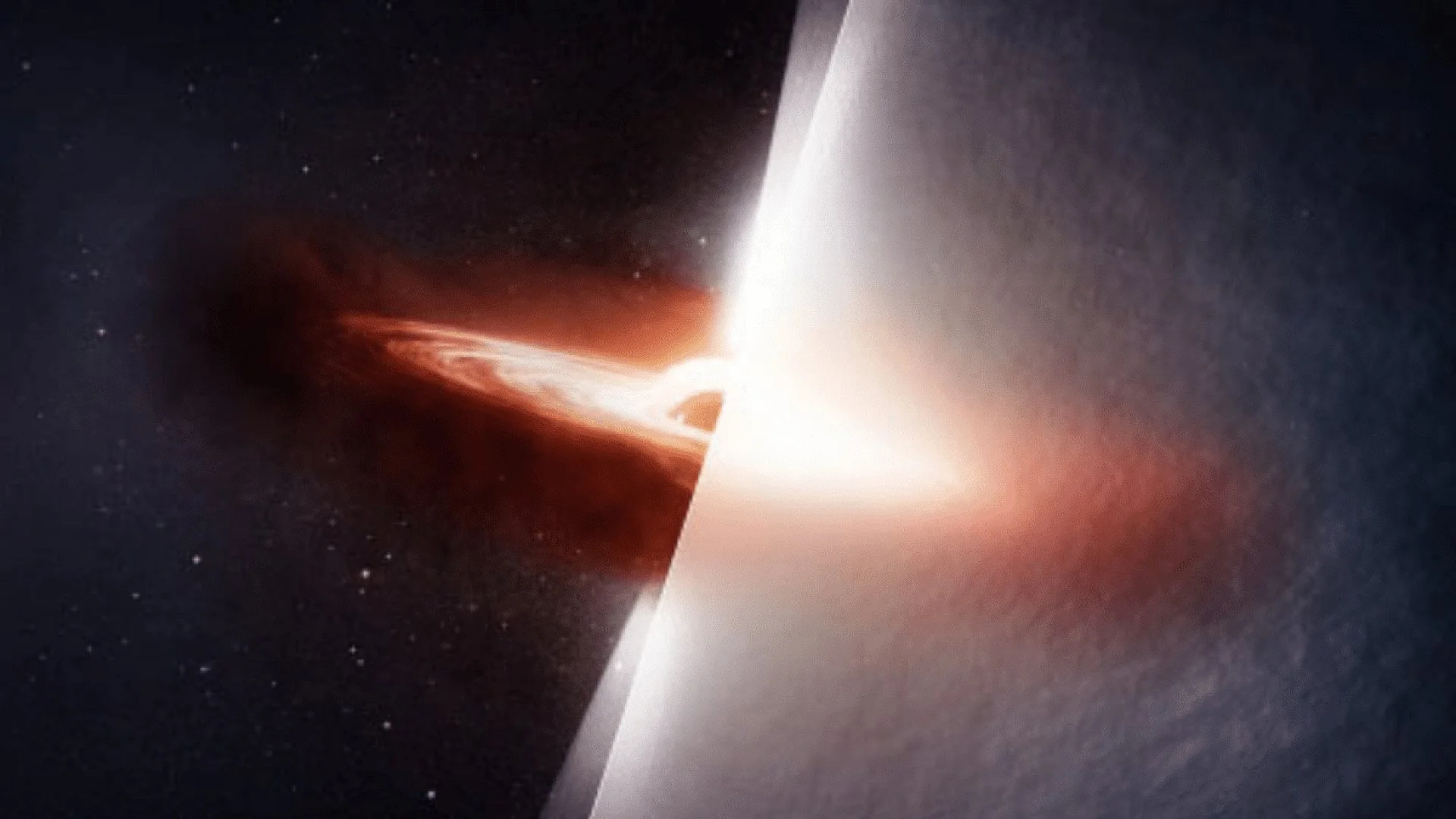
A groundbreaking discovery has shed new light on the turbulent forces shaping the Milky Way’s interstellar medium. By analyzing nearly a decade of archival data, researchers have revealed that the radio waves emitted by a quasar 10 billion light-years away are significantly distorted as they pass through the galaxy’s chaotic clouds of ionized gas and electrons. This phenomenon, published in the Astrophysical Journal Letters, offers a unique window into understanding the invisible forces governing the space between stars. The quasar, TXS 2005+403, is situated in the constellation Cygnus, powered by a supermassive black hole billions of light-years distant. As its radio waves traverse the Milky Way, they encounter the highly turbulent Cygnus region, one of the galaxy’s most strongly scattering environments. Contrary to expectations, the waves do not fade into a simple blur, but instead exhibit structured, patchy distortions, providing a rare opportunity to study the dynamics of interstellar turbulence. According to Dr. Alexander Plavin of Harvard & Smithsonian’s Center for Astrophysics, “Most of what we see in the radio data isn’t coming from the quasar itself, it’s coming from the scattering caused by the turbulence in this region of the Milky Way.” This scattering and the distortions that come with it allow researchers to study the turbulence and better understand its structure. By carefully analyzing archival data from NSF’s Very Long Baseline Array (VLBA), the team tracked how the quasar’s light changed over nearly ten years. This long-term study revealed that turbulence is not random noise, but instead creates persistent patterns in the signal, challenging prior assumptions about the chaotic interstellar medium. The findings suggest that the same turbulent processes could affect other observations of distant galaxies, supernovae, and cosmic radio sources. These persistent distortions provide a unique probe of the Milky Way’s ionized gas clouds, revealing structure on scales previously impossible to measure. The research, published in the Astrophysical Journal Letters, has significant implications for astronomy and future research. Understanding the behavior of interstellar turbulence is critical for interpreting radio observations, and the study demonstrates that even distant, bright sources like quasars can be reshaped by the space they traverse. The team hopes that this work will inspire further long-term studies using VLBA and other radio observatories. By mapping turbulence across multiple lines of sight, astronomers can build a three-dimensional picture of the Milky Way’s ionized gas, informing models of star formation, cosmic ray propagation, and galactic evolution. The study’s findings have sparked excitement in the scientific community, highlighting the stability of certain turbulent features despite the dynamic environment. As researchers continue to explore the mysteries of the universe, this groundbreaking discovery offers a new perspective on the complex forces governing the space between stars.
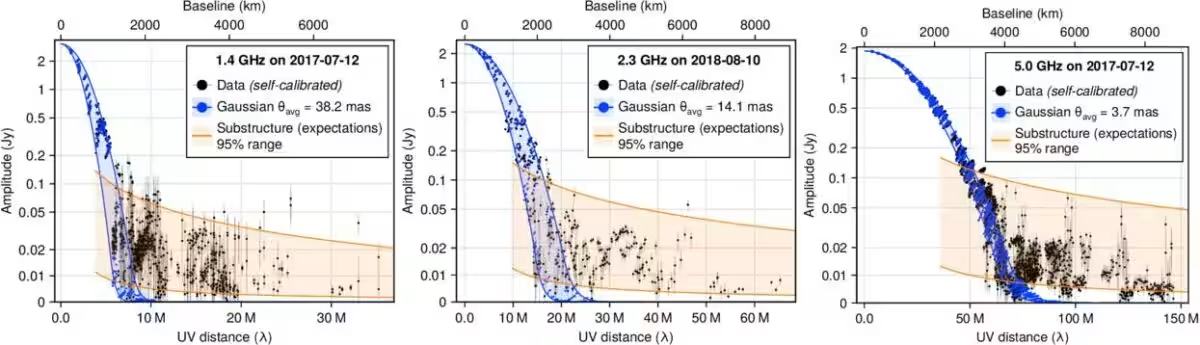
Credit: Astrophysical Journal Letters.
Unlocking the Secrets of the Galaxy
The study’s findings have significant implications for our understanding of the galaxy’s ionized gas clouds and the role of turbulence in shaping the universe. By continuing to explore the mysteries of the universe, researchers can gain a deeper understanding of the complex forces governing the space between stars.
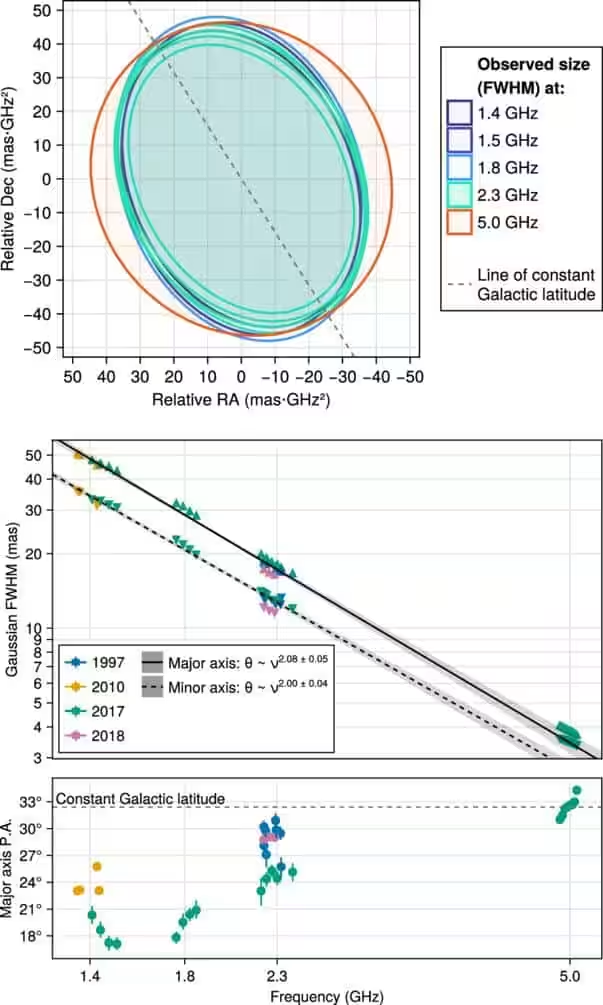
Credit: Astrophysical Journal Letters.
A New Era of Discovery
The study’s findings have sparked excitement in the scientific community, highlighting the stability of certain turbulent features despite the dynamic environment. As researchers continue to explore the mysteries of the universe, this groundbreaking discovery offers a new perspective on the complex forces governing the space between stars.
This article has been fact checked for accuracy, with information verified against reputable sources. Learn more about us and our editorial process.
Last reviewed on .
Article history
- Latest version
Reference(s)
- Plavin, A. V.., et al. “Direct Very Long Baseline Interferometry Detection of Interstellar Turbulence Imprint on a Quasar: TXS 2005+403.” The Astrophysical Journal Letters, vol. 1003, no. 1, May 13, 2026, pp. L4 American Astronomical Society, doi: 10.3847/2041-8213/ae60f4. <https://iopscience.iop.org/article/10.3847/2041-8213/ae60f4>.
Cite this page:
- Posted by Farah Siddiqui