A Space Telescope Just Detected a Strange Cosmic Pattern Scientists Have Searched for Since 1912
A space-based observatory might have detected an enigmatic signal that could unravel one of astronomy’s most enduring puzzles. Researchers expressed astonishment upon observing the identical peculiar pattern recurring across multiple types of cosmic radiation.
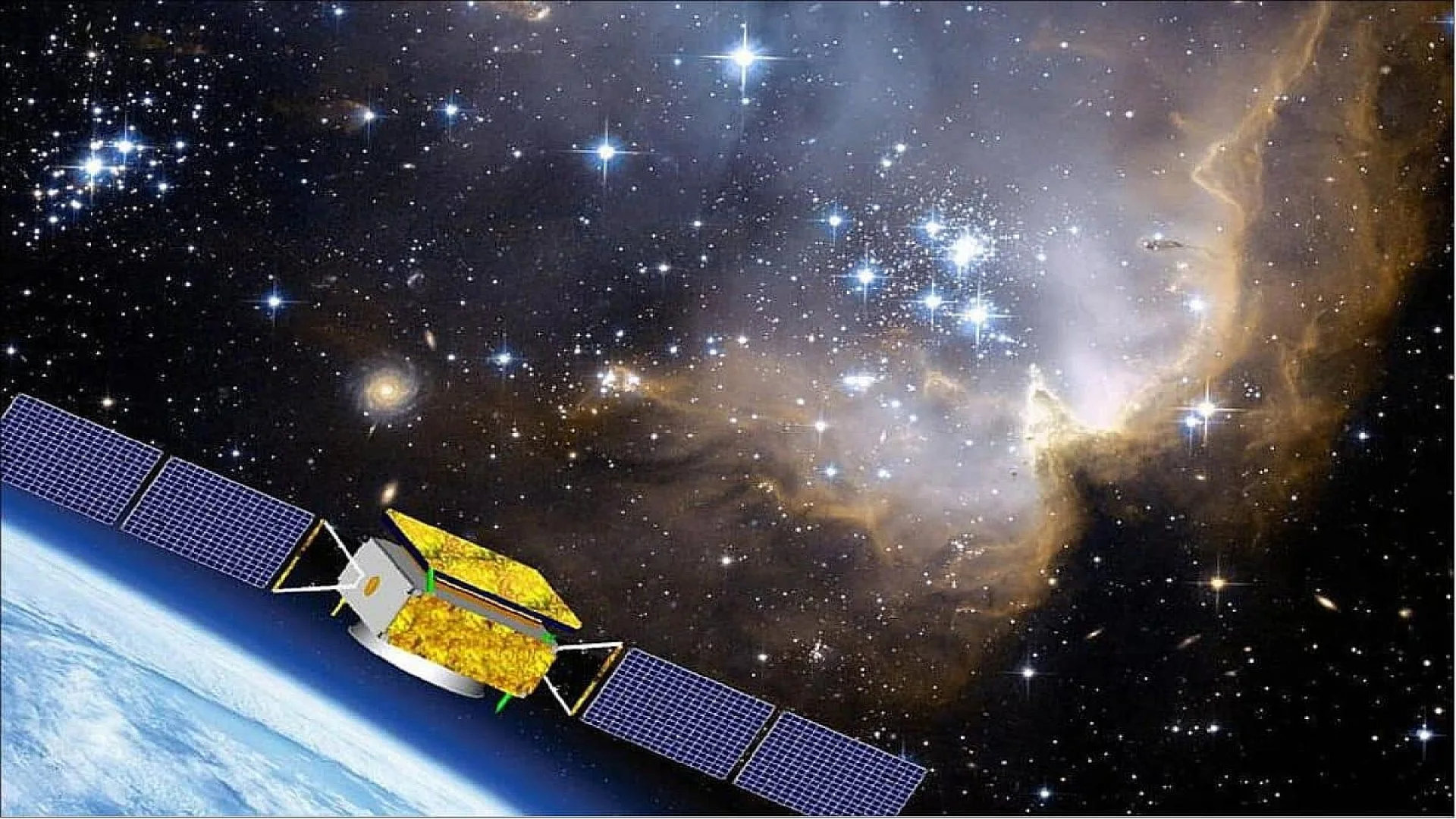
After a century of studying cosmic rays, scientists may have uncovered a hidden principle governing their behavior across the universe. By analyzing data from the DAMPEspace telescope, researchers discovered a common pattern among several types of high-energy cosmic particles, a finding published in the Nature journal.
This breakthrough could help clarify how cosmic rays are accelerated and transported through space. For decades, researchers have debated the mechanisms behind these particles, which remain among the most energetic forms of matter ever observed.
Cosmic rays are charged particles traveling through the galaxy at incredibly high energies. Scientists believe they originate from violent astrophysical phenomena, including supernova explosions, pulsars, and jets emitted by black holes.
Unveiling a Universal Pattern in Cosmic Ray Data
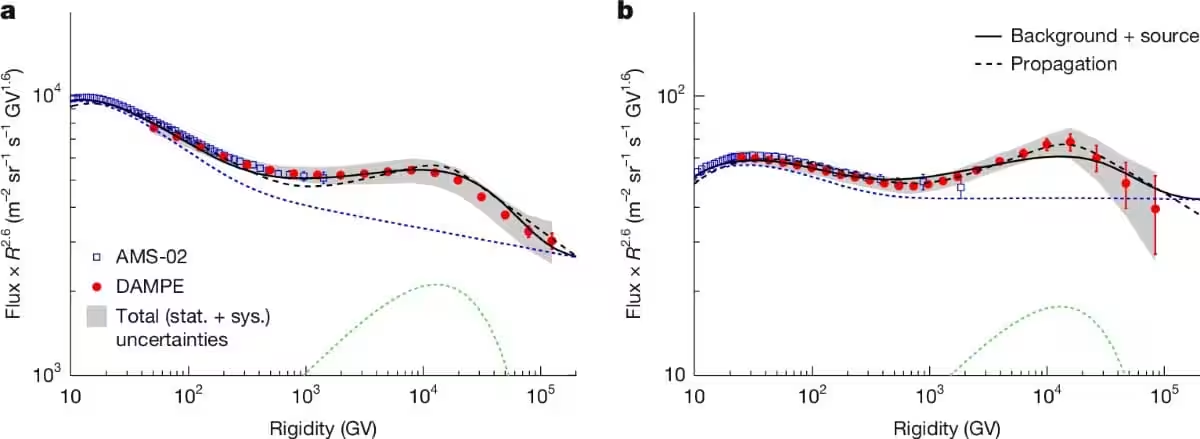
The new research is based on data collected by DAMPE, the Dark Matter Particle Explorer launched in December 2015. Scientists noticed the same unusual feature in several cosmic ray nuclei: the number of detected particles suddenly drops after a certain threshold, a phenomenon known as spectral softening.
According to the study, this sharper decline appears at around 15 TV, or teraelectron-volts. Rigidity describes how strongly a charged particle resists being bent by magnetic fields as it moves through space.
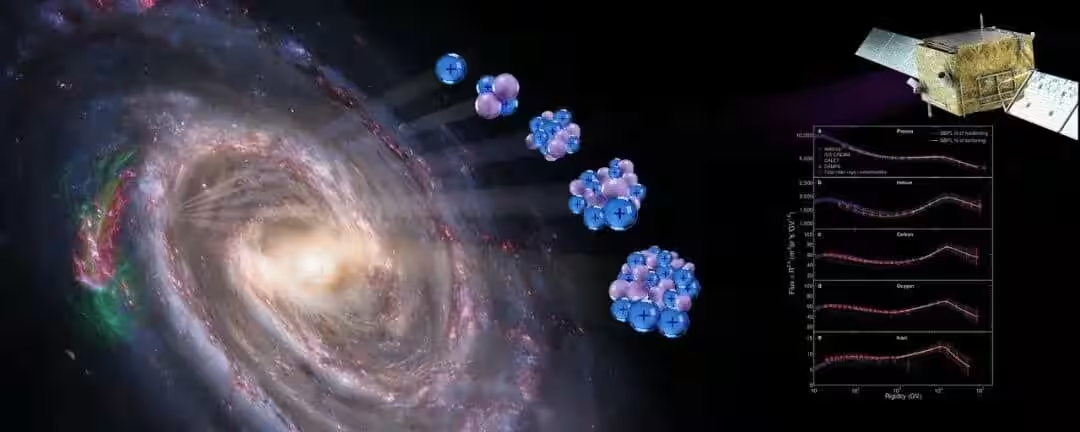
The same pattern showed up in different particles, from lightweight protons to much heavier iron nuclei. This caught researchers’ attention right away. Scientists have spent decades searching for signs that different cosmic rays might follow the same physical rule, and DAMPE may have finally revealed it.
“Cosmic rays are primarily composed of protons, but also of helium, carbon, oxygen, and iron nuclei.” He added, “These particles are also categorized according to their energy: low, up to a few billion electron-volts; intermediate, from a few billion to several hundred billion electron-volts; and high, from 1,000 billion electron-volts and beyond.”
Rigidity Theory Gains Strong Support
The DAMPE observations strongly support the idea that cosmic rays are shaped by rigidity rather than by energy per nucleon. As the researchers, older explanations based on energy divided by the number of nucleons do not match the new data very well.
The study reports a confidence level of 99.999% against those alternative models, giving scientists strong evidence that they may finally be moving in the right direction.
Researchers say the findings help narrow down how cosmic rays gain their enormous energy before crossing interstellar space. The results also put stricter limits on current models of particle acceleration in extreme astrophysical environments.
Scientists have been trying to answer this question for more than a century. Even today, the role played by magnetic fields, shock waves, and violent cosmic events is still widely debated.
Artificial Intelligence Played a Key Role
The Geneva group also contributed to measurements involving proton and helium fluxes and participated in the analysis of carbon nuclei data. Alongside this work, the researchers led development of the Silicon-Tungsten Tracker, one of DAMPE’s central instruments.
The detector is used to reconstruct particle trajectories and determine the electric charge of incoming cosmic rays with high precision. Scientists involved in the mission say this capability proved essential for identifying the newly observed spectral softening pattern.
This article has been fact checked for accuracy, with information verified against reputable sources. Learn more about us and our editorial process.
Last reviewed on .
Article history
- Latest version
Reference(s)
- “DAMPE (Dark Matter Particle Explorer) - eoPortal.” <https://www.eoportal.org/satellite-missions/dampe>.
- Alemanno, Francesca. “Charge-dependent spectral softenings of primary cosmic rays below the knee - Nature.”, vol. 653, no. 8113, pp. 52-55. Nature, doi: 10.1038/s41586-026-10472-0. <https://www.nature.com/articles/s41586-026-10472-0>.
- <https://ui.adsabs.harvard.edu/abs/2016NIMPA.831..378A>.
Cite this page:
- Posted by Farah Siddiqui