NASA’s Artemis III Lander Tests Set the Stage for the Next Moon Landing Race
NASA readies Artemis III with fresh lunar lander tests to boost confidence ahead of the next crewed Moon landing.

NASA is gearing up for Artemis III, the next crewed mission that aims to land astronauts near the Moon’s south‑polar region, by launching a series of human‑landing‑system (HLS) demonstrations. The agency says upcoming flight tests by SpaceX and Blue Origin will sharpen the hardware and procedures required for the historic touchdown.
Advancing the Lunar Lander Architecture
The Artemis III effort marks a pivotal phase in NASA’s vision of a long‑term human foothold on and around the Moon. Before any crew flies, the space agency is partnering with private firms to vet the lander concepts that will ferry astronauts from lunar orbit to the surface and back.
Under the Human Landing System program, NASA has backed two distinct commercial designs. SpaceX is iterating a lunar variant of its Starship launch‑vehicle, while Blue Origin is progressing the Blue Moon lander architecture. Both teams are pursuing separate engineering routes while satisfying NASA’s stringent criteria for crew safety, mission performance, and lunar‑surface operations.
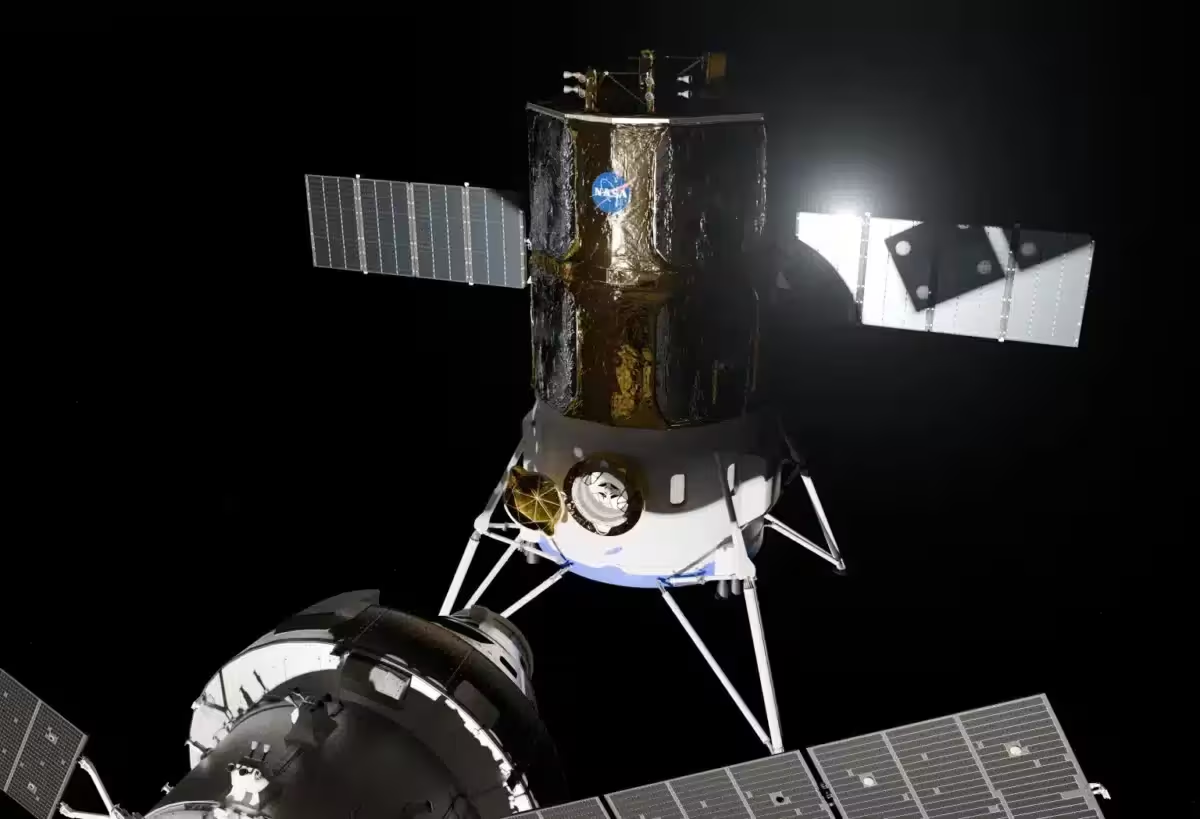
NASA’s test campaign is designed to build operational know‑how before crew members board the vehicles. The upcoming demonstrations will probe spacecraft capabilities, refine mission‑step procedures, and assess the intricate choreography linking launch assets, lunar‑orbit maneuvers, and surface activities.
“Each human landing system provider has taken a different approach to the Artemis III mission,” said Steve Creech, program manager, Human Landing System Program, NASA’s Marshall Space Flight Center in Huntsville, Alabama. “Ultimately, SpaceX and Blue Origin have put forward a list of aggressive objectives and goals intended to complement upcoming uncrewed demonstration missions at the Moon so that we can gain both understanding and confidence in the spacecraft and launch vehicles prior to a crewed landing. The lander prototype designs will inform future development efforts and will continue to mature over the next year.”
Coordinating a Multi‑Vehicle Lunar Mission
Delivering Artemis III will demand tight integration across a suite of launch vehicles, orbiting platforms, and ground teams. In contrast to the Apollo era, modern lunar exploration depends on a broader ecosystem of commercial and government assets working in concert to achieve a single crewed descent.
NASA emphasizes the need for extensive systems‑engineering and operational planning before astronauts set foot on the Moon. The mission profile encompasses Earth launch, spacecraft rendezvous, lunar‑orbit insertion, descent preparation, surface exploration, and eventual return to Earth.
The agency expects the uncrewed validation flights to deliver concrete data on how the human landing systems behave in realistic mission contexts. Engineers will leverage those insights to fine‑tune procedures and resolve technical hurdles ahead of the crewed phase.
“Artemis III will be a highly choreographed dance with a demanding launch sequence across multiple launch pads and equally demanding mission operations for our ground and flight crews, making it one of the most complex and ambitious missions NASA has ever undertaken,” said Jeremy Parsons, Artemis program manager. “The demonstration mission will set the stage before our next giant leap. NASA’s expertise in systems engineering and integration, as well as launch and mission operations in low Earth orbit, will bring the mission together.”

Divergent Paths to the Same Goal
The collaboration between NASA and private launch companies mirrors a broader transition toward competitive, multi‑solution development in space exploration. Rather than relying on a single, government‑built vehicle, the Artemis program leverages competition to advance lunar transportation technology.
SpaceX’s Starship lunar variant is envisioned as a large, reusable spacecraft capable of deep‑space missions, demanding sophisticated orbital maneuvers and lunar‑surface preparation.
Blue Origin’s Blue Moon design adopts a dedicated lander concept, aimed at supporting crewed missions and future exploration architectures.
Both uncrewed test flights will furnish the data needed to refine hardware, mission planning, and overall lunar‑exploration capability before humans embark on the Artemis III landing.
This article has been fact checked for accuracy, with information verified against reputable sources. Learn more about us and our editorial process.
Last reviewed on .
Article history
- Latest version
Cite this page:
- Posted by Karan Das