Humans Just Changed an Asteroid’s Path Around the Sun, And Scientists Can Now Measure It
NASA’s DART spacecraft famously shifted the orbit of an asteroid moon in 2022. New research shows the impact also nudged the entire asteroid system around the Sun, marking the first confirmed human-caused change to a celestial body’s heliocentric orbit.
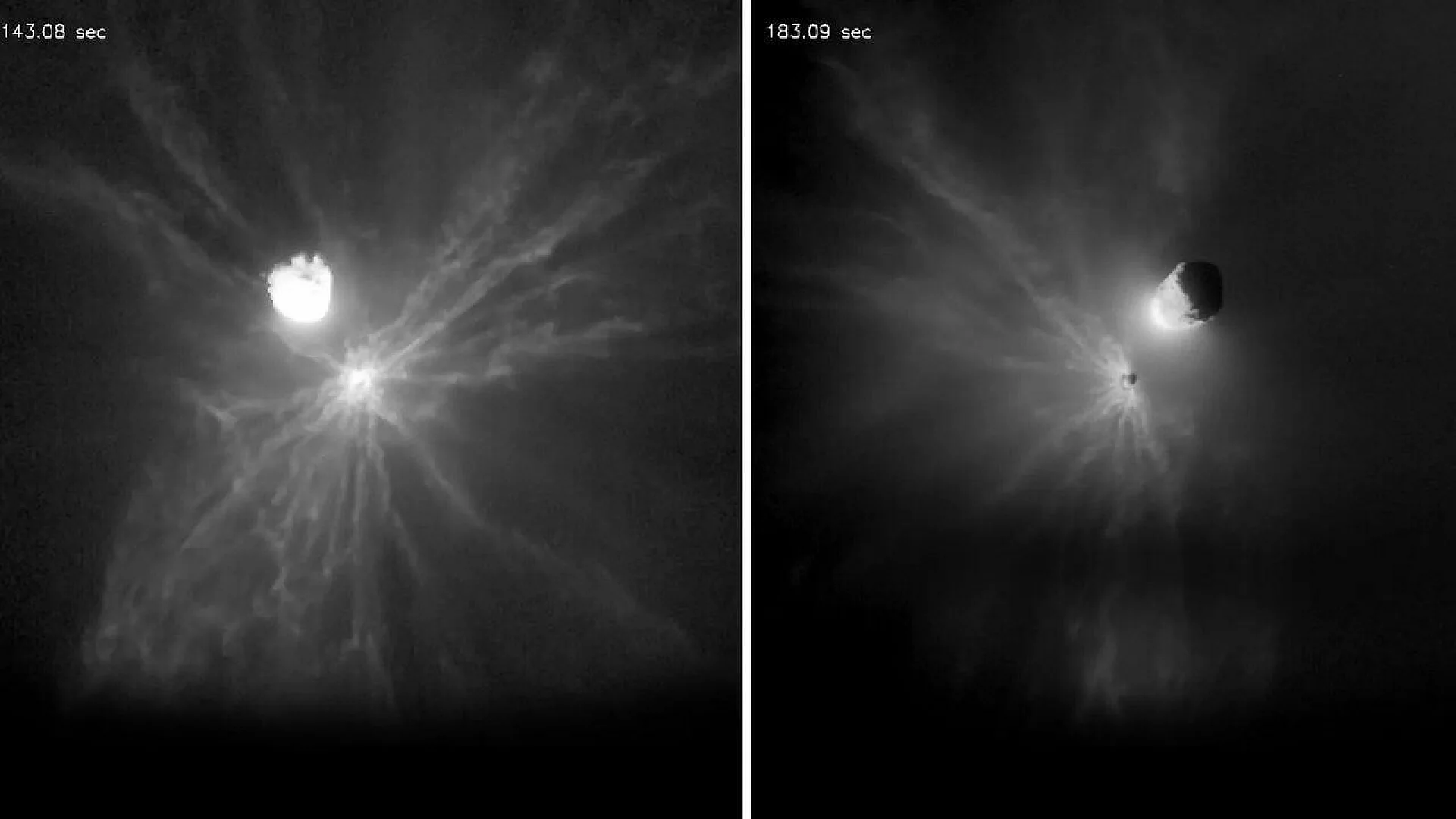
In September 2022, a spacecraft traveling at more than 22,000 kilometers per hour slammed into a small asteroid moon.
The event was deliberate.
NASA’s Double Asteroid Redirection Test, or DART, was designed to answer a simple but profound question: if an asteroid were ever heading toward Earth, could humanity push it out of the way?
The mission succeeded almost immediately. Observations showed that the collision shortened the orbital period of the asteroid moon Dimorphos around its larger companion Didymos by about 33 minutes.
But scientists suspected something more subtle might also have happened.
The impact may have nudged the entire asteroid system itself as it travels around the Sun.
Now, new research confirms that this is exactly what occurred.
A Planetary Defense Experiment
Earth is constantly bombarded by small particles from space. Most burn up harmlessly in the atmosphere.
Larger asteroids strike far less frequently, but their potential impact can be catastrophic.
For that reason, planetary defense researchers focus on three key challenges. Astronomers must detect potentially dangerous asteroids, calculate whether their orbits threaten Earth, and develop methods to change those trajectories if needed.
The DART mission addressed the final step.
Instead of targeting a solitary asteroid, NASA chose a binary system called Didymos. The larger asteroid measures roughly 780 meters across, while its moon Dimorphos spans about 160 meters.
This arrangement made it an ideal test case.
Because Dimorphos orbits Didymos in a well-measured cycle, even small changes in its motion could be detected from Earth.
When DART struck Dimorphos on September 26, 2022, the spacecraft transferred momentum to the asteroid, pushing it slightly off course.
But the physics of the collision meant the effect would not stop there.
The Hidden Force of Asteroid Debris
When the spacecraft hit Dimorphos, it did not simply bounce off.
The impact blasted enormous amounts of rock and dust into space, creating a plume of debris that streamed away from the asteroid.
That ejecta carried momentum with it.
In physics terms, this amplified the force of the impact through what scientists call a momentum enhancement factor. The escaping material effectively acted like a natural rocket exhaust, giving the asteroid system an extra push.
Some of that debris escaped the gravity of the binary asteroid system entirely.
If enough material escaped in a particular direction, it could slightly shift the motion of the system’s center of mass as it orbits the Sun.
Detecting such a shift, however, is extremely difficult.
The expected change was tiny.
Tracking an Almost Invisible Motion
To determine whether the system’s heliocentric orbit had changed, scientists spent several years collecting precise astronomical observations.
They combined multiple independent sources of data.
The dataset ultimately included nearly 6,000 ground-based measurements of the asteroid’s position, 22 stellar occultation events, radar observations, and navigation data recorded by the DART spacecraft itself during its final approach.
Stellar occultations played a particularly important role.
During these events, the asteroid passes in front of a distant star, briefly blocking its light. By timing these moments precisely from different locations on Earth, astronomers can measure the asteroid’s position with extraordinary accuracy.
With enough observations collected over several years, the researchers could determine whether the system’s orbit around the Sun had subtly changed.
A Tiny Push With Measurable Consequences
The results revealed that the DART collision did indeed alter the motion of the Didymos system.
Researchers calculated that the impact slowed the system’s orbital velocity around the Sun by about 11.7 micrometers per second.
That number is extraordinarily small.
For comparison, it corresponds to roughly 42 millimeters per hour, about the width of a smartwatch.
Yet in the vast emptiness of space, even tiny velocity changes accumulate over time.
Over a decade, such a small adjustment could shift the asteroid system’s position by several kilometers.
This is the first confirmed measurement showing that humans have directly changed the heliocentric orbit of a natural object.
Measuring the Momentum of the Impact
Beyond detecting the shift itself, the research also provided new insight into the physics of asteroid impacts.
Scientists estimated a heliocentric momentum enhancement factor of about 2.0, meaning the debris thrown into space roughly doubled the effective momentum transferred by the spacecraft alone.
The analysis also yielded improved estimates for the densities of both asteroids.
Didymos appears to have a bulk density of roughly 2600 kilograms per cubic meter, while Dimorphos is somewhat less dense at around 1540 kilograms per cubic meter.
These properties are important for future planetary defense strategies. The effectiveness of a kinetic impact depends heavily on an asteroid’s structure, composition, and internal strength.
Why This Matters
At first glance, shifting an asteroid’s velocity by a few micrometers per second may seem insignificant.
But planetary defense works on long time scales.
If astronomers detect a potentially hazardous asteroid years or decades before a predicted impact, even a very small change in its trajectory can grow large enough to prevent a collision with Earth.
The DART mission demonstrated that such changes are physically achievable.
This new research shows that scientists can also measure and verify those changes with remarkable precision.
Together, these advances represent a major step forward in humanity’s ability to protect the planet from future asteroid threats.
A Closer Look Is Still Coming
The Didymos system will soon receive another visitor.
The European Space Agency’s Hera spacecraft is scheduled to arrive later this decade.
Hera will study the aftermath of the DART impact in detail, including the crater formed on Dimorphos and the internal structures of both asteroids.
Those measurements will help scientists refine models of asteroid collisions and better understand how kinetic impacts alter asteroid trajectories.
In combination with the observations already collected from Earth, the mission should provide the most comprehensive picture yet of how humanity can redirect objects in space.
A Historic First in Planetary Engineering
The DART mission began as a technology demonstration.
Its primary goal was simply to prove that an asteroid could be deflected using a spacecraft.
Instead, the experiment produced something even more profound.
For the first time, scientists can measure a human-caused change in the orbit of a natural object moving around the Sun.
It is a small shift.
But in the vast mechanics of the Solar System, even the smallest push can change the future path of a world.
The research was published in Science Advances on March 06, 2026.
This content has been reviewed by subject-matter experts to ensure scientific accuracy. Learn more about us and our editorial process.
Last reviewed on .
Article history
- Latest version
Reference(s)
- Makadia, Rahil., et al. “Direct detection of an asteroid’s heliocentric deflection: The Didymos system after DART.” Science Advances, vol. 12, no. 10, 06 March 2026, doi: 10.1126/sciadv.aea4259. <https://doi.org/10.1126/sciadv.aea4259>.
Cite this page:
- Posted by Aisha Ahmed