NASA Satellite That Studied Earth’s Radiation Belts Has Fallen Back to Earth
A retired NASA spacecraft that once explored Earth’s hazardous radiation belts has fallen back to Earth years earlier than expected, after heightened solar activity gradually pulled it out of orbit.
Space missions rarely end with a dramatic finale. Most spacecraft quietly drift into retirement, circling Earth long after their scientific work is finished.
One such mission has now reached its unexpected end.
A retired NASA science satellite that once explored the hazardous radiation environment surrounding Earth has plunged back through the atmosphere. The spacecraft reentered in an uncontrolled descent over the Pacific Ocean, ending a journey that began more than a decade ago.
While the event itself caused little risk to people on the ground, it reveals something important about the changing conditions in near-Earth space. Increased solar activity in recent years gradually altered the spacecraft’s orbit, hastening a fall that scientists once expected to occur many years later.
The satellite’s fiery return also closes a chapter in one of NASA’s most important missions studying Earth’s radiation belts.
The Hazardous Radiation Zones Surrounding Earth
Far above the atmosphere, Earth is wrapped in invisible but powerful regions of trapped radiation. These areas, known as the Van Allen radiation belts, contain high-energy charged particles captured by the planet’s magnetic field.
The belts pose a serious hazard for spacecraft and astronauts. Electronics can be damaged, and radiation exposure can rise sharply when spacecraft pass through these zones.
Understanding this environment has been a longstanding challenge for space scientists. The belts can change rapidly depending on conditions in space, especially when the Sun releases bursts of energetic particles.
Despite decades of research, many questions about how the belts form and evolve remained unanswered.
To tackle this mystery, NASA launched a pair of dedicated spacecraft in 2012.
A Mission Designed to Explore a Dangerous Region
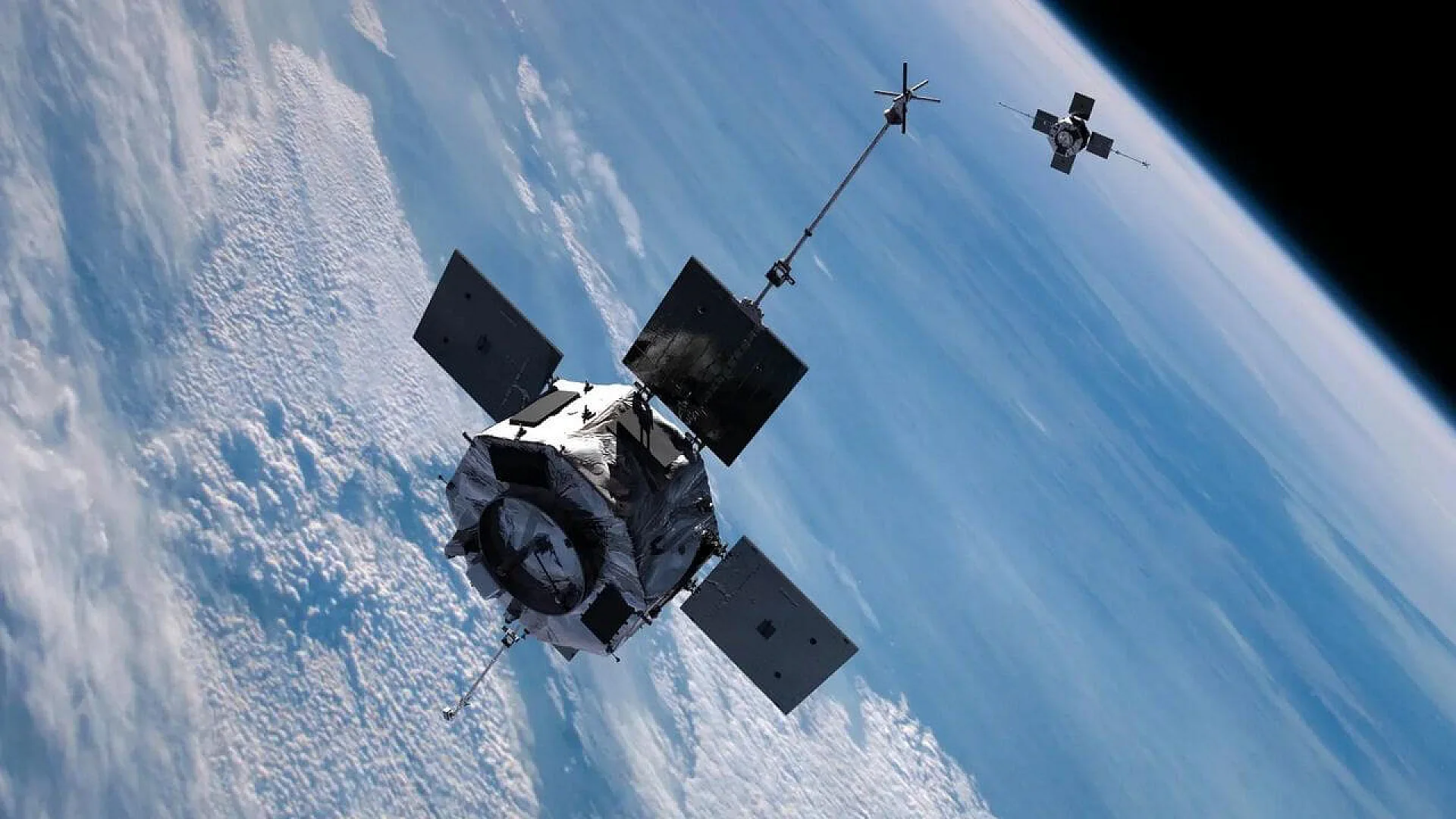
The twin satellites were known as the Van Allen Probes. They were designed to travel directly through the radiation belts again and again, collecting measurements that earlier missions could not safely obtain.
Flying in elongated orbits around Earth, the two spacecraft repeatedly crossed the belts at different distances from the planet. Their instruments measured the behavior of charged particles, magnetic fields, and waves that move through space plasma.
This approach allowed scientists to observe how the radiation belts grow, shrink, and shift during solar storms.
The probes soon began revealing surprising complexity.
Researchers discovered that the radiation belts are far more dynamic than previously thought. Sometimes a third temporary belt appeared between the two main ones. In other cases, powerful space storms accelerated particles to extreme energies in a matter of hours.
These discoveries helped scientists better understand how radiation hazards form in near-Earth space.
Seven Years of Scientific Discovery
The Van Allen Probes operated for about seven years, delivering a wealth of data about one of the most hostile regions surrounding our planet.
During that time, the spacecraft continuously flew through the radiation belts while transmitting observations back to Earth. Their measurements helped researchers understand how particles become trapped by Earth’s magnetic field and how solar activity influences the system.
The mission also revealed how waves of energy traveling through plasma can accelerate particles to nearly the speed of light. Such processes are critical for predicting space weather effects that may threaten satellites, navigation systems, and communications infrastructure.
By the end of the mission, the spacecraft had transformed scientific understanding of the radiation belts.
Eventually, however, the probes began running out of fuel.
The End of Operations in 2019
By 2019, the twin satellites had exhausted the propellant needed to maintain their carefully controlled orbits.
NASA ended the active mission that year. The spacecraft were left drifting silently around Earth, no longer transmitting scientific data.
At the time, engineers estimated that the satellites would remain in orbit for many more years before eventually falling back toward the atmosphere.
Initial predictions suggested the spacecraft might stay aloft until around 2034.
Instead, one of them returned much sooner.
A Descent Over the Pacific Ocean
The spacecraft known as Van Allen Probe A has now reentered Earth’s atmosphere.
According to tracking by the US Space Force, the satellite came down over the Pacific Ocean west of the Galapagos Islands.
Most of the spacecraft burned up as it plunged through the atmosphere at extremely high speed. However, NASA estimated that some fragments could survive the intense heat of reentry.
The satellite weighed roughly 600 kilograms, or about 1,323 pounds.
Although pieces might reach the surface, the risk to people was extremely small. NASA estimated the chance of bodily harm at about one in 4,200.
Such probabilities are typical for spacecraft reentries and are considered very low.
Still, predicting exactly where debris might fall is rarely straightforward.
Why Predicting Reentry Is So Difficult
When a spacecraft falls from orbit without control, scientists must estimate when and where it will reenter based on complex orbital calculations.
These predictions can be challenging because many factors influence how quickly an orbit decays.
The upper layers of Earth’s atmosphere expand and contract depending on solar activity. When the atmosphere expands, it increases drag on satellites passing through the outermost fringes of the atmosphere.
That drag gradually slows spacecraft down.
As their speed drops, they spiral lower and lower until they finally plunge into the atmosphere.
Even small changes in atmospheric density can significantly alter the timing of reentry.
This makes precise forecasts difficult, especially when the spacecraft follows an unusual orbit.
Dutch satellite tracker Marco Langbroek noted that the returning spacecraft followed a particularly eccentric path around Earth. Such elongated orbits complicate calculations about when the final descent will occur.
As a result, predicting the exact moment and location of reentry often remains uncertain until the final hours.
Solar Activity Accelerated the Fall
The early return of Van Allen Probe A appears to be linked to changes in the Sun.
Over the past several years, the Sun has been entering a more active phase of its roughly eleven-year cycle. Increased solar activity can heat and expand Earth’s upper atmosphere.
When that happens, satellites that once orbited safely above the thin atmosphere begin to experience stronger drag.
NASA says this effect likely accelerated the probe’s orbital decay.
Instead of remaining in space until the mid-2030s, the spacecraft gradually lost altitude until it could no longer stay in orbit.
This process highlights the powerful influence the Sun has on Earth’s near-space environment.
Space weather does not just affect radiation conditions in orbit. It can also reshape the long-term paths of spacecraft circling our planet.
One Twin Spacecraft Still Remains
Although Probe A has completed its journey, its companion spacecraft remains in orbit.
Van Allen Probe B is still circling Earth, though it is no longer operational.
Scientists expect this second spacecraft to remain in orbit for several more years before experiencing a similar fate.
Current estimates suggest it will not reenter the atmosphere until sometime after 2030.
Until then, it will continue drifting silently above the planet, a relic of a mission that once revolutionized understanding of Earth’s radiation environment.
Why the Mission Still Matters
Even though the spacecraft are no longer active, the scientific legacy of the Van Allen Probes continues.
The mission produced a vast archive of measurements that researchers are still analyzing. These observations help scientists understand how space weather interacts with Earth’s magnetic field and atmosphere.
This knowledge has practical importance.
Modern society depends heavily on satellites for navigation, communication, weather forecasting, and scientific observation. Many of these satellites operate in or near the radiation belts.
Better understanding of this environment helps engineers design spacecraft that can survive the intense conditions found there.
It also improves forecasting of space weather events that may disrupt satellite operations.
The data gathered by the Van Allen Probes remains an important resource for this research.
The Challenge of Aging Satellites
The spacecraft’s return also highlights a growing issue in space operations.
Thousands of satellites now orbit Earth, and many eventually become inactive. Without propulsion or control systems, these objects slowly lose altitude over time.
Some eventually burn up in the atmosphere, while others remain in orbit for decades.
Managing these aging spacecraft is becoming an important part of maintaining a safe orbital environment.
Designing satellites that naturally reenter the atmosphere within a reasonable time frame is now a key goal for many space agencies.
The Van Allen Probe A followed this path, gradually descending until it safely burned up over the ocean.
A Quiet End to a Remarkable Mission
The dramatic image of a spacecraft blazing through the atmosphere might suggest a catastrophic ending.
In reality, the reentry marks the final stage of a carefully planned lifecycle.
After years of groundbreaking observations, the Van Allen Probes completed their scientific mission and slowly returned to Earth.
Most of the spacecraft disintegrated high above the planet, leaving little trace of its long journey through the radiation belts.
What remains is the scientific knowledge it helped uncover.
The mission revealed that the region around Earth is far more dynamic and complex than researchers once believed. Energetic particles swirl, accelerate, and disappear in ways scientists are still trying to fully understand.
Thanks to the Van Allen Probes, the invisible radiation environment surrounding our world is no longer quite as mysterious.
Why This Matters
Studying the radiation belts is not just a theoretical exercise.
These energetic particles can damage satellites, disrupt communication systems, and endanger astronauts traveling beyond Earth’s protective atmosphere.
Understanding how the belts behave helps scientists predict when hazardous conditions might arise.
The Van Allen Probes provided the most detailed measurements ever collected from this region of space. Their data continues to guide research on how space weather affects technology in orbit.
Even after one spacecraft has returned to Earth, the mission’s discoveries continue to shape the future of space science.
This article has been fact checked for accuracy, with information verified against reputable sources. Learn more about us and our editorial process.
Last reviewed on .
Article history
- Latest version
Cite this page:
- Posted by Aisha Ahmed