Scientists Directly Detect Hidden Water Locked Inside Ancient Martian Crust
By combining neutron and X-ray imaging, researchers have mapped hydrogen inside a rare Martian meteorite, revealing concentrated water-rich minerals that may represent a widespread crustal reservoir on early Mars.
The next major milestone in planetary science is the return of carefully selected rock samples from Mars. These materials, collected by NASA’s Perseverance rover, are expected to arrive on Earth in the coming years. Before scientists begin cutting or dissolving them for chemical tests, they must first understand what lies inside.
A new study demonstrates how that can be done without damaging the samples. By directly detecting hydrogen inside a rare Martian meteorite, researchers have revealed concentrated pockets of water-bearing minerals embedded within ancient crustal fragments.
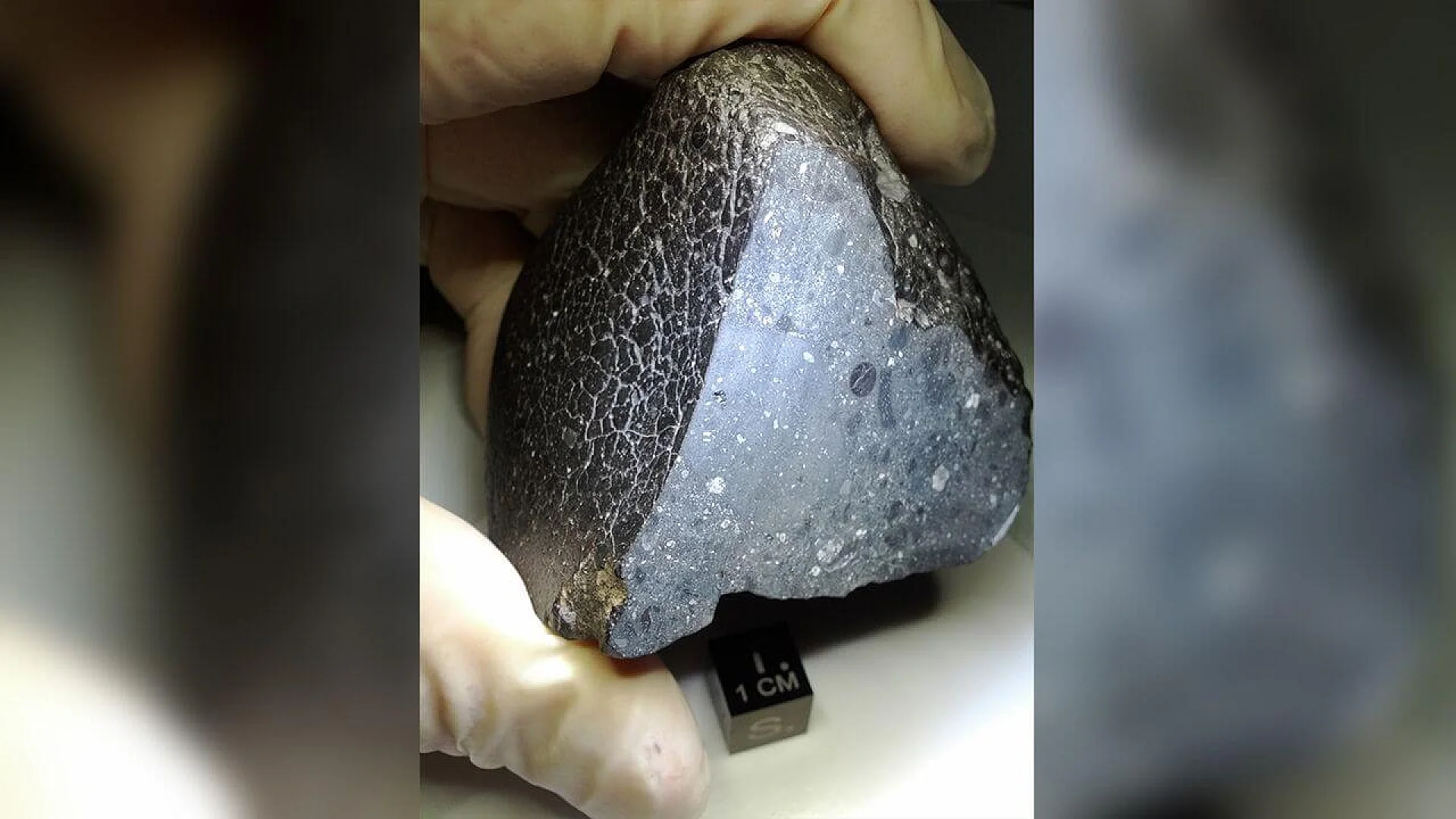
The meteorite is known as Northwest Africa 7034. Often nicknamed “Black Beauty,” it is one of the most unusual Martian meteorites ever discovered. It contains fragments of ancient crust dating back more than 4.4 billion years, making it one of the oldest accessible records of Mars’ surface.
Unlike most Martian meteorites, which formed deep underground, this sample represents surface crust. It is also unusually rich in water compared to other Martian rocks found on Earth.
Now, researchers have mapped where that water is stored, in three dimensions, across an intact piece of the meteorite.
Looking for Water Without Breaking the Rock
Traditionally, scientists study meteorites by slicing them into thin sections. Those sections are then polished, examined under microscopes, or chemically dissolved for isotope analysis. While effective, those approaches destroy part of the sample and only reveal information from the exposed surface.
For future Mars samples, which will be limited and irreplaceable, scientists want to examine the interior first without cutting.
X-ray computed tomography, similar to medical CT scans, is already widely used for this purpose. X-rays pass through a sample and are absorbed depending on density and atomic number. Dense minerals such as iron oxides appear bright, while lighter materials appear darker.
But X-rays are not especially sensitive to hydrogen.
Neutrons are different. When a neutron beam passes through rock, hydrogen strongly absorbs and scatters it. Even small amounts of hydrogen produce a measurable signal. Because hydrogen is a key ingredient of water, neutron imaging can act as a direct tracer for hydration.
In this study, scientists combined neutron computed tomography with X-ray computed tomography and X-ray diffraction tomography. Together, these methods allowed them to map hydrogen distribution and identify the minerals hosting it.
A 12-Millimeter Window Into Early Mars
The team analyzed a small slab of Northwest Africa 7034 measuring 12 by 8 by 2 millimeters. Although small, the piece contained a complex internal structure.
The meteorite is a polymict breccia, meaning it is made of many different rock fragments cemented together. These fragments include igneous clasts, formed from molten rock, as well as fine-grained matrix material and impact-related components.
X-ray and neutron scans revealed four main categories of material inside the sample: feldspars with low attenuation, iron-titanium oxides with strong X-ray signals, hydrogen-rich iron oxyhydroxides with strong neutron signals, and a fine-grained matrix composed of mixed minerals.
The most striking result was the presence of distinct hydrogen-rich clusters embedded within certain igneous clasts.
Localized Hydrogen Hotspots
The hydrogen-rich regions did not occur evenly throughout the meteorite. Instead, they formed localized clusters inside specific clasts ranging from roughly 120 to 380 micrometers in size.
These clasts contained three major components: iron-titanium oxides, feldspar crystals, and high-neutron-attenuation regions interpreted as hydrogen-bearing iron oxyhydroxides.
The hydrogen signal was intense in these zones. In contrast, the surrounding matrix showed no comparable hotspots.
In total, hydrogen-rich clasts made up about 0.4 percent of the meteorite’s volume. That may sound small, but their contribution to the water budget was significant.
By comparing measured neutron attenuation with theoretical values, the researchers estimated that these clasts contain up to 15 weight percent hydroxyl groups, chemical units of hydrogen and oxygen bonded within mineral structures.
When converted to water equivalent, these clasts account for approximately 635 parts per million of water. That represents about 11 percent of the meteorite’s total bulk water content, which is around 6,000 parts per million.
This means a noticeable fraction of the meteorite’s water is concentrated in specific crustal fragments rather than evenly dispersed.
Identifying the Mineral Hosts
To determine which minerals were associated with hydrogen, the team performed X-ray diffraction tomography. This method identifies crystalline structures by analyzing how X-rays scatter from atomic lattices.
The dominant minerals in the hydrogen-rich clasts were plagioclase feldspar, ilmenite, magnetite or maghemite, and minor rutile.
Magnetite and ilmenite are common igneous minerals. Maghemite is typically formed by oxidation of magnetite. None of these minerals are inherently water-rich.
However, iron oxides can incorporate hydrogen during alteration. Oxidation and hydrothermal processes can introduce hydroxyl groups into crystal structures or onto mineral surfaces.
The diffraction patterns also revealed weak signals from one or two additional phases that could not be confidently identified. Moreover, the hydrogen-rich areas showed excess X-ray attenuation beyond what known minerals could explain.
In addition, small-angle X-ray scattering revealed nanometer-scale structures, approximately 5 nanometers in size, restricted to the hydrogen-rich regions.
Together, these observations suggest that the dominant hydrogen hosts are likely nanophase alteration minerals such as ferrihydrite or goethite. These are iron oxyhydroxides known to form in the presence of water.
Evidence for Martian, Not Terrestrial, Water
Meteorites can sometimes be altered after landing on Earth. To address this possibility, the study considered oxygen isotope measurements from water released during heating experiments performed in earlier research.
Those measurements show signatures consistent with Martian origin rather than terrestrial contamination.
The hydrogen-rich clasts contribute a substantial fraction of the meteorite’s water. If they had formed on Earth, their isotopic signature would likely reflect terrestrial water. Instead, the isotopic evidence supports a Martian source.
This strengthens the conclusion that these hydrated phases formed on Mars.
A Possible Crustal Water Reservoir
The hydrogen-bearing clasts originate from distinct igneous source rocks. Unlike the fine-grained matrix, which contains mixed fragments of uncertain origin, these clasts represent coherent crustal units.
Their mineral textures resemble iron-titanium-rich plutonic clasts described in earlier studies of the meteorite. Some components in similar clasts have crystallization ages between 4.45 and 4.2 billion years.
This places their formation in the earliest chapters of Martian history.
The presence of hydrated iron minerals inside these ancient igneous fragments suggests that water interacted with the Martian crust after its formation. Hydrothermal activity or surface weathering likely introduced hydrogen into iron oxides.
Because these clasts are preserved inside a regolith breccia, they provide a record of near-surface processes.
The study proposes that similar hydrated iron phases may have formed a macroscopic water reservoir within the early Martian crust.
Connections to Jezero Crater
The findings gain additional importance in light of recent rover observations.
NASA’s Perseverance rover has documented hydrated iron minerals in Jezero crater, including secondary iron oxyhydroxides in both lava flows and altered igneous rocks.
The mineral assemblages identified in the meteorite closely resemble those observed in Jezero samples.
This similarity suggests that the processes recorded in Northwest Africa 7034 were not isolated events. Instead, they may reflect widespread alteration across early Mars.
If so, hydrated iron oxides could have served as a significant near-surface water reservoir.
Such minerals can trap water as hydroxyl groups within their structures. They also form in environments where liquid water was once present.
Preparing for Mars Sample Return
The study also demonstrates the value of combining neutron and X-ray imaging for future sample analysis.
Neutrons penetrate dense materials, including titanium sample tubes used by the Perseverance rover, more effectively than X-rays. They also require no cutting or preparation.
By mapping hydrogen directly in three dimensions, scientists can identify hydrated regions before performing destructive analyses.
This approach preserves sample integrity while guiding targeted measurements. It also creates a permanent record of the internal structure of each sample.
As Mars Sample Return progresses, such non-destructive methods are expected to play a central role in early characterization.
A Window Into Early Habitability
Understanding where water existed on early Mars is essential for assessing habitability.
Liquid water is not stable on the Martian surface today. However, geological and mineral evidence indicates that early Mars experienced prolonged interactions between rock and water.
Hydrated iron minerals are particularly informative. They form during oxidation in the presence of water and can persist long after liquid water disappears.
By directly detecting hydrogen within ancient crustal fragments, this study provides tangible evidence of water-rock interaction recorded at the grain scale.
The hydrogen hotspots mapped inside Northwest Africa 7034 are small in size but large in implication. They show that water was not only present, but chemically integrated into crustal minerals.
That integration creates a geological archive, one that may also be preserved in the samples currently sealed on Mars.
A Method That Changes What We Can See
For decades, hydrogen in Martian meteorites has been inferred indirectly from mineral chemistry or bulk measurements.
This study marks the first time hydrogen has been directly mapped throughout a Martian regolith sample in three dimensions without destroying it.
The result is both methodological and planetary.
It shows that hydrogen-rich alteration phases form localized reservoirs inside ancient crustal rocks. It also demonstrates a pathway for analyzing the next generation of planetary samples.
When Mars rocks finally arrive on Earth, scientists will want to know where to look before making the first cut.
Now they have a way to see the water first.
The research was published in arXiv on January 14, 2026.
This content has been reviewed by subject-matter experts to ensure scientific accuracy. Learn more about us and our editorial process.
Last reviewed on .
Article history
- Latest version
Reference(s)
- Naver, Estrid Buhl., et al. “Direct detection of hydrogen reveals a new macroscopic crustal water reservoir on early Mars.” arXiv, 14 January 2026, doi: 10.48550/arXiv.2601.08390. <https://doi.org/10.48550/arXiv.2601.08390>.
Cite this page:
- Posted by Aisha Ahmed