This Small Comet May Have Flipped Its Spin Direction After Swinging Past the Sun
New Hubble observations suggest comet 41P may have slowed down, stopped, and started spinning the opposite way after its close pass by the Sun in 2017.
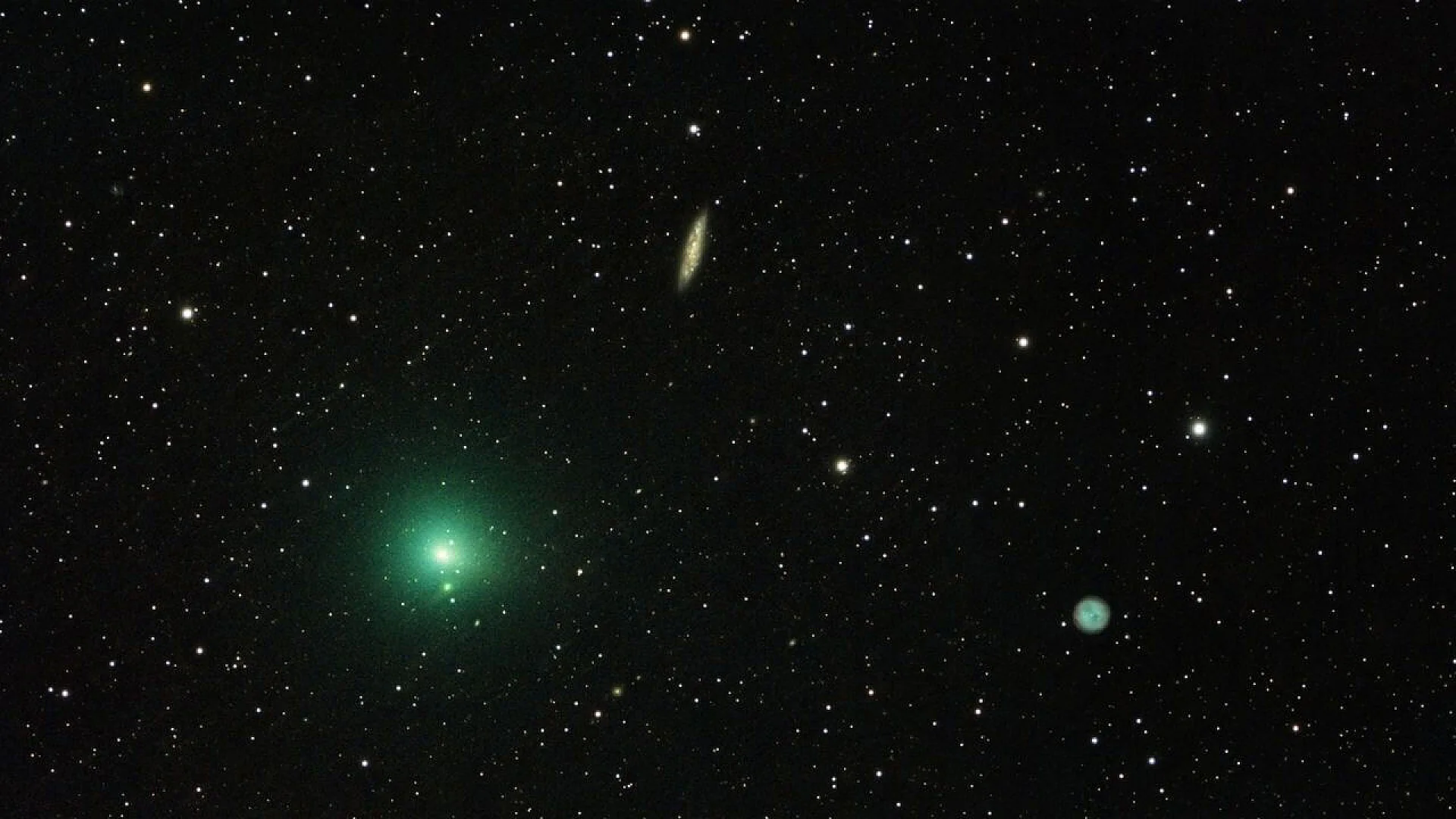
Comets may look calm in telescope images, glowing softly against the dark sky. But in reality, they are constantly changing.
As they move closer to the Sun, heat causes their icy surfaces to release gas. That gas shoots outward into space. And even though it may seem gentle, it pushes back on the comet itself.
Over time, that push can change how the comet spins.
In 2017, one small comet showed just how dramatic that effect can be. The comet is called 41P/Tuttle–Giacobini–Kresak, or simply 41P. It belongs to a group known as Jupiter family comets, short-period comets whose paths are shaped by the giant planet Jupiter.
What happened to 41P was unusual. Its rotation did not just slow a little. It changed drastically.
And according to new analysis using data from the Hubble Space Telescope, it may have done something even more surprising. It likely reversed its spin completely.
A Close Approach to the Sun
Comet 41P reached perihelion, its closest point to the Sun, on April 12, 2017. At that time, it was just over one astronomical unit away, roughly the same distance as Earth.
During that close pass, the comet became more active. Water ice turned into vapor and escaped at a rate of about 3 × 10²⁷ molecules per second. That equals roughly 90 kilograms of water every second.
That may not sound like much on a cosmic scale. But for a small comet, it matters.
Earlier in 2017, astronomers noticed that the comet’s rotation period was increasing quickly. It went from about 20 hours to around 53 hours in just two months. In other words, the comet was slowing down very fast.
Such a rapid change is rare, and it immediately raised questions about what was happening on its surface.
Hubble Looks Again, Months Later
The new study focused on observations taken months after perihelion, in December 2017.
At that time, the comet was already moving away from the Sun. It was about 2.79 astronomical units from the Sun and roughly 3.3 astronomical units from Earth.
Hubble’s Wide Field Camera 3 captured 24 images between December 11 and 14. Each exposure lasted 160 seconds, and when combined, they provided over an hour of total observing time.
The stacked images showed the comet as almost a point of light. There was only a faint surrounding coma, the cloud of dust and gas that usually surrounds an active comet.
That faintness actually helped.
When the coma is weak, astronomers can measure the brightness of the solid nucleus more accurately. And that brightness holds important clues.
Measuring the Size of the Nucleus
By carefully measuring how bright the comet appeared and correcting for distance and viewing angle, researchers estimated the nucleus’s true brightness.
From that, they calculated its size.
Assuming a typical dark surface that reflects about 4 percent of sunlight, the results suggest the nucleus has a radius of about 560 meters. Independent calculations based on the comet’s non-gravitational acceleration, meaning tiny changes in its orbit caused by outgassing, gave a slightly smaller estimate near 440 meters.
Taking everything together, the researchers adopted a working value of about 500 meters, with an uncertainty of 100 meters.
That is small. Just half a kilometer across.
And small bodies respond more strongly to forces like gas jets. So in this case, size is everything.
Watching the Brightness Change
The Hubble images did not just reveal the comet’s size. They also showed its brightness changing over time.
Across four days, the comet’s brightness varied by about 0.4 magnitudes. That variation was much larger than the measurement uncertainty, which means it was real.
Brightness variations like this usually happen because the object is rotating. If a comet is slightly elongated, different surface areas reflect different amounts of sunlight as it spins.
To find the rotation period, researchers tested different possibilities. Two periods fit the data reasonably well.
One was about 0.300 days, or roughly 7.2 hours. The other was about 0.599 days, which equals about 14.4 hours.
Most small solar system bodies show two peaks in brightness during one full rotation. That happens because their shapes are not perfect spheres. So the two-peaked solution, 0.599 days, makes more physical sense.
This means that by December 2017, the comet was rotating once every 14.4 hours.
That is very different from the 53-hour period observed earlier in the year.
So what changed?
Did the Comet Reverse Its Spin?
Here is where things get interesting.
Earlier measurements showed the comet’s rotation slowing steadily near perihelion. The rotational frequency was decreasing smoothly over time.
The December data can be interpreted in two ways. Either the comet continued spinning in the same direction, or it slowed to zero and then started spinning the other way.
From brightness alone, both interpretations can produce similar light patterns.
However, when the new measurement is plotted alongside earlier data, one scenario looks much more natural.
If the comet slowed to a stop around early June 2017 and then reversed direction, the December data follow the same smooth trend. The curve continues neatly from earlier observations.
If instead the comet kept spinning in the same direction, then the torque would have had to suddenly change direction after perihelion, and there is no clear reason why that would happen.
The simpler explanation is that the outgassing torque kept acting in the same general way. It first slowed the comet, then stopped it, and then made it spin backward.
In other words, the comet likely flipped its rotation direction.
The Physics Behind the Flip
The key force here is asymmetric outgassing.
When gas escapes from certain areas more strongly than others, it creates a twisting effect. This is similar to how a small push on the edge of a door makes it rotate around its hinges.
Scientists describe this twisting efficiency using a number called the dimensionless moment arm, written as kT.
For 41P, the estimated value of kT is about 0.013. That is roughly twice the median value measured in other short-period comets, but still within the known range.
So the comet is not unusually powerful in terms of gas jets. It is just small.
Because torque effects depend strongly on size, a small nucleus can experience rapid changes in rotation even if the gas flow is moderate.
That seems to be exactly what happened here.
A Surface That Has Evolved
The comet’s activity level has also changed over time.
In 2001, 41P was much more active. Its water production rate was about 1,500 kilograms per second, far higher than in 2017.
At that time, the active fraction, meaning the portion of the surface releasing water, appeared to exceed one. That suggests that icy grains in the coma were also contributing to the observed water vapor.
By 2017, the active fraction had dropped to about 0.14.
That is a major decrease.
This tells us that the comet’s surface has evolved. Dust layers may have built up, covering ice. Outbursts may have exposed fresh material and then faded. Over many orbits, these changes reshape the nucleus.
And as the active regions shift, so does the torque pattern, which affects rotation.
A Short Path to Breakup
There is another important consequence of rapid spin changes.
If a comet spins too fast, centrifugal forces can overcome gravity and tear it apart.
For a strengthless object with a density of about 500 kilograms per cubic meter, the critical rotation period is about 4.7 hours. Spin faster than that, and the object may begin to break up.
Using the measured spin acceleration near perihelion, researchers estimate that the comet could reach breakup speed in about 13 years, or roughly 2.5 orbits. Another scaling relation suggests about 25 years.
Either way, that is short.
In contrast, dynamical models suggest the comet could remain in its current orbit for around 10,000 years.
So there is a mismatch. The rotational lifetime appears much shorter than the orbital lifetime.
Yet the comet is still here.
Why Is It Still Intact?
Two explanations seem possible.
First, the comet may currently be more active than usual. If average activity is lower over long timescales, then the typical torque would also be smaller, which would lengthen the time before rotational breakup.
We already know that water production rates can vary by an order of magnitude from one orbit to the next. That variability could protect the nucleus from steady spin-up.
Second, the comet may have once been larger.
Spin-up timescales increase strongly with size. A kilometer-scale nucleus could survive much longer before reaching critical rotation speeds. Over time, sublimation or fragmentation could reduce it to its present 500-meter size.
In that case, 41P would be a surviving fragment of a once larger body.
Right now, there is no firm evidence to choose between these possibilities. Both may even play a role.
A Natural Laboratory in Space
Comet 41P offers something rare in astronomy. It changes on human timescales.
Instead of waiting centuries to see slow evolution, scientists can watch its rotation shift from one orbit to the next.
Its next perihelion is predicted for February 16, 2028. The viewing geometry will not be as favorable as in 2017, but new observations could still refine our understanding of its spin state.
For now, the picture is surprisingly clear.
A small, half-kilometer icy body approached the Sun. Gas jets slowed its rotation. The spin likely dropped to zero. Then the same steady torque pushed it into reverse.
It is a simple physical process, driven by sunlight and escaping vapor.
Yet it is powerful enough to flip an entire world.
The research was published in arXiv on February 06, 2026.
This content has been reviewed by subject-matter experts to ensure scientific accuracy. Learn more about us and our editorial process.
Last reviewed on .
Article history
- Latest version
- Peer reviewed by Dr. Arjun Patel, PhD
Reference(s)
- Jewitt, David. “Reversal of Spin: Comet 41P/Tuttle-Giacobini-Kresak.” arXiv, 06 February 2026, doi: 10.48550/arXiv.2602.06403. <https://doi.org/10.48550/arXiv.2602.06403>.
Cite this page:
- Posted by Aisha Ahmed