The Clearest Map Yet Shows How Dark Matter Quietly Built the Universe
Scientists have created the sharpest map ever of dark matter, revealing how this invisible substance shaped galaxies, stars, and even the conditions needed for life.
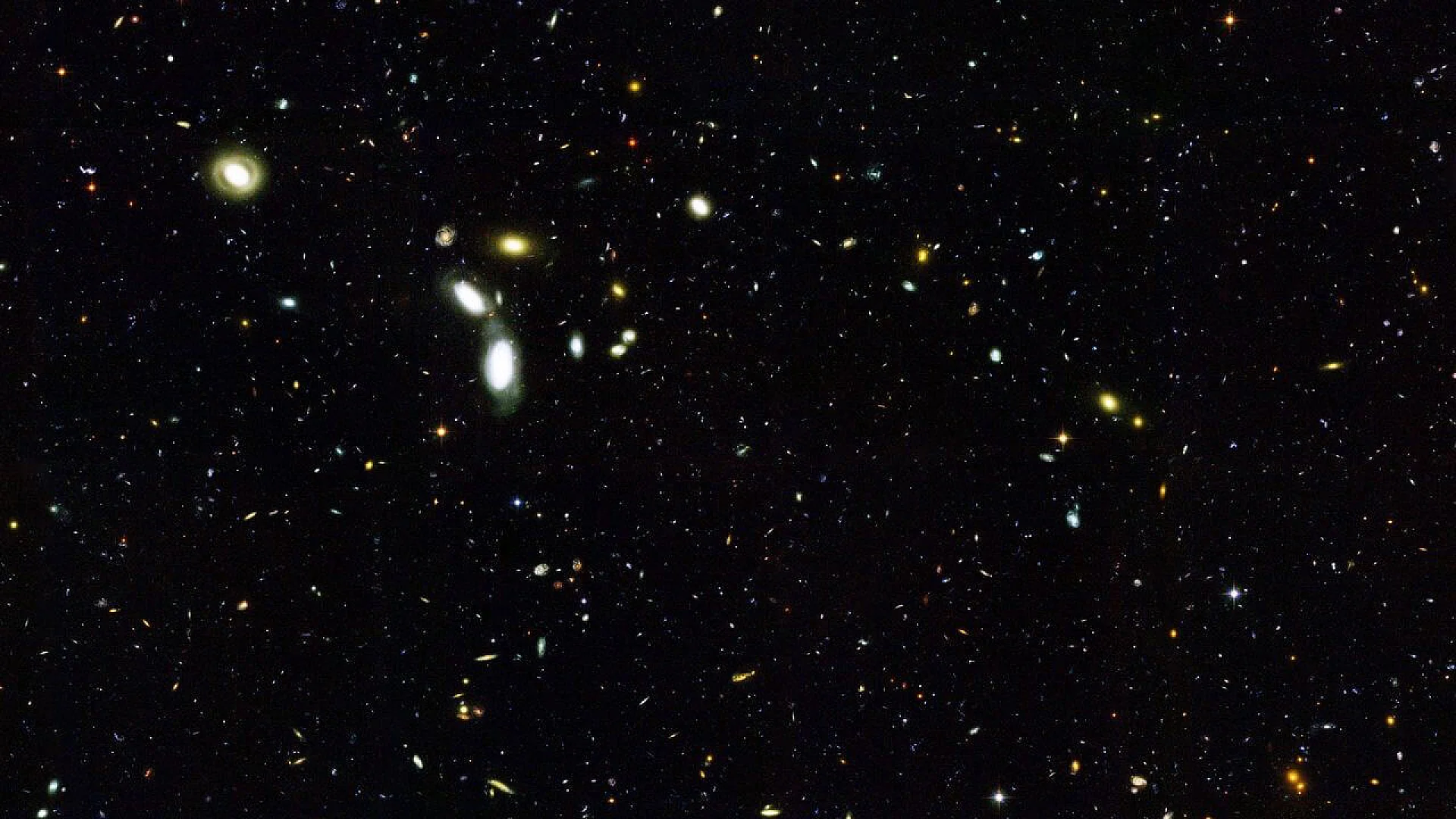
When you look at the night sky, it feels complete. Stars shine, galaxies glow, and everything seems held firmly in place. But most of what keeps the universe together is completely invisible.
Scientists have long known that ordinary matter, the stuff made of atoms that forms stars, planets, and people, is only a small part of the universe. The majority is dark matter, a mysterious substance that does not give off light or reflect it. We cannot see it with telescopes. We cannot photograph it. And yet, without it, the universe would fall apart.
Now, astronomers have created the clearest map ever made of this hidden material. Using powerful data from the James Webb Space Telescope, they traced how dark matter’s gravity shaped the large-scale structure of the cosmos. The map shows, in striking detail, how dark matter guided normal matter into galaxies and clusters over billions of years.
This is not just a prettier picture of the universe. It is strong evidence that dark matter played a central role in building everything we see today, from giant galaxy clusters to the raw ingredients that later made planets and life possible.
Why Dark Matter Is So Important
Dark matter sounds mysterious, and it is. But its effects are very real.
Galaxies spin much faster than they should if they only contained visible matter. According to the laws of physics, they should fly apart. The fact that they do not tells scientists that there must be extra mass holding them together. That extra mass is dark matter.
Light from distant galaxies also bends as it travels through space. This bending is stronger than visible matter alone can explain. Once again, dark matter provides the missing gravity.
Over time, these clues added up. Dark matter went from a strange idea to a core part of modern cosmology. Today, scientists estimate that it makes up about 85 percent of all matter in the universe.
Still, knowing that dark matter exists is not the same as seeing how it is arranged. That is where this new map becomes so important.
The Early Universe Was Almost Smooth
Shortly after the Big Bang, the universe was hot, dense, and surprisingly uniform. Matter was spread out almost evenly. There were no stars, no galaxies, and no planets. Just tiny fluctuations in density.
Dark matter was the first to respond to these small differences. Because it does not interact with light, it was free to clump together under gravity while ordinary matter was still tightly linked to radiation.
As dark matter gathered into dense regions, it created gravitational traps. Later, when the universe cooled enough, normal matter began falling into these traps. Gas collected. Stars ignited. Galaxies slowly took shape.
The new Webb map strongly supports this story. It shows that wherever galaxies exist today, dark matter is already there, quietly shaping their growth from the very beginning.
How Scientists Map Something They Cannot See
If dark matter does not emit light, how can anyone make a map of it?
The answer lies in gravity.
Mass bends space itself. When light from very distant galaxies passes through regions filled with mass, its path changes slightly. The galaxies appear stretched, warped, or shifted. This effect is called gravitational lensing.
By measuring these tiny distortions across hundreds of thousands of background galaxies, scientists can calculate how much mass is present and where it is located. This includes both visible matter and dark matter. On large scales, dark matter dominates the signal.
This technique has been used before. But never with the level of detail made possible by the James Webb Space Telescope.
Why James Webb Made Such a Big Difference
Webb is different from earlier telescopes in several key ways. It observes the universe mainly in infrared light, allowing it to see very faint and very distant galaxies. It also has extremely sharp resolution.
In this study, Webb observed a patch of sky in the constellation Sextans. The total observing time was about 255 hours. That long exposure allowed the telescope to detect nearly 800,000 galaxies, many of them far too faint to be seen before.
Each one of those galaxies acted like a small test probe, helping scientists measure how space was warped along its path. The more galaxies you can measure, the clearer the dark matter map becomes.
Compared to earlier maps made from ground-based telescopes, this one contains about ten times more galaxies. Even compared to maps made with the Hubble Space Telescope, it roughly doubles the available data.
The result is a much sharper, cleaner view of dark matter’s structure.
A Hidden Framework for Galaxies
One of the most striking findings is how closely dark matter and galaxies line up.
The map shows dark matter forming long filaments and dense knots. Galaxies sit right on top of these structures, like lights decorating an invisible frame. This confirms the idea that dark matter acts as the universe’s scaffolding.
Without this framework, galaxies would not have formed where they did. Stars would have appeared later, if at all. Heavy elements needed for rocky planets would have taken much longer to form.
In a very real sense, dark matter helped prepare the universe for complexity.
Dark Matter Is All Around Us
Dark matter is not just something that exists far away in deep space. It surrounds our own galaxy as well.
The Milky Way sits inside a huge halo of dark matter. This invisible cloud provides most of the gravity that keeps our galaxy stable as it rotates.
Scientists estimate that enormous numbers of dark matter particles pass through Earth every second. They pass through buildings, oceans, and even our bodies without leaving a trace. They do not interact with atoms in any noticeable way.
And yet, without them, our galaxy would not exist in its current form.
Sharper Distances With Infrared Vision
To build an accurate dark matter map, scientists also needed good distance measurements for the background galaxies.
Webb’s mid-infrared instrument played a key role here. Infrared light can pass through dust that blocks visible light. This allows astronomers to see galaxies that would otherwise be hidden.
Infrared observations also help determine how far away those galaxies are. Better distance estimates lead to a more accurate reconstruction of where dark matter lies along the line of sight.
Years of careful instrument design made this level of precision possible.
What This Map Confirms and What It Does Not
The new map strongly supports the standard model of cosmology. Dark matter clumped first. Normal matter followed. Together, they built the cosmic web of galaxies we see today.
However, the map does not reveal what dark matter actually is. Scientists still do not know whether it is made of one particle or many, or whether it has properties beyond gravity.
What the map does provide is a powerful reference point. Future observations can compare their results to this high-quality dataset and look for small differences that might hint at new physics.
What Comes Next
This deep map covers only a small region of the sky. Future missions aim to expand this work across much larger areas.
The European Space Agency’s Euclid telescope and NASA’s Nancy Grace Roman Space Telescope are both designed to study dark matter using gravitational lensing. Together, they will help scientists track how dark matter evolved over cosmic time.
The Webb map will serve as a benchmark, a place where the universe has been studied in exceptional detail.
Why This Really Matters
Dark matter may be invisible, but its impact is everywhere.
It shaped the first galaxies. It helped stars form earlier. It influenced how chemical elements spread through space. And indirectly, it played a role in making planets like Earth possible.
By seeing dark matter more clearly, scientists are not just filling in a missing piece of the universe. They are refining the story of how everything began, how structure emerged from near emptiness, and how the cosmos became a place where life could exist.
Sometimes, the most important forces are the ones we never see at all.
The research was published in Nature Astronomy on January 26, 2026.
This article has been fact checked for accuracy, with information verified against reputable sources. Learn more about us and our editorial process.
Last reviewed on .
Article history
- Latest version
Reference(s)
- Scognamiglio, Diana., et al. “An ultra-high-resolution map of (dark) matter.” Nature Astronomy, 26 January 2026, doi: 10.1038/s41550-025-02763-9. <https://www.nature.com/articles/s41550-025-02763-9>.
Cite this page:
- Posted by John Williams