Edison’s First Light Bulbs Might Have Made Graphene Long Before Anyone Knew What It Was
A modern lab experiment suggests Thomas Edison’s 1879 light bulbs may have briefly created graphene, a powerful material that science would not officially recognize for more than 100 years.
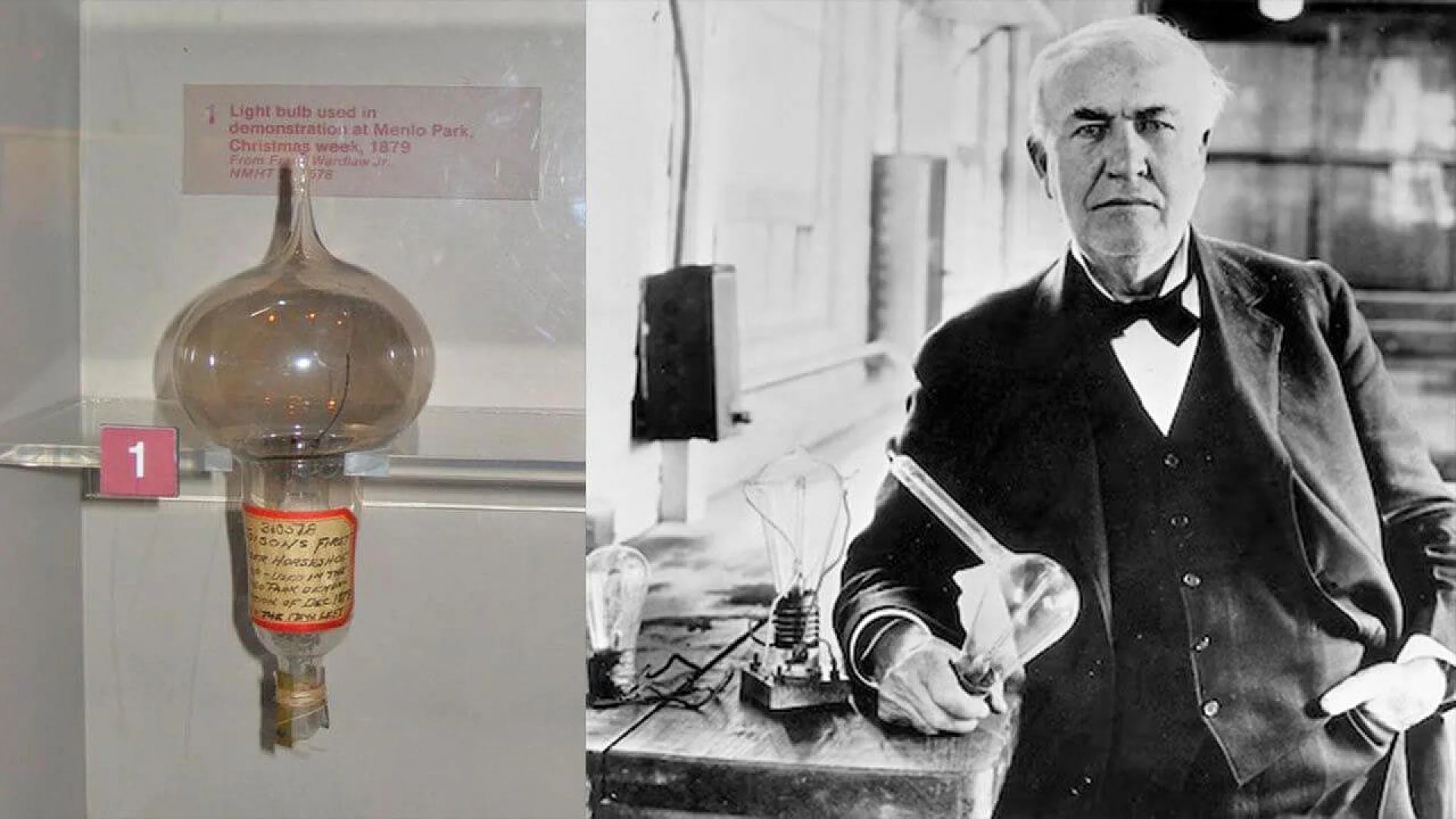
When Thomas Edison turned on one of his early light bulbs in 1879, he was not thinking about advanced materials or atomic structures. He had one goal in mind. Make electric light reliable enough for everyday use.
That was it.
But more than a century later, scientists looking back at those same experiments are asking a very different question. What else might have happened inside those glowing filaments, without anyone realizing it at the time?
According to new research from Rice University, the answer might be graphene, one of the most valuable and talked-about materials in modern science. If that sounds strange, it should. Graphene was not officially discovered until the early 2000s. Yet the conditions needed to form it may have existed inside Edison’s light bulbs all along.
Not intentionally. Not knowingly. But possibly, and that is what makes the story so fascinating.
Graphene is a form of carbon, but not like the carbon you find in charcoal or pencil lead. It is made of a single layer of atoms arranged in a tight, honeycomb-like pattern. Just one atom thick.
That structure gives graphene some extreme properties. It is incredibly strong for its weight. It conducts electricity extremely well. It is flexible, nearly transparent, and surprisingly stable.
Because of that, graphene is being explored for use in faster electronics, better batteries, sensitive sensors, and lightweight materials for future technologies. When scientists first isolated and studied it in the early 21st century, it was such a big deal that it earned a Nobel Prize in Physics.
The challenge has always been making graphene efficiently and cheaply. Many production methods are expensive or complicated. But one modern technique stands out.
It involves taking carbon-based materials and heating them very rapidly to extremely high temperatures, often above 2,000 degrees Celsius. This sudden heating forces the carbon atoms to rearrange themselves into graphene layers.
Today, scientists call this process flash Joule heating.
And here is where Edison quietly enters the picture.
Edison’s earliest light bulbs did not use tungsten filaments like modern bulbs do. Tungsten came later. Instead, Edison experimented with carbon-based filaments, including carefully prepared bamboo.
When electricity flowed through those filaments, resistance caused them to heat up very quickly. Hot enough to glow. Hot enough to produce light. And, as it turns out, hot enough to reach temperatures similar to those used in modern graphene production.
In other words, Edison’s light bulbs were doing something much more intense than most people realize. They were pushing carbon materials to their limits.
For scientists at Rice University, this raised an intriguing possibility. If modern flash Joule heating can make graphene, could Edison’s light bulbs have done the same thing, even briefly?
To test that idea, researchers decided to recreate Edison’s setup as faithfully as possible. That was easier said than done.
Many decorative “Edison-style” bulbs sold today do not actually use carbon filaments. They often contain tungsten that just looks old-fashioned. That would not work for this experiment.
After several failed attempts, the researchers finally tracked down artisan-made bulbs that used real bamboo filaments, similar to what Edison described in his original patents. Even the filament thickness closely matched historical measurements.
Once they had the right bulb, the setup was straightforward. The researchers connected it to a 110-volt direct current power supply, just like Edison would have done. Then they switched it on.
But only for about 20 seconds.
Longer heating times can cause carbon to settle into graphite, which is more stable but lacks graphene’s special properties. Timing mattered.
When the filament cooled, something had clearly changed.
Under a microscope, the filament no longer looked the same. Instead of dark gray, parts of it appeared shiny and silver-like. That alone did not prove anything, but it was enough to raise eyebrows.
To find out what had actually formed, the researchers used Raman spectroscopy. This technique uses lasers to read the unique atomic “fingerprints” of materials. It is extremely precise and widely used in modern materials science.
The results showed that parts of the filament had turned into turbostratic graphene. This is a type of graphene where layers are slightly misaligned rather than perfectly stacked. Even so, it retains many of graphene’s most useful properties.
That confirmation changed the conversation. Edison’s setup was not just capable of producing extreme heat. Under the right conditions, it could rearrange carbon atoms into graphene.
This is where the story needs to slow down and stay honest.
There is no evidence that Edison knew he was making graphene. There is also no proof that graphene survived for long inside his original bulbs. In fact, it almost certainly did not.
Edison’s famous long-duration tests kept bulbs glowing for many hours. Under that kind of sustained heat, any graphene formed early on would likely have turned into graphite. The structure would be lost.
Also, none of Edison’s original bulbs are available for modern analysis. Even if one were found, decades of aging would make it difficult to detect anything meaningful.
So this is not about rewriting history or giving Edison credit for discovering graphene.
It is about recognizing that science sometimes moves forward without realizing it.
Why This Matters More Than It Seems
This research highlights something important about how discovery actually works.
Scientific breakthroughs are not always about new machines or futuristic labs. Sometimes they come from asking fresh questions about old ideas. By applying modern tools to historical experiments, scientists can uncover effects that were invisible at the time.
It also shows the value of detailed documentation. Edison’s patents were so precise that researchers more than a century later could recreate his experiments with surprising accuracy.
In a way, Edison unknowingly left behind a message in his work, waiting for future scientists to read it.
Lessons for Modern Science
There is also a practical takeaway. If something as simple as a light bulb filament can reach the conditions needed to form graphene, that opens the door to more accessible production methods.
Flash Joule heating is already being explored as a low-cost way to make graphene at scale. This research reinforces the idea that simple systems, when used creatively, can lead to powerful results.
It also encourages scientists to stay curious. Today’s experiments may contain hidden outcomes that only future tools will fully reveal.
A Quiet Conversation Across Time
James Tour, the lead researcher on the study, described the experience as exciting not just scientifically, but philosophically. Recreating Edison’s work with modern knowledge felt like a conversation across centuries.
It raises a bigger question. What discoveries are we making today without realizing it? What results will future scientists uncover when they look back at our experiments?
Science is not always a straight line. Sometimes it flickers on briefly, like a filament glowing in the dark, before anyone understands what they are seeing.
The research was published in ACS Nano on January 20, 2026.
This content has been reviewed by subject-matter experts to ensure scientific accuracy. Learn more about us and our editorial process.
Last reviewed on .
Article history
- Latest version
Reference(s)
- Eddy, Lucas., et al. “Evidence for Graphene Formation in Thomas Edison’s 1879 Carbon Filament Experiments.” ACS Nano, vol. 20, no. 2, 20 January 2026, pp. 1769-1774. American Chemical Society, doi: 10.1021/acsnano.5c12759. <https://pubs.acs.org/doi/10.1021/acsnano.5c12759>.
Cite this page:
- Posted by Asif Iqbal