A Mysterious Blue Glow Could Signal a Deep Instability in Empty Space
Physicists suggest that an eerie flash of Cherenkov light in empty space could reveal that the cosmic vacuum is unstable, offering rare clues about gravity and the fabric of spacetime.
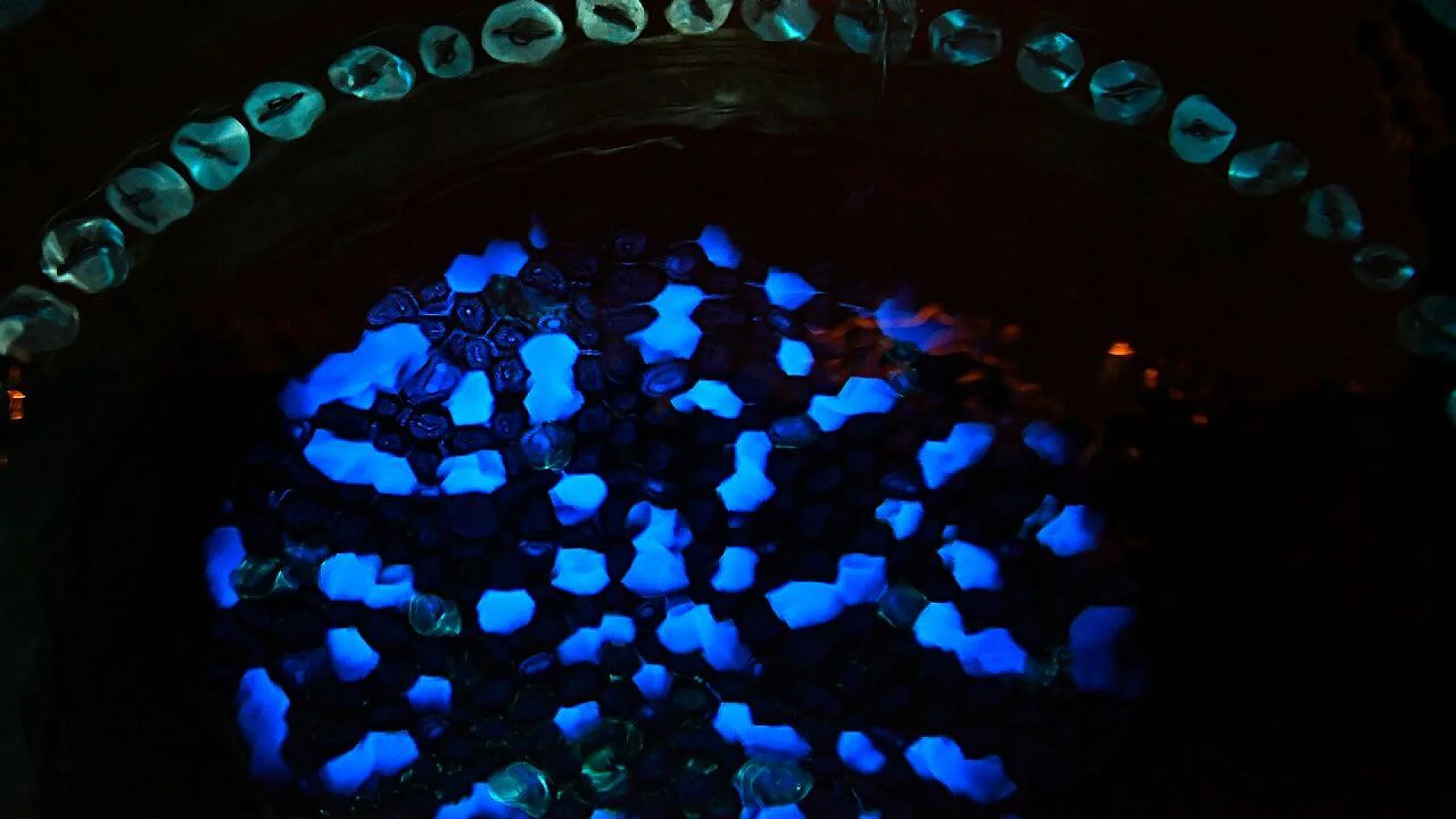
For most people, the word “vacuum” evokes a simple idea: emptiness, nothingness, the absence of matter and energy. In physics, however, the vacuum is anything but simple. It is usually defined as the lowest-energy state of the Universe, a baseline against which all physical processes unfold. Yet a new theoretical proposal suggests that this assumption may be incomplete. If certain conditions are met, empty space itself might become unstable, and the evidence could arrive in the form of a faint but unmistakable blue flash.
That flash would resemble Cherenkov radiation, a phenomenon already well known to physicists. On Earth, it appears when charged particles move through a medium, such as water, faster than light can travel through that medium. The result is a visible “boom” of light, often seen glowing eerily inside nuclear reactors. According to new theoretical work, spotting a similar glow in the vacuum of space would be far more than a curiosity. It could signal a deep instability in spacetime and provide a rare observational window into physics beyond our current theories.
A Familiar Effect With an Unfamiliar Twist
Cherenkov radiation is often described as the optical equivalent of a sonic boom. When an aircraft exceeds the speed of sound, pressure waves pile up and release energy in a sharp shock. In a similar way, when a charged particle moves through a material medium faster than light can propagate through that medium, electromagnetic disturbances accumulate and are released as a flash of light.
Crucially, this effect depends on the presence of a medium. Light always travels at its maximum speed in a vacuum, according to well-tested physical laws. Because nothing can exceed that speed, Cherenkov radiation should not occur in empty space. For decades, this assumption has been unchallenged.
The new work does not dispute this rule directly. Instead, it asks a more subtle question. What if the vacuum is not as empty, or as stable, as we assume? Under certain theoretical frameworks, spacetime itself could behave like a medium with hidden structure. In that case, phenomena that resemble Cherenkov radiation might arise, not because particles are breaking the cosmic speed limit, but because the vacuum itself is unstable.
Ghosts in the Mathematics of Nature
At the center of this idea is a concept with an unsettling name: ghosts. In physics, the term has more than one meaning. Sometimes it refers to purely mathematical constructs introduced to keep equations consistent. In other contexts, however, a ghost can describe a physical disturbance that carries negative energy.
Negative energy sounds paradoxical, but it plays a role in many theoretical discussions about gravity and quantum fields. A ghost of this type is not a particle in the usual sense. Instead, it is a sign that a system is unstable, capable of lowering its total energy by producing paired disturbances, one carrying positive energy and the other carrying negative energy.
Theoretical physicist Eugeny Babichev of the University of Paris-Saclay argues that such ghost instabilities can be viewed through the same lens as Cherenkov radiation. In his analysis, the two phenomena share identical underlying kinematics. In simple terms, the equations that describe how energy and momentum are conserved look the same in both cases.
“This allows us to consider two seemingly different physical effects from the same perspective,” Babichev explains in his paper, arguing that Cherenkov radiation can be interpreted as a form of instability involving the creation of a negative-energy ghost.
Ripples Without a Pebble
To understand why this matters, it helps to use an analogy. Imagine a calm lake. The flat surface represents the lowest-energy state of the water. Normally, ripples appear only when energy is added, such as when a pebble is thrown into the lake. Nature does not produce ripples spontaneously, because doing so would require extra energy.
Now imagine a strange version of the lake in which certain ripples carry negative energy. In this scenario, the system could lower its overall energy by creating two ripples at once, one positive and one negative, without any pebble at all. The flat surface would no longer be stable. Ripples could appear spontaneously.
In Babichev’s framework, the vacuum of space may behave in an analogous way under certain conditions. A ghost instability would allow the vacuum to lower its energy by producing paired disturbances. One possible observational signature of this process would look very much like Cherenkov radiation.
Why a Blue Glow Would Change Everything
If Cherenkov-like radiation were ever detected in empty space, the implications would be profound. Such a signal would suggest that the vacuum is not the lowest-energy state of the Universe, at least not in the way physicists currently define it. Instead, the vacuum would have structure, limits, and stored energy that can be released under specific circumstances.
This would directly challenge one of the foundational assumptions of modern physics. Both general relativity and quantum field theory rely on the idea of a stable vacuum. While quantum mechanics allows for fleeting fluctuations, the overall picture assumes a well-defined ground state. Evidence of a ghost instability would force theorists to rethink this picture from the ground up.
It would also offer a rare experimental handle on modified theories of gravity. Many attempts to reconcile general relativity with quantum mechanics introduce additional fields or degrees of freedom. Some of these models predict ghost-like behavior under certain conditions. Observing a Cherenkov signal in the vacuum could help rule out some theories while lending support to others.
Gravity’s Longstanding Identity Crisis
The idea that our theory of gravity is incomplete is hardly new. For decades, physicists have struggled to reconcile Einstein’s general relativity with the rules of quantum mechanics. The two frameworks are both extraordinarily successful, yet they remain mathematically incompatible in extreme regimes, such as inside black holes or at the very beginning of the Universe.
This tension has motivated a vast landscape of alternative and modified gravity theories. Many of these models behave exactly like general relativity under ordinary conditions but differ subtly in extreme environments. Detecting signs of vacuum instability would provide a way to test these ideas, not through abstract mathematics, but through observable phenomena.
In this sense, the proposed link between Cherenkov radiation and ghost instability is valuable even if it remains purely theoretical. It offers a conceptual bridge between familiar laboratory physics and the exotic behavior predicted by advanced gravitational models.
From Nuclear Reactors to Cosmic Voids
On Earth, Cherenkov radiation is most famously observed in nuclear reactors, where it appears as a soft blue glow in pools of water used to cool radioactive fuel. The light is harmless, but its presence is a clear indicator that high-energy charged particles are passing through the medium.
Transplanting this idea into the vacuum of space requires a dramatic shift in perspective. In the cosmic context, there is no water, no glass, no conventional medium at all. If a Cherenkov-like signal appeared there, it would not be telling us about fast-moving particles alone. It would be telling us something fundamental about the vacuum itself.
According to Babichev’s analysis, a ghost instability in empty space could mimic the behavior of a superluminal charged particle in a medium. The resulting radiation would have the same kinematic signature as Cherenkov light, even though no physical speed limit is being violated.
What We Do Not Know Yet
Despite its intriguing implications, this idea remains firmly in the realm of theory. The paper does not propose a practical way to detect such a signal, nor does it claim that ghost instabilities must exist in nature. Instead, it provides a framework for thinking about how such phenomena might manifest if they do occur.
One major open question is whether these instabilities could be slow enough to be relevant. In many models, ghost instabilities develop extremely rapidly, making them incompatible with the long-lived structures we observe in the Universe. Babichev suggests exploring scenarios in which the instability rate is much lower, potentially allowing ghost-like behavior to persist without immediately destroying the system.
As an example, he points to black holes. In some modified gravity theories, a black hole could host a ghost instability whose growth rate is slower than other physical processes associated with the object. In such a case, the instability might leave subtle observational signatures without leading to obvious contradictions.
Why This Matters for Observation
Looking for Cherenkov radiation in the vacuum is not something current instruments are designed to do. The effect, if it exists at all, would likely be extremely faint and rare. Nevertheless, having a clear theoretical prediction is an essential first step.
Physics has a long history of ideas that began as abstract mathematics and later found experimental confirmation. Gravitational waves were predicted a century before they were detected. The Higgs boson existed on paper long before it appeared in particle detectors. In this tradition, exploring the consequences of ghost instabilities helps define what future observations should look for.
Even a null result would be valuable. If no such signals are ever observed, that absence can place strong constraints on modified gravity theories that predict vacuum instabilities.
A Vacuum With a Story to Tell
The most striking aspect of this work is not the technical detail, but the conceptual shift it encourages. The vacuum is often treated as a passive stage on which physical processes unfold. This research suggests it may be an active participant, capable of instability and transformation under the right conditions.
If that is true, then empty space is not truly empty. It is a dynamic entity with its own rules, limitations, and vulnerabilities. A simple blue flash, familiar from reactor pools on Earth, could become a messenger from the deepest layers of physical reality.
For now, this idea remains a theoretical possibility. But by linking a well-known phenomenon to one of the most challenging problems in modern physics, it opens a new way of thinking about how the Universe might reveal its secrets.
The research was published in Physical Review D on October 06, 2025.
This article has been fact checked for accuracy, with information verified against reputable sources. Learn more about us and our editorial process.
Last reviewed on .
Article history
- Latest version
- Last updated by Dayyal Dungrela, MLT, BSc, BS
- Peer reviewed by Dr. Arjun Patel, PhD
Reference(s)
- Babichev, Eugeny. “Cherenkov radiation as ghost instability.” Physical Review D, vol. 112, no. 8, 06 October 2025, doi: 10.1103/bgwl-dwbd. <https://link.aps.org/doi/10.1103/bgwl-dwbd>.
Cite this page:
- Posted by Aisha Ahmed