The 2-Minute Day: Newly Discovered Asteroids Are Spinning Into Oblivion
The first data from the world’s most advanced sky-mapping camera has revealed a hidden population of asteroids spinning at dizzying speeds, challenging everything we know about how these space rocks hold themselves together.
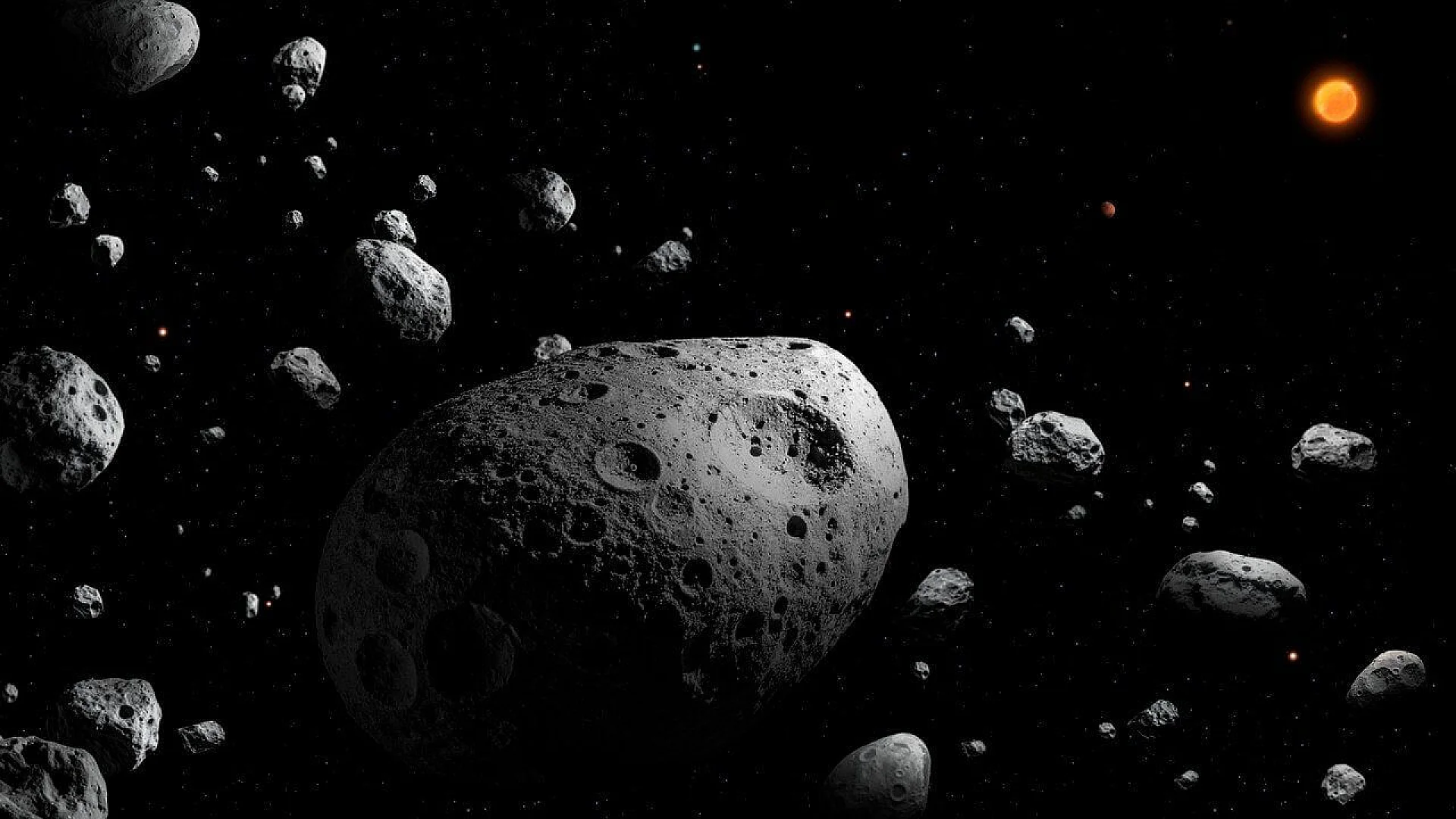
The Vera C. Rubin Observatory has not even officially begun its full decade-long survey, yet it is already shattering astronomical records. In a landmark study published in The Astrophysical Journal Letters, scientists have detailed the discovery of “ultrafast” asteroids that rotate so quickly they defy the traditional laws of physics for space debris.
The Technological Marvel on Cerro Pachón
Perched high in the Chilean Andes, the Vera C. Rubin Observatory is equipped with the largest digital camera ever built for astronomy. During its recent “First Look” testing phase, it directed its massive 3,200-megapixel eye toward a patch of the sky to see what might be lurking in the darkness. While the telescope was technically being calibrated, it managed to capture a treasure trove of data that has left the scientific community buzzing.
The researchers, led by Sarah Greenstreet, analyzed more than 1,100 images taken over a span of nine nights. Unlike traditional telescopes that peer deeply at a single galaxy, the Rubin Observatory takes wide-angle “snapshots” of the entire sky. This allowed the team to track thousands of moving objects simultaneously, providing a rare glimpse into the chaotic motion of the asteroid belt.
The Mystery of the 2.2-Hour Spin Barrier
To understand why this discovery is so shocking, one must first understand the “spin barrier.” For decades, astronomers have observed that almost no asteroid larger than a few hundred meters spins faster than once every 2.2 hours.
The reason for this is structural. Most asteroids are not solid, single boulders; they are “rubble piles,” which are loose collections of rocks, dust, and gravel held together only by the weak force of gravity. If a rubble pile spins too fast, the centrifugal force (the same force that pushes you to the side in a turning car) becomes stronger than the gravity holding the rocks together. At the 2.2-hour mark, a typical asteroid should literally fly apart, scattering its guts into the void of space.
Breaking the Cosmic Speed Limit
The Rubin Observatory’s first batch of data has turned this rule on its head. By measuring the “lightcurves” (the way an asteroid’s brightness flickers as it rotates), the team identified 76 asteroids with highly reliable rotation periods.
Out of this small sample, 19 were found to be spinning faster than the 2.2-hour limit. These are known as “superfast rotators.” Even more incredible was the discovery of three “ultrafast” rotators that finish a full “day” in less than five minutes. The star of the show, an asteroid named 2025 MN45, is roughly 500 meters wide and spins once every 1.9 minutes.
At that speed, the surface of the asteroid is moving with incredible force. For an object of that size to remain in one piece while spinning that fast, it cannot be a simple pile of rubble. It must have “backbone.”
How Did They Find Them?
Finding these tiny, fast-moving targets is like trying to track a specific bee in a swarm from a mile away. The researchers used a method called “linking,” where sophisticated software connects the dots of light seen in images taken at different times. Once they had a track for an asteroid, they could look at the subtle changes in its brightness.
If an asteroid is shaped like a potato, it reflects more light when its broad side is facing Earth and less light when its narrow end is facing us. By timing these pulses of light, the team could calculate exactly how fast the object was spinning. The Rubin Observatory’s ability to detect these faint, rapid changes is what made these record-breaking discoveries possible.
Why This Changes Everything
This discovery forces scientists to reconsider the physical makeup of the small bodies in our solar system. If these asteroids are not flying apart at 1.9-minute rotation speeds, they must have some form of internal cohesion.
This “cosmic glue” could come from van der Waals forces, which are tiny attractive forces between molecules, or perhaps these objects are solid, monolithic chunks of rock forged in ancient collisions. Understanding this internal strength is vital for several reasons:
- Planetary Defense: If an asteroid were ever on a collision course with Earth, knowing whether it is a solid rock or a loose pile of sand determines how we would try to deflect it. A solid rock might require a different kinetic impact than a rubble pile.
- The History of the Solar System: The spin of an asteroid is often increased by the “YORP effect,” where sunlight hitting the surface acts like a tiny thruster. Finding so many fast rotators suggests that the small asteroid population has a much more active and violent history than we realized.
- Mining and Exploration: Future space missions aiming to land on or mine asteroids will need to contend with these “spinning tops.” Landing on a rock that rotates every two minutes is a significant engineering challenge.
A Balanced Perspective: The Caveats
While these findings are revolutionary, the researchers are careful to note that this is just the beginning. The data was collected during a “commissioning” phase, meaning the telescope was still being fine-tuned. The sample size of 76 asteroids is relatively small compared to the millions that the Rubin Observatory will eventually discover.
There is also the possibility that some of these ultrafast rotators are much smaller than currently estimated. If an asteroid is very small (less than 100 meters), it is more likely to be a single solid rock, which would naturally allow it to spin faster. However, the brightness data for 2025 MN45 suggests it is quite large, which is what makes its speed so baffling.
The Future of the Rubin Observatory
This study is essentially a “proof of concept” for the Legacy Survey of Space and Time (LSST), which is scheduled to begin in 2026. Over the next ten years, the Rubin Observatory will map the entire southern sky every few nights.
Astronomers expect the LSST to increase the number of known asteroids in our solar system by a factor of ten. We are about to move from knowing a few thousand asteroid rotation periods to knowing millions. This “Big Data” approach to astronomy will allow us to see patterns in the solar system that were previously invisible, such as how asteroid “families” (fragments from the same original body) behave differently depending on their size and distance from the sun.
A New Era of Discovery
The discovery of these “ultrafast” asteroids is a fitting start for an observatory named after Vera Rubin, the woman who proved the existence of Dark Matter. Just as she revealed that there was more to galaxies than meets the eye, the observatory bearing her name is revealing that the “empty” space between planets is actually filled with high-speed, structurally complex machines of rock and metal.
As we look toward the start of the full survey in 2026, one thing is clear: the solar system is a much more dynamic, violent, and surprising place than we ever imagined. The “spin barrier” has been broken, and we are only just beginning to understand what else might be hiding in the dark.
Conclusion
The first results from the Rubin Observatory have proven that even “test data” can lead to world-class scientific breakthroughs. By identifying asteroids that spin at speeds that should be physically impossible for rubble piles, Sarah Greenstreet and her team have opened a new chapter in planetary science. We now know that the small residents of our solar system are tougher and faster than we gave them credit for, leaving us with a renewed sense of wonder (and perhaps a bit of caution) about the millions of rocks whizzing through our cosmic backyard.
The research was published in The Astrophysical Journal Letters on January 07, 2026.
This article has been fact checked for accuracy, with information verified against reputable sources. Learn more about us and our editorial process.
Last reviewed on .
Article history
- Latest version
- Last updated by Dayyal Dungrela, MLT, BSc, BS
- Peer reviewed by Dr. Arjun Patel, PhD
Reference(s)
- Greenstreet, Greenstreet., et al. “Lightcurves, Rotation Periods, and Colors for Vera C. Rubin Observatory’s First Asteroid Discoveries.” The Astrophysical Journal Letters, 07 January 2026, doi: 10.3847/2041-8213/ae2a30. <https://iopscience.iop.org/article/10.3847/2041-8213/ae2a30>.
Cite this page:
- Posted by Aisha Ahmed