New NASA Telescope Hunts for Dark Matter ‘Ghost Particles’ in Deep Space
A revolutionary new X-ray telescope has turned its gaze toward the most massive structures in the universe to solve a ten-year-old mystery: is dark matter hiding in plain sight as a faint, unexplained glow?
The universe we see is only a tiny fraction of what actually exists. When we look at the night sky, the stars, planets, and glowing nebulae represent less than five percent of the total matter and energy in the cosmos. The rest is a mystery. Approximately 85 percent of all matter in the universe is “dark matter,” an invisible substance that does not emit, reflect, or absorb light. We know it is there only because its immense gravity pulls on the visible stars and galaxies, acting as the invisible glue that prevents the universe from flying apart.
For decades, the search for the identity of this dark matter has been the “Holy Grail” of modern physics. Scientists have proposed many candidates, from “WIMPs” (Weakly Interacting Massive Particles) to tiny black holes. Among the most intriguing candidates are “ghost particles” known as sterile neutrinos. These theorized particles are so elusive that they could pass through an entire planet of lead without ever touching an atom. However, physics suggests that if they exist, they might slowly decay, releasing a tiny, telltale spark of X-ray light.
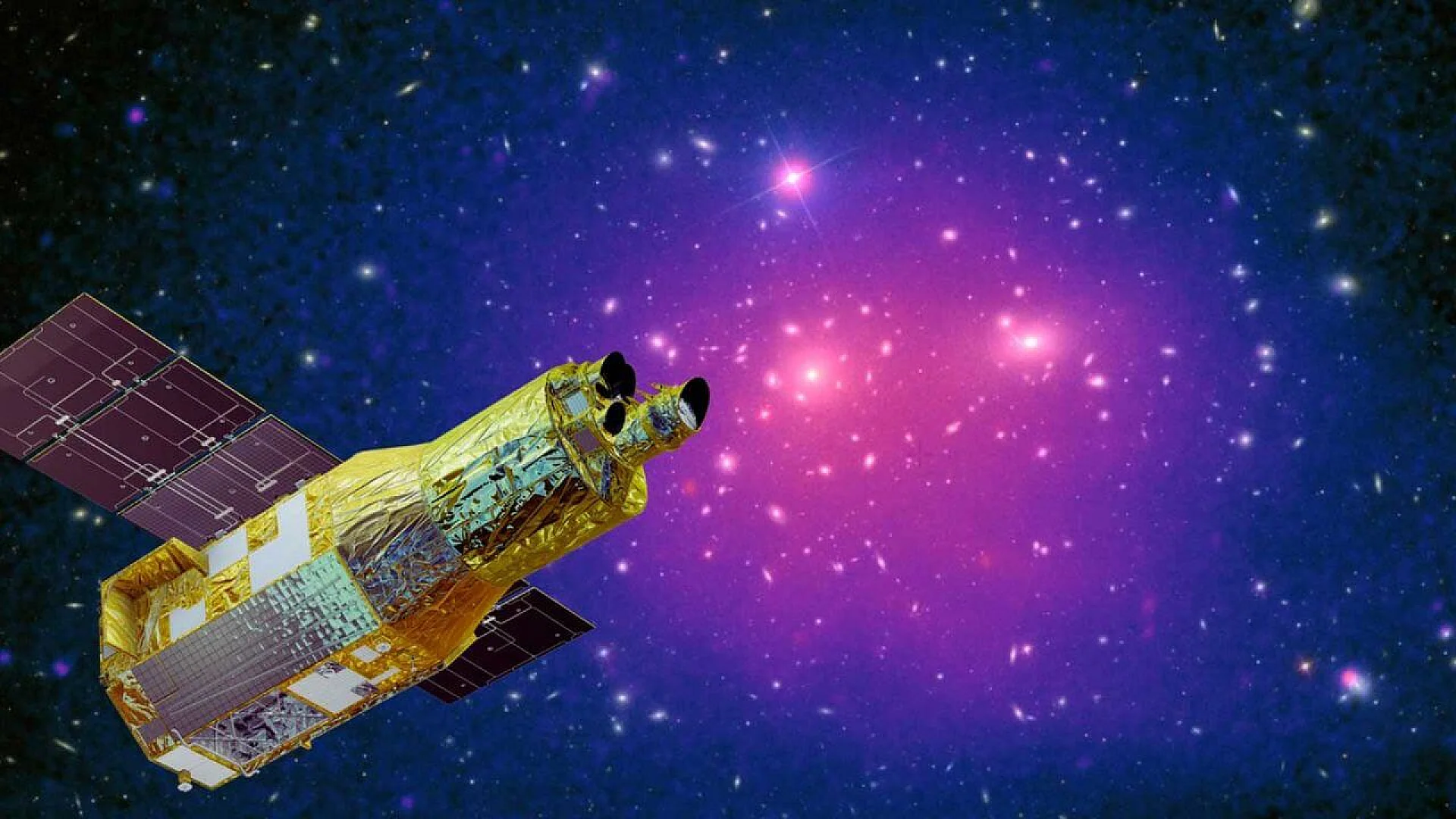
Recently, an international team of scientists used the most advanced X-ray observatory ever launched, the X-ray Imaging and Spectroscopy Mission (XRISM), to hunt for this signal. By staring deep into the hearts of giant galaxy clusters, they sought to capture the “ghost” in the act of revealing itself.
A Ten-Year Cosmic Whodunnit
The story of this specific hunt began in 2014. Using older telescopes like NASA’s Chandra X-ray Observatory and the European Space Agency’s XMM-Newton, researchers spotted something strange. They found a faint, unidentified spike of energy in the X-ray spectrum at 3.5 kiloelectronvolts (keV). This was not a signal from any known element like oxygen or iron in the way they expected.
The scientific community was electrified. If this 3.5 keV line was real, it matched the predicted signature of a sterile neutrino with a mass of about 7.1 keV. It was potentially the first direct evidence of dark matter ever recorded. However, the signal was incredibly weak, and skeptics argued it might just be a mistake in the data or a signal from common elements like potassium or sulfur that were not modeled correctly.
The Sterile Neutrino Hypothesis
The idea behind the sterile neutrino is fascinating. Standard neutrinos are “active” particles that we can detect, though with great difficulty. Sterile neutrinos, however, are even more antisocial. They would not interact via the weak nuclear force, only through gravity. This makes them perfect candidates for “Warm Dark Matter”.
Unlike “Cold Dark Matter,” which moves slowly and clumps together easily, “Warm Dark Matter” would move a bit faster, smoothing out some of the smallest structures in the universe. This could explain why we see fewer small “satellite” galaxies than our current computer models predict. If the 3.5 keV line was the decay of these particles, it would solve multiple cosmic mysteries at once.
XRISM: A New Eye on the High-Energy Universe
To settle the debate, scientists needed a better tool. Earlier telescopes were like looking at a distant mountain through a foggy window; they could see the shape, but the details were lost in the blur. XRISM, a joint mission between the Japan Aerospace Exploration Agency (JAXA) and NASA, was designed to provide the sharpest X-ray vision in history.
The “secret sauce” of XRISM is an instrument called Resolve. Unlike traditional X-ray cameras that use silicon chips, Resolve is a microcalorimeter. It works by measuring the tiny amount of heat generated when a single X-ray photon hits its detector. To do this, the instrument must be cooled to just a fraction of a degree above absolute zero, colder than the deepest reaches of interstellar space.
The Resolve Microcalorimeter: Measuring Heat from Space
The precision of Resolve is staggering. While older detectors had an energy resolution of about 100 electronvolts, Resolve has a resolution of just 5 electronvolts. This means it can distinguish between different types of light with twenty times more accuracy than its predecessors. If the 3.5 keV line was a “fake” signal caused by elements like potassium, Resolve would be able to see the difference. It is the ultimate high-fidelity ear for the music of the spheres.
The Power of Stacking Ten Cosmic Giants
In their latest study, the XRISM Collaboration did not just look at one part of the sky. They used a technique called “stacking”. They combined observations from ten of the largest galaxy clusters in the nearby universe, including famous names like Perseus, Coma, and Virgo.
Why Galaxy Clusters?
Galaxy clusters are the perfect laboratories for hunting dark matter. They are the largest structures in the universe held together by gravity, containing thousands of galaxies and trillions of stars. Crucially, they are mostly made of dark matter. About 80 percent of a cluster’s mass is dark matter, while most of the rest is a “soup” of hot, X-ray emitting gas called the intracluster medium. Because there is so much dark matter in one place, the chances of seeing a decay signal are much higher than anywhere else in the sky.
The team collected a total of 3.75 million seconds (about 43 days) of “exposure time” from these clusters. By stacking the data, they essentially turned ten faint whispers into one louder signal, making it much easier to see if a dark matter line was hiding in the noise.
The Results: Searching for a Needle in a Galactic Haystack
The results of this deep search were recently published in The Astrophysical Journal Letters. After carefully analyzing the stacked spectrum and accounting for all the known chemical elements in the clusters, the verdict was clear: XRISM found no unidentified X-ray lines.
This means that the 3.5 keV line did not appear in the Resolve data at the level the researchers were testing. By not finding the signal, the team was able to set a new, much stricter “upper limit” on how quickly dark matter particles can decay.
A Narrowing Window for Dark Matter
The study calculated that if a 7.1 keV sterile neutrino exists, its “decay rate” (the frequency at which it turns into X-rays) must be lower than approximately 1.0 x 10^-27 per second. This number is incredibly small, but in science, these limits are vital. They act like a map, telling researchers exactly where dark matter isn’t, so they can focus their future searches on the remaining possibilities.
Why This Negative Result is a Scientific Victory
In the world of science, not finding something is often just as important as finding it. This new study is a major step forward for several reasons.
First, it has significantly surpassed previous missions. In 2016, a mission called Hitomi (the predecessor to XRISM) also looked for this signal in the Perseus cluster but found nothing. The new XRISM results are three to four times more sensitive than the Hitomi results, proving that the technology is working better than ever before.
Surpassing the Hitomi Legacy
While Hitomi was unfortunately lost shortly after launch, XRISM is thriving. Its ability to look at ten different clusters instead of just one allows it to average out the “noise” and ensure that a single cluster’s weirdness (like the bright gas in Perseus) does not confuse the results. This study marks the beginning of the “high-resolution era” of dark matter hunting.
Second, the study provides a reality check for the original 2014 discovery. While XRISM did not find the line, its results are not yet sensitive enough to completely “kill” the original XMM-Newton detection. The signal reported in 2014 was so faint that it would take several more years of XRISM observations to definitively prove it was just an error.
The Road Ahead: Can XRISM Solve the Mystery?
The hunt is far from over. The researchers emphasize that this study used only the very first data from the mission. As XRISM continues to circle the Earth, it will collect more and more “photons” from these and other galaxy clusters.
The researchers calculate that by combining several years of future data, they will finally reach the sensitivity needed to double-check the 2014 results once and for all. We are currently in a “waiting game” where the resolution of the telescope is high enough, but we simply need more time to gather enough light to see the faintest signals.
Furthermore, XRISM will not just be looking for the 3.5 keV line. It is scanning a wide range of energies (from 2.5 to 15 keV), looking for any other “unidentified” bumps that might signal a different type of dark matter. The universe might still have surprises waiting for us in a different part of the spectrum.
Conclusion: The Persistent Search for Our Cosmic Origin
The search for dark matter is a testament to human curiosity. We have built complex machines, cooled them to temperatures lower than the void of space, and launched them into orbit just to look for a faint glow from a particle we aren’t even sure exists.
While the “ghost particles” remain hidden for now, the XRISM mission has shown that we are closer than ever to the truth. By narrowing the window where dark matter can hide, scientists are refining our map of the universe. Whether the 3.5 keV mystery ends in a world-changing discovery or a simple explanation involving ordinary gas, the journey itself is teaching us more about the massive, invisible framework that shaped the galaxies, the stars, and ultimately, us.
Science is a marathon, not a sprint. With XRISM leading the way, we are continuing the long run toward understanding the true nature of our invisible universe. The ghosts of the cosmos may be quiet, but we have never been better equipped to hear them.
The research was published in The Astrophysical Journal Letters on November 18, 2025.
This article has been fact checked for accuracy, with information verified against reputable sources. Learn more about us and our editorial process.
Last reviewed on .
Article history
- Latest version
- Last updated by Dayyal Dungrela, MLT, BSc, BS
- Peer reviewed by Dr. Arjun Patel, PhD
Reference(s)
- Audard, Marc., et al. “XRISM Constraints on Unidentified X-Ray Emission Lines, Including the 3.5 keV Line, in the Stacked Spectrum of 10 Galaxy Clusters.” The Astrophysical Journal Letters, vol. 994, no. 1, 18 November 2025, doi: 10.3847/2041-8213/ae17ad. <https://iopscience.iop.org/article/10.3847/2041-8213/ae17ad>.
Cite this page:
- Posted by Aisha Ahmed