Black Hole Wind Caught Blasting Out At 20 Percent Light Speed
A soft X-ray flare in the galaxy NGC 3783 produced a rare, ultrafast outflow traveling at nearly one-fifth the speed of light, providing an unprecedented look at how supermassive black holes release energy into space.
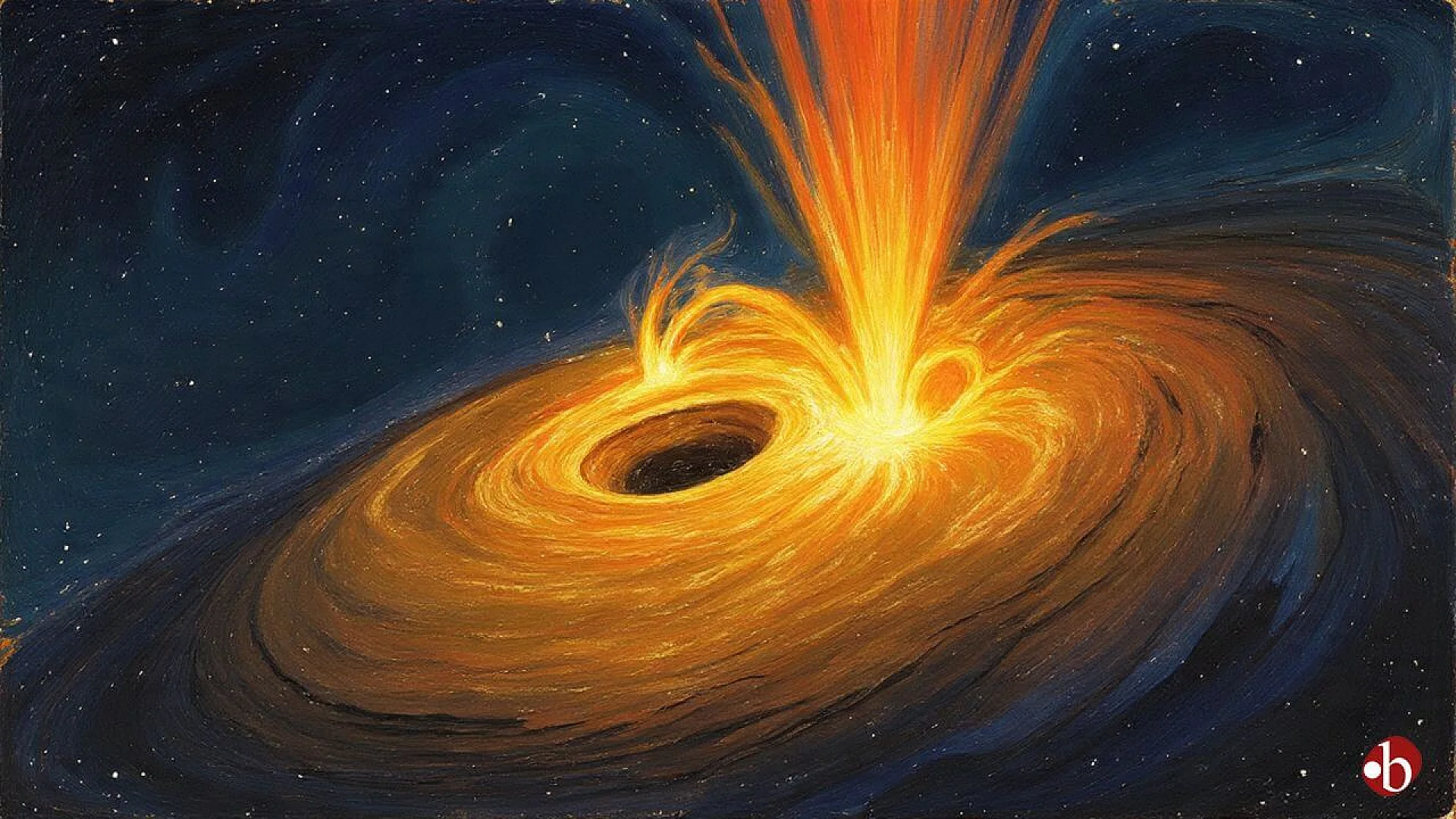
At the heart of the distant galaxy NGC 3783, astronomers have caught a supermassive black hole performing something spectacular. Instead of pulling matter only inward, this cosmic giant briefly blasted material outward at nearly one fifth the speed of light, roughly sixty thousand kilometers per second.
This violent episode was linked to a powerful flare in soft X rays, a sudden rise in high energy light. For the first time, scientists could clearly connect a bright flare from a black hole to an ultrafast wind racing out of its surroundings. That connection is important because it helps reveal how black holes can influence entire galaxies.
How Can Black Hole “Blow” Instead Only “Suck
The Lives Of Supermassive Black Holes
Supermassive black holes in centers of many, including our own Milky Way They can be millions to billions of times more than Sun. In galaxies, gas and dust toward black hole and form a hot, disk. This swirling material produces intense radiation radio waves up to X rays. NG 3783 a type of active galaxy known as a Seyfert galaxy Its central black hole regularly feeds on gas lighting its core. during the new observations, astronomers saw more than just feeding. They the black hole environment suddenlyel material outward at extreme speeds.
The Mystery Black Hole “Feedback”
Astrophysicists know that the mass of a galaxy’s central black hole is closely linked to the properties of the galaxy itself. This tight connection suggests constant communication between the two. The main suspect behind this connection is a process called feedback.
- The black hole shines brightly as gas falls inward.
- Part of the energy released heats or pushes away surrounding gas.
- This can either:
- strip a galaxy of star forming gas, or
- stir and heat the gas so that star formation slows down.
For years, astronomers have seen fast winds coming from around black holes. But it has been difficult to catch them in the act and show exactly when and how they are launched. The new results from NGC 3783 finally connect a specific flare event to a powerful outward flow.
A Ten Day Stakeout Of A Distant Galaxy
Watching A Black Hole Real Time
To capture such a fleeting event, researchers organized a ten day observing campaign focused on NGC 3783. They followed the black hole continuously using an mission called XRISM together with several other space and ground based observatories.
This strategy gave them two big advantages:
- High resolution X ray spectroscopy
- XRISM can split X ray light into very fine color slices.
- Tiny shifts in these slices show how fast gas is moving.
- Continuous monitoring
- Looking at the galaxy over many days makes it possible to catch rapid changes.
- Sudden brightening or dimming can be matched to changes in the gas around the hole.
The main goal was to hunt for ultrafast outflows that might switch on and off when the black hole brightens or fades.
The Critical Moment: A Soft X Ray Flare
A Sudden Flash In High Energy Light
During the campaign, the black hole in NGC 3783 went through a dramatic event. Its soft X ray emission suddenly climbed, creating a flare. In simple terms, the region close to the black hole suddenly became much brighter in relatively low energy X rays.
This flare marked a change in the environment near the black hole. As the flare rose and then started to decline, XRISM detected a subtle but powerful signal in the X ray spectrum. Rather than just seeing light from hot gas, the team saw signatures of gas absorbing some of that light.
Those absorption fingerprints revealed something remarkable.
A Wind Racing Out At 57,000 Kilometers Per Second
The absorption lines were shifted in a way that showed the gas was moving rapidly away from the black hole along our line of sight. The measured velocity was about 57,000 kilometers per second, close to 20 percent of the speed of light.
Key features of this outflow:
- Ultra fast speed
- Far beyond typical stellar winds.
- High enough that the material can escape from the black hole’s immediate surroundings.
- Timing with the flare
- The wind was seen during the decay phase of the soft X ray flare.
- This temporal link strongly suggests that the same physical event that triggered the also launched the wind.
- High kinetic energy
- The moving gas carries a large amount of energy outward.
- On large scales, that energy can influence the gas content of entire galaxy
This is a clear example black feedback caught at the moment it is switched.
What Is Powering This Ultrafast Wind?
Magnetic Reconnection Near A Black Hole
The most likely engine behind this outflow involves magnetic fields. The gas swirling around the black hole carries tangled magnetic field lines. Under the right conditions these lines can suddenly snap and reconnect, releasing intense bursts of energy.
This process, called magnetic reconnection, is known from:
- Solar flares in our own Sun.
- Magnetic storms in Earth’s magnetosphere.
In NGC 3783, something similar appears to be happening much closer to a supermassive black hole. Magnetic reconnection near the inner regions of the accretion disk can:
- Heat the surrounding plasma, leading to bright X ray flare.
- Fling gas outward at extreme speeds, driving an ultrafast wind.
The nearly simultaneous and out match this picture. Both are signs magnetic energy being rapidly converted into heat and motion.
Why This Black Hole Wind Matters For Galaxies
Shaping Star Formation
On human scales, the region near the black is tiny. On galactic scales, however, the and in these winds can have dramatic long term effects.
- Heating galactic gas
- High speed winds slam into gas clouds spread through the.
- Shocks and turbulence can heat the gas, making it harder for it to cool and collapse new stars.
- Removing fuel for stars
- The wind can drive gas out of the central region.
- With less cold gas available, star formation slows or even stops.
- Creating “red and dead” galaxies
- Galaxies without fresh star formation gradually lose their young, blue stars.
- They become dominated by older, redder stars, and appear “red dead” in astronomical surveys.
By showing that ultrafast winds can switch on during X ray flares, the NGC 3783 observations support the idea that black hole episodes can regulate when and where stars form.
A Key Piece In The Galactic Ecosystem
Galaxies are not just collections of stars. They are complex ecosystems where:
- Black holes feed on gas.
- That feeding triggers outflows.
- Those outflows reshape the supply and future star formation.
The new observations reveal a live example of this chain action. A flare close to the black hole launches a wind that may eventually influence structures tens of thousands of light years away.
What This Discovery Adds To Astrophysics
Linking Flares To Feedback
Before this work, many active galaxies had shown fast winds in X ray spectra. But it was not clear how closely those winds were tied to short lived changes in the black hole’s brightness.
The NGC 3783 campaign provides:
- A well timed observation of a soft X ray flare.
- A clear detection of an ultrafast outflow linked to that flare.
- Evidence that the kinetic energy in the wind is high enough to contribute to long term feedback.
This strengthens the idea that episodes of magnetic reconnection can be major drivers of feedback in active galaxies.
A Template For Future Studies
The study also offers a blueprint for how to catch similar events elsewhere:
- Pick an active galaxy with a bright, variable central source.
- Watch it over many days with high resolution X ray instruments.
- Look for changes in both brightness and spectral features at the time.
Repeating such campaigns across many galaxies will help astronomers:
- Measure how often these ultrafast outflows.
- Estimate the total energy they inject into their host galaxies.
- Understand the full role of black holes in cosmic evolution.
Limits Of What We So Far
Snapshot Of A Complex Process
As impressive as the results are, they come from just ten days of data on a single galaxy. This limited window means:
- We do not know how frequently such flares and winds occur in NGC 3783.
- We cannot yet say typical this behavior is for other active galaxies.
- We do not fully understand how long each episode of ultrafast outflow lasts.
To move beyond a snapshot, astronomers will need:
- Longer monitoring of NGC 3783 over months or years.
- Similar campaigns on many other active galactic nuclei.
- Detailed models that connect magnetic reconnection, flares and winds.
Even with these uncertainties, the detection itself is firm and highly informative. It anchors theoretical models real, time resolved data.
A New Window On How Black Holes Sculpt The Cosmos
The ultrafast wind in GC 3783 offers a rare glimpse of supermassive black hole in the act of its host galaxy. A briefening soft X rays, likely powered by magnetic reconnection, not just light up the region near the event horizon. It also hurled gas outward at a speed that defies everyday intuition.
Over millions of years, repeated events like this could gradually heat, stir and strip away the that fuels star birth. The result is a direct line from the physics of hot plasma few light hours from a black hole to the long term fate of galaxies.
As next generation X ray missions and multi observatory campaigns come online, more such events will be captured in detail. Each one will help refine our picture of how black holes, rather than being mere cosmic vacuum cleaners, act as powerful engines that drive life cycles of galaxies across the universe.
The research was published in Astronomy & Astrophysics on December 09, 2025.
This article has been fact checked for accuracy, with information verified against reputable sources. Learn more about us and our editorial process.
Last reviewed on .
Article history
- Latest version
- Last updated by Dayyal Dungrela, MLT, BSc, BS
- Peer reviewed by Dr. Arjun Patel, PhD
Reference(s)
- Gu, Liyi., et al. “Delving into the depths of NGC 3783 with XRISM.” Astronomy & Astrophysics, vol. 704, 09 December 2025, doi: 10.1051/0004-6361/202557189. <https://www.aanda.org/articles/aa/full_html/2025/12/aa57189-25/aa57189-25.html>.
Cite this page:
- Posted by Aisha Ahmed