NASA Captures Lightning Flashing Across Mars for the First Time
Perseverance detected tiny electrical bursts in Martian dust storms, revealing new atmospheric processes and reshaping how scientists view Mars.
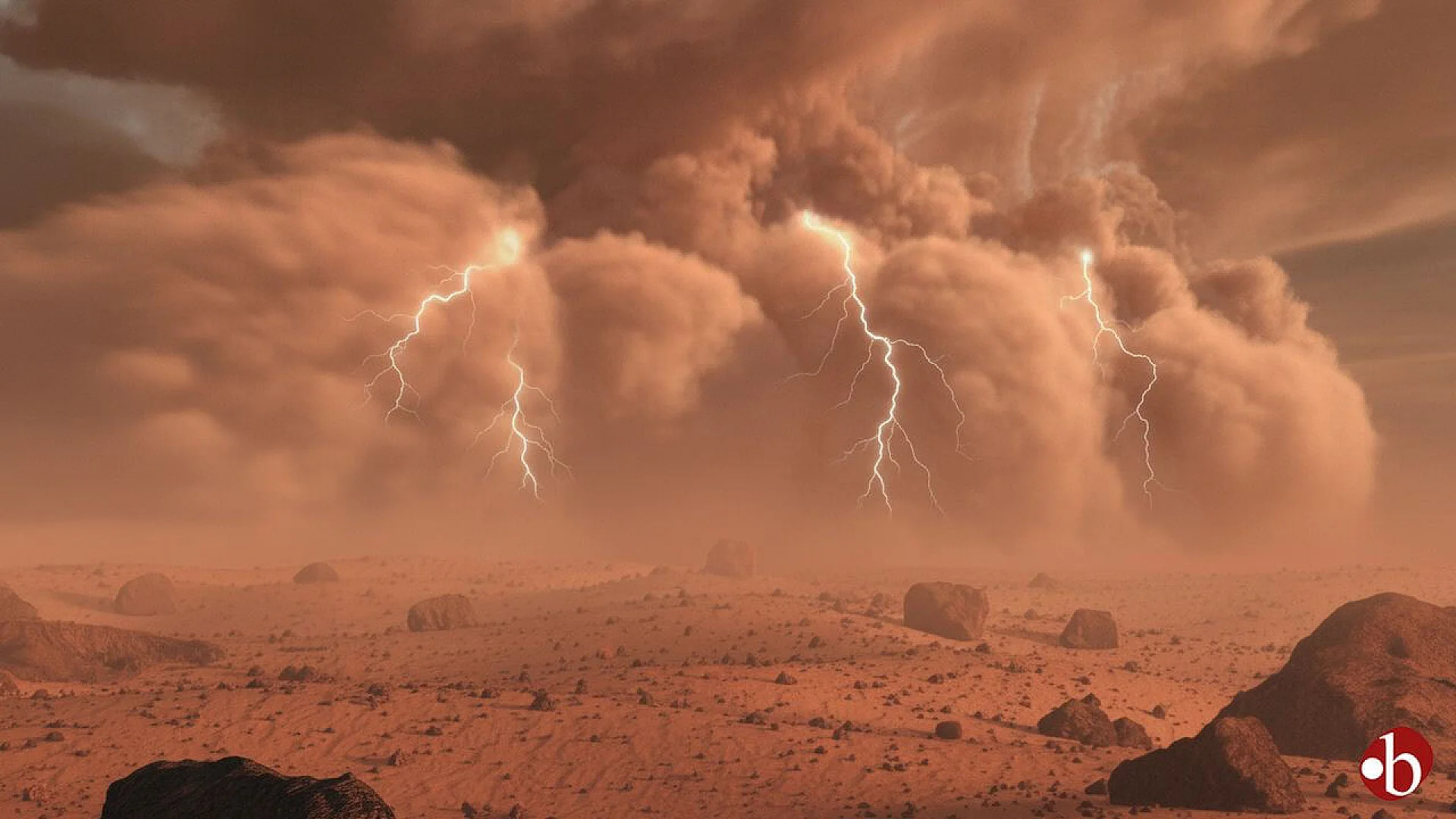
For decades, scientists suspected that the dry and dusty environment of Mars could produce electrical activity similar to what occurs in volcanic ash plumes or desert sandstorms on Earth. This belief was based on laboratory studies and theoretical models, but no mission had ever captured an actual discharge occurring on the planet. Now, with microphone data collected over two Martian years, the Perseverance rover has revealed that the Red Planet is not as electrically silent as previously assumed. Instead, it experiences brief electrical bursts whenever strong winds and dense dust interact near the surface. These findings reshape current assumptions about Martian weather and demonstrate that even a thin atmosphere can support significant electrostatic activity under the right conditions.
The Scientific Question Behind the Study
The central question driving this research was whether the Martian lower atmosphere contains the necessary particle interactions to support electrical charging and discharging. On Earth, electrical energy in the atmosphere forms through interactions between ice crystals, water droplets, and rising air masses. However, Mars lacks these typical terrestrial ingredients. Instead, its surface is dominated by fine dust that is easily lifted by strong winds. The possibility that grain-to-grain collisions could mimic some aspects of terrestrial charging processes had been debated for years, but without direct in situ recordings, the true behavior of Martian dust remained uncertain. Scientists needed concrete evidence to confirm whether dust storms on Mars can accumulate and release electrical energy in a measurable way.
How Perseverance Captured the Sounds of Martian Electricity
Perseverance carries an advanced remote sensing suite known as SuperCam. This instrument includes a highly sensitive microphone that usually records environmental sounds, wind activity, and acoustic responses from laser-induced rock sampling. However, the microphone also has the unique ability to detect short electrical disturbances. When an electrical discharge occurs, it produces a brief electromagnetic pulse that couples into the microphone’s electronics. This pulse is followed by a short acoustic relaxation lasting a few milliseconds. In rare cases, it generates a tiny pressure wave that can be recorded as a faint sonic click.
The research team searched through 28 hours of SuperCam recordings collected over two Martian years. Their analysis identified 55 events that matched the combined electromagnetic and acoustic pattern expected from electrical discharges. Seven of these events included the full acoustic signature, which provided the strongest confirmation that the recorded signals were not instrument noise but real atmospheric phenomena. Laboratory experiments using a SuperCam replica reproduced the same waveform shapes, reinforcing the interpretation that Perseverance had captured true electrical activity.
What Perseverance Detected: Dozens of Discharges Hidden in the Dust
The recorded events occurred almost entirely during periods of intense wind and elevated dust concentration. More than half were linked with the leading edges of dust storms, and 16 were detected during encounters with dust devils. These swirling columns of air are common on Mars and have long been suspected to host significant charge separation.
Most of the discharges released extremely small amounts of energy, often less than a few hundred nanojoules. Although these values are minuscule compared with terrestrial lightning, their importance lies not in their magnitude but in the fact that they demonstrate that Mars does generate atmospheric electrical activity. One of the stronger events released about 40 millijoules of energy, a level inconsistent with atmospheric discharges alone and likely caused by static build-up on the rover exterior discharging into the surrounding environment. This observation highlights the role of static electricity in dust-rich settings and underscores the need to understand such interactions for future exploration systems.
Why Dust and Wind Make This Possible on Mars
Dust grains on Mars become electrified when they collide and rub against each other, a process known as triboelectric charging. As winds accelerate and lift dust into turbulent flows, grains of different sizes and mineral compositions exchange charges. Over time, this leads to areas of positive and negative charge separation. When the electric field grows strong enough, the energy discharges into the surrounding air.
The thin Martian atmosphere makes long electrical arcs impossible, because the low pressure inhibits electron mobility. However, close to the surface, where pressure is slightly higher and dust concentration is greatest, small discharges can still occur. The Perseverance data confirm that localized bursts can develop whenever dust loading is high and wind speeds reach values within the upper third of the rover’s recorded history. This makes dust storms and dust devils ideal environments for small-scale atmospheric electricity.
Why This Discovery Matters for Science and Exploration
Although each electrical burst is small, the implications of this discovery are significant because they influence atmospheric chemistry, environmental safety, and future mission design.
New insights into Martian atmospheric chemistry
Electrical discharges produce reactive chemical species, including nitrogen oxides and other oxidants. These molecules can participate in chemical pathways that are not easily triggered under typical Martian conditions. Even small discharges can alter local chemistry, especially near the surface. Understanding this process will help refine models of the Martian atmosphere and its long-term evolution.
Engineering considerations for future missions
Static discharge is a known hazard for electronics and instrumentation. Even small events can create electromagnetic interference or damage sensitive components over time. Missions planning for long-term operations on Mars, including sample return systems and human habitats, need accurate data to implement grounding and shielding strategies. The new measurements provide mission designers with real-world values that can be used to model electrostatic risks.
Astrobiological relevance
Electrical energy has long been considered a potential driver of prebiotic chemistry. Although the observed Martian discharges are far weaker than terrestrial lightning, they still supply localized bursts of energy that might influence surface or atmospheric chemistry. This does not indicate the presence of life, but it contributes to a broader understanding of the environmental factors that could support or inhibit chemical complexity on Mars.
Limitations of the Study
Like many major discoveries, this work comes with important limitations.
First, the observed discharges are extremely small. Their global impact on atmospheric chemistry may be limited compared with larger-scale processes. Detailed modeling will be required to quantify their broader influence.
Second, the findings come from a single rover at a single location. Mars is a planet with diverse terrain and variable dust conditions. Measurements from other sites will be needed to determine whether electrical activity is uniform across the planet.
Third, the absence of direct electric field sensors on Perseverance means that researchers relied on indirect signals. Although laboratory replication strengthens the results, future missions equipped with specialized sensors would offer more definitive confirmation.
The Future of Martian Atmospheric Research
This discovery sets the stage for more advanced investigations into Martian dust physics. Scientists aim to develop new atmospheric models that incorporate electrical phenomena, design instruments capable of measuring electric fields directly on Mars, and compare findings with data from other regions. Understanding how dust movement interacts with electrical charge will be essential for the success of upcoming exploration missions, including those involving human presence.
A Final Perspective
The detection of electrical discharges on Mars marks a significant step in understanding the planet’s dynamic environment. Although the bursts are small and silent to human ears, they reveal that the Red Planet is more active than previously believed. Dust storms and swirling dust devils are not just atmospheric spectacles but also sites of electrical processes that influence chemistry, engineering safety, and planetary science. As Perseverance continues its mission, each new recording deepens our understanding of a world that still holds many surprises beneath its thin sky and dusty horizon.
The finding was published in Nature on November 26, 2025.
This article has been fact checked for accuracy, with information verified against reputable sources. Learn more about us and our editorial process.
Last reviewed on .
Article history
- Latest version
- Last updated by Dayyal Dungrela, MLT, BSc, BS
- Peer reviewed by Dr. Arjun Patel, PhD
Reference(s)
- Chide, Baptiste., et al. “Detection of triboelectric discharges during dust events on Mars.” Nature, vol. 647, no. 8091, 26 November 2025, pp. 865-869. Nature Publishing Group UK, doi: 10.1038/s41586-025-09736-y. <https://www.nature.com/articles/s41586-025-09736-y>.
Cite this page:
- Posted by Aisha Ahmed
- Astrobiology
- Dust Devils Mars
- Dust Storms Mars
- Electrical Discharges Mars
- First Mars Lightning
- Lightning On Mars
- Mars
- Mars Atmosphere
- Mars Discovery
- Mars Research
- Mars Science
- Martian Environment
- Martian Lightning
- Martian Weather
- NASA
- Perseverance Rover
- Planetary Science
- Red Planet
- Space Exploration
- Space Science
- Supercam