James Webb May Have Finally Solved the ‘Little Red Dots’ Mystery
These puzzling, crimson specks in the early universe appeared to hold impossibly large black holes. New research suggests they are actually young giants swaddled in dense, light-scattering cocoons that have misled astronomers for years.
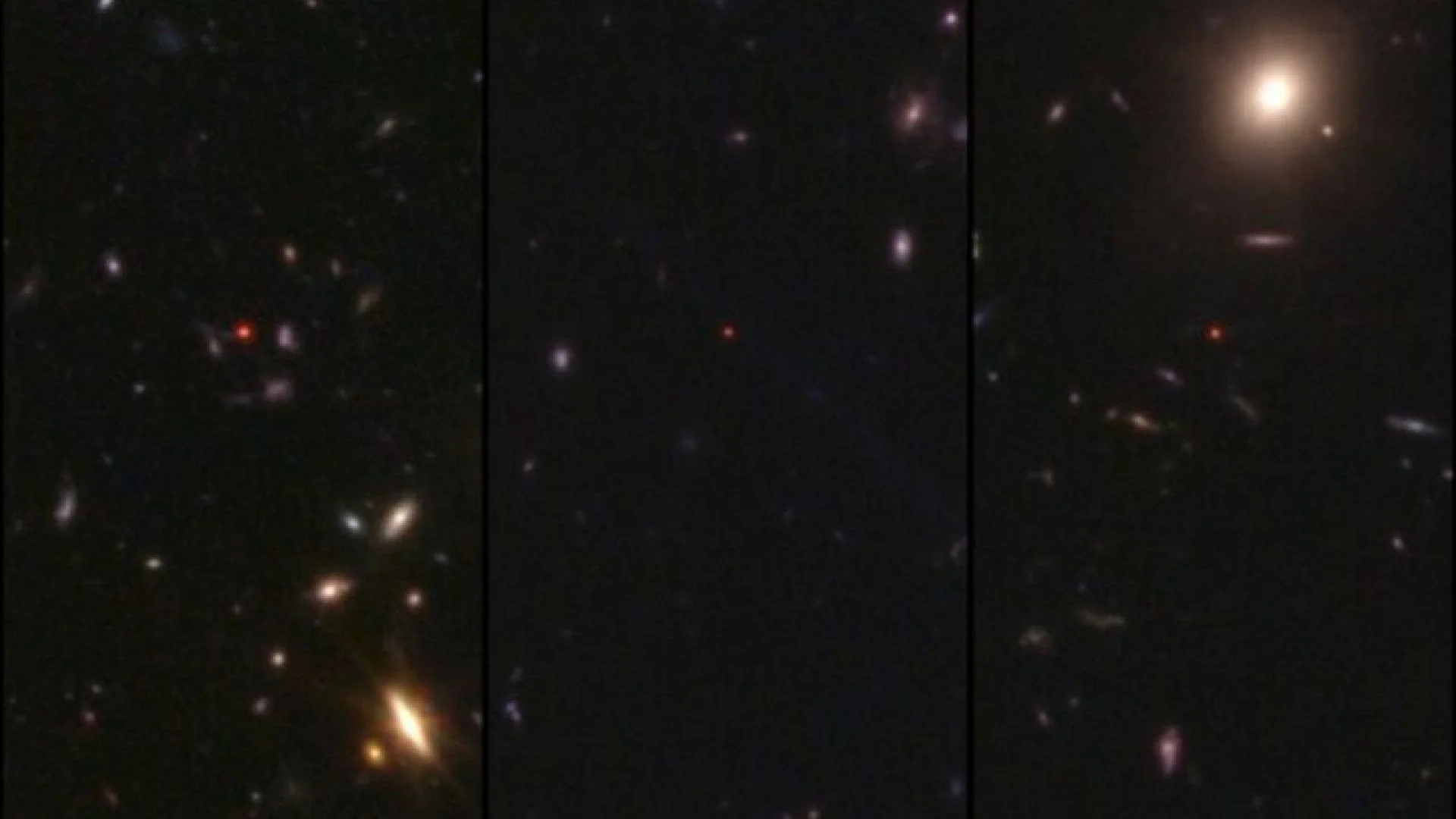
When the James Webb Space Telescope (JWST) first began peeling back the layers of the early universe, astronomers expected to see the faint, orderly assembly of the first galaxies. Instead, they found a cosmic riddle. Scattered across the deep field images were tiny, intensely red pinpricks of light that looked like nothing seen before.
These objects, quickly nicknamed “Little Red Dots” (LRDs) due to their compact size and distinct crimson hue, have spent the last two years challenging the foundations of astrophysics. At first glance, they appeared to be home to supermassive black holes that were “overmassive,” containing far more mass than should be possible given the small size of their host galaxies. Even more confusingly, these purported giants were strangely quiet, emitting almost no X-rays or radio waves, which are usually the telltale “shouts” of a feeding black hole.
For a while, scientists were at a crossroads. Were these black holes truly an impossible new species of cosmic monster, or was the light itself playing a trick on our instruments? A new study led by V. Rusakov and an international team of researchers suggests that the latter is true. The “Little Red Dots” aren’t impossible giants at all; they are baby black holes hiding inside dense, foggy cocoons of gas that make them look much more formidable than they actually are.
The Paradox of the Overmassive Black Hole
To understand why these red dots were so troubling, one must look at how astronomers measure black hole mass from billions of light-years away. Since we cannot see a black hole directly, we look at the gas orbiting it. As gas spirals into the abyss, it heats up and moves at incredible speeds. This motion causes the light emitted by the gas (specifically hydrogen and helium) to smear out, a phenomenon known as Doppler broadening.
In the case of the Little Red Dots, the spectral lines were incredibly wide. If you assume that width is caused solely by gravity and motion, the resulting mass calculations are staggering. Some of these black holes appeared to be as heavy as their entire host galaxies. In the local universe, a black hole usually accounts for only about 0.1 percent of its galaxy’s mass. Finding black holes that were essentially “all head and no body” suggested that black holes might have formed much faster than galaxies, upending our timeline of the early universe.
However, the lack of X-rays was a major red flag. A black hole that massive, actively feeding on gas (accreting), should be glowing brightly in high-energy X-rays. Yet, when telescopes like Chandra looked at these red dots, they found almost nothing. This led to a heated debate: were these actually black holes, or were they just clusters of extremely bright, red stars?
The Secret of the Ionized Cocoon
The team led by Rusakov decided to take a closer look at the shape of those smeared-out spectral lines. Using the high-resolution NIRSpec instrument on JWST, they noticed something that previous studies had missed. The broad lines didn’t have the typical “Gaussian” (bell-curve) shape expected from gas moving in an orbit. Instead, they had an “exponential” shape, characterized by long, straight-looking wings when plotted on a specific scale.
This specific shape is the smoking gun for a process called electron scattering. Instead of the light being spread out because the gas is moving fast, the light is being spread out because it is bouncing off a dense forest of electrons. Imagine a pinball machine where the ball (a photon of light) hits thousands of bumpers (electrons) before it finally escapes. Each collision slightly changes the energy and direction of the light, “broadening” the signal in a way that mimics the look of high-speed motion.
The researchers found that these Little Red Dots are surrounded by incredibly dense “cocoons” of ionized gas. These cocoons are so thick that the column density of electrons is roughly 10 to 100 times higher than what is found in a typical active galaxy.
Shrinking the Giants Down to Size
Once the team accounted for this scattering effect, they were able to “peel back” the distortion and find the true signal underneath. The results were transformative. The intrinsic width of the lines (the part actually caused by the black hole’s gravity) was roughly 10 times narrower than the total observed width.
This means the black holes are not nearly as heavy as we thought. The new estimates suggest they are roughly 100 times less massive than the original calculations indicated. Instead of being “overmassive” monsters, they are black holes with masses between 100,000 and 10 million times that of our Sun.
This discovery brings these objects back into the realm of known physics. They are no longer outliers that defy the scaling laws of galaxies; instead, they align perfectly with the relationship between black hole mass and galaxy mass observed in the modern universe. It turns out the “overmassive” black hole problem was largely an optical illusion created by the dense gas cocoon.
Why the X-Rays Went Missing
The cocoon model also solves the second half of the mystery: the missing X-rays. A dense, ionized shell of gas is an incredibly effective shield. The researchers found that the gas in the cocoon is “Compton-thick,” meaning it is dense enough to absorb or redirect most of the high-energy radiation coming from the center.
Specifically, the soft X-rays are almost entirely absorbed by the gas. Meanwhile, the hard X-rays (which are harder to stop) are likely suppressed by the nature of the black hole’s growth itself. Because these black holes are young and feeding at their absolute limit (the Eddington limit), they produce intense ultraviolet light that cools the area where X-rays are normally generated.
Between the dense gas shield and the high-speed feeding process, the X-rays are muffled to the point that they are nearly invisible to our current telescopes. This explains why astronomers were so confused: they were looking for a loud, bright monster, but they were actually looking at a noisy baby whose cries were being smothered by its thick, dusty nursery.
The Early Life of a Giant
The implications of this study go far beyond just fixing a math error. By identifying these objects as young, low-mass supermassive black holes, the researchers have effectively found a “missing link” in cosmic evolution.
We have long known that giant black holes exist in the centers of galaxies like our own Milky Way, but we haven’t been sure how they grew so fast in the early universe. These Little Red Dots appear to be black holes caught in their most frantic growth phase. They are buried in the very gas they are consuming, growing at the fastest rate physics allows.
The researchers describe these cocoons as a sign of “youth”. In older, more mature galaxies, the intense radiation and winds from the black hole eventually blow the gas away, clearing out the center of the galaxy and revealing the bright “quasar” underneath. But in these distant, red specks, we are seeing the process before that clearing has happened. We are seeing the “bulk growth” phase of the universe’s most massive objects.
Why Are They So Red?
The distinct crimson color of these objects, which gave them their name, is also explained by the cocoon. The light we see isn’t just coming from stars; a huge portion of it is “nebular emission”. This is light that has been absorbed by the gas cocoon and then re-emitted at different wavelengths.
Because the cocoon is so dense, it traps most of the blue and ultraviolet light, allowing only the longer, redder wavelengths to escape easily. This creates the characteristic “V-shaped” spectrum that has defined the LRD population. It isn’t that the stars in these galaxies are old and red; it is that the central engine is so shrouded in gas that the light is forced to redden as it fights its way out.
Limitations and Future Frontiers
While this study provides a cohesive explanation for many of the LRDs’ strange properties, it doesn’t solve every mystery. The researchers noted that a few objects in their sample still have complex features that don’t fit the simple cocoon model perfectly. For instance, some show evidence of outflows or asymmetric shapes that suggest a more chaotic environment than a simple spherical shell of gas.
There is also the question of how many of these objects exist. If most “Little Red Dots” are actually these shrouded baby black holes, it suggests that the early universe was teeming with young giants in the making.
The next step for astronomers will be to use JWST’s Mid-Infrared Instrument (MIRI) and upcoming observations from the Vera C. Rubin Observatory to see if they can catch these cocoons in the act of being blown away. By finding objects in different stages of “hatching” from their cocoons, scientists could map out the entire life cycle of a supermassive black hole from birth to maturity.
A Universe Full of Surprises
The story of the Little Red Dots is a classic example of how new technology doesn’t just give us answers (it often gives us more questions). JWST allowed us to see these objects for the first time, but it took a deeper dive into the physics of light to understand what we were actually looking at.
By moving away from the assumption that every wide spectral line is a sign of immense mass, and instead looking at how light interacts with its environment, astronomers have turned a cosmological crisis into a major breakthrough. We now know that the first black holes in the universe weren’t impossibly large; they were just incredibly messy eaters, hidden behind a veil of their own making.
This research reminds us that in the vastness of space, things are rarely what they seem at first glance. Sometimes, a tiny red dot isn’t a monster (it is just a giant in the making), waiting for its cocoon to clear so it can finally take its place at the center of a galaxy.
The research was published in Nature on January 14, 2026.
This article has been fact checked for accuracy, with information verified against reputable sources. Learn more about us and our editorial process.
Last reviewed on .
Article history
- Latest version
- Last updated by Dayyal Dungrela, MLT, BSc, BS
- Peer reviewed by Dr. Arjun Patel, PhD
Reference(s)
- Rusakov, V.., et al. “Little red dots as young supermassive black holes in dense ionized cocoons.” Nature, vol. 649, no. 8097, 14 January 2026, pp. 574-579., doi: 10.1038/s41586-025-09900-4. <https://www.nature.com/articles/s41586-025-09900-4>.
Reference(s)
nullCite this page:
- Posted by Aisha Ahmed