First Evidence That Colliding Black Holes Can Emit Light
A rare cosmic event hints that colliding black holes can produce light, but only under extreme conditions deep inside active galactic cores.
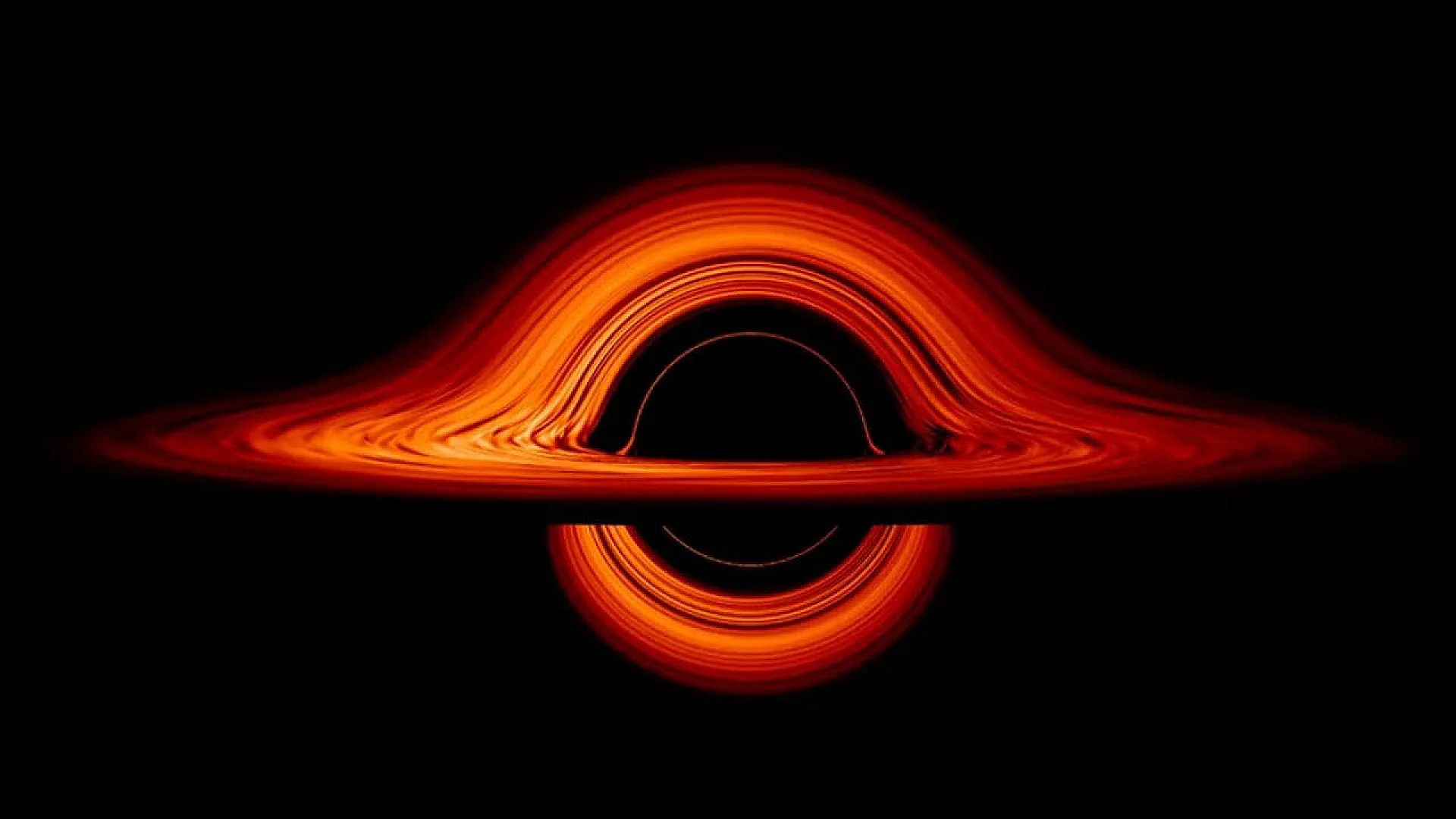
Black holes are defined by absence. They swallow light, trap matter, and conceal their most violent processes behind an invisible boundary known as the event horizon. For decades, astronomers have assumed that when two black holes collide, the universe offers no visual spectacle. The event unfolds silently, detectable only through ripples in spacetime.
Then, in November 2024, something unusual happened.
A gravitational wave signal swept across detectors on Earth, marking the merger of two black holes billions of light years away. Within seconds, telescopes recorded a burst of high-energy radiation from the same region of the sky. It was brief, intense, and unexpected.
The observation has now been analyzed in detail, and researchers suggest it may represent something never clearly confirmed before: a black hole merger that produced light.
A Signal That Should Not Exist
The event, cataloged as S241125n, began as many others have since the first detection of gravitational waves in 2015. Instruments from the global LIGO-Virgo-KAGRA collaboration registered a distinctive pattern, one that signals two black holes spiraling inward before merging into a single, more massive object.
These collisions are among the most energetic events in the universe. Yet despite their immense power, they are typically invisible. Unlike exploding stars or neutron star mergers, black holes do not emit radiation during their union.
But this time, something followed.
Roughly 11 seconds after the gravitational wave signal, multiple observatories detected X-rays and a gamma-ray burst from the same patch of sky. The probability of this being a coincidence, according to the researchers, is extremely low.
This raised an immediate question. If black hole mergers are dark, where did the light come from?
Searching for a Missing Ingredient
To solve the puzzle, scientists turned to a key principle. Black holes themselves do not shine, but the material around them often does.
When gas, dust, or debris falls toward a black hole, it forms an accretion disk. This swirling structure heats up due to friction and gravitational forces, reaching temperatures high enough to emit intense radiation. In some cases, powerful jets can also form, blasting matter outward at near-light speeds.
The presence of such material could provide a way to generate light during a merger. But most black hole collisions occur in relatively empty regions of space, far from any significant source of fuel.
So the researchers considered a different environment.
Inside a Crowded Galactic Core
At the center of many galaxies lies a supermassive black hole, millions or even billions of times more massive than the Sun. When actively feeding, these giants are surrounded by thick disks of gas and dust, known as active galactic nuclei.
These regions are chaotic. Stars, gas clouds, and even smaller black holes can become trapped in the disk, interacting in complex ways.
The research team proposed that the merging black holes in S241125n were embedded within such a disk. This scenario changes everything.
In a dense environment, a merger does not occur in isolation. Instead, the newly formed black hole is immediately surrounded by material that can be pulled in and heated, potentially producing a burst of light.
A Violent Kick and a Flash of Energy
The study goes further by examining what happens after the merger itself.
When two black holes collide, especially if they have unequal masses, the resulting object can receive a “natal kick.” This is a recoil caused by the uneven emission of gravitational waves, effectively launching the new black hole through space.
In an empty region, this motion would go largely unnoticed. But inside an accretion disk, it becomes dramatic.
Simulations show that a kicked black hole would plow through dense gas, rapidly accumulating material. This sudden accretion could ignite a short-lived but powerful burst of radiation, consistent with the observed gamma-ray signal.
The timing also fits. Since gravitational waves and light travel at the same speed, the delay suggests the light was produced shortly after the merger, not before.
Why the Signal Looked Different
The detected gamma-ray burst did not match the typical signatures associated with known cosmic explosions.
Most gamma-ray bursts originate from either collapsing massive stars or merging neutron stars. These events produce well-characterized patterns in both duration and energy distribution.
The signal linked to S241125n showed unusual features. It was shorter and exhibited characteristics that did not fully align with established categories.
This inconsistency initially made the event harder to classify. However, within the context of a black hole merger inside an accretion disk, the differences begin to make sense.
The mechanism is fundamentally different, driven not by stellar collapse or neutron star matter, but by rapid accretion triggered by motion through dense gas.
Testing the Hypothesis
Despite its appeal, the explanation remains provisional.
The distance involved, more than four billion light years, makes direct observation of the environment extremely challenging. Astronomers cannot yet confirm whether the merger truly occurred within an active galactic nucleus.
Instead, the hypothesis rests on indirect evidence and simulations. The alignment of gravitational waves and light, the timing of the signals, and the statistical improbability of coincidence all support the idea.
Future observations will be critical. Researchers suggest that identifying the host galaxy and studying its properties could help determine whether an active nucleus is present. Improved measurements of the black holes’ orbital characteristics may also provide clues.
Why This Matters
If confirmed, the discovery could shift how scientists interpret one of the universe’s most extreme phenomena.
Black hole mergers have been treated as purely gravitational events, observable only through spacetime distortions. The possibility that they can also produce light, under specific conditions, opens a new window for study.
This would allow astronomers to combine gravitational wave data with traditional electromagnetic observations. Such a multi-messenger approach can reveal far more detail than either method alone.
It also highlights the importance of environment. The same type of collision may look entirely different depending on where it occurs, whether in empty space or inside a dense galactic core.
A New Layer in Black Hole Physics
The findings contribute to a growing realization that black holes are not isolated actors. They exist within dynamic systems that can amplify or transform their behavior.
Active galactic nuclei, in particular, are emerging as potential hubs for complex interactions. The presence of gas, magnetic fields, and multiple compact objects creates conditions where unusual events may become possible.
The idea that smaller black holes can merge within these disks, and produce observable light, suggests that such environments could be more important than previously thought.
Looking Ahead
Astronomy is entering an era where gravitational wave detections are becoming routine. Hundreds of events have already been recorded, and more are expected as detector sensitivity improves.
Among these, rare cases like S241125n may stand out as opportunities to explore new physics.
Researchers are now watching for similar coincidences, where gravitational waves and electromagnetic signals arrive from the same region of the sky. Each new detection will help refine models and test whether this event was unique or part of a broader pattern.
For now, the observation remains a compelling possibility. A collision that should have been invisible may have briefly illuminated its surroundings, offering a glimpse into a hidden corner of the universe.
The research was published in The Astrophysical Journal Letters on February 09, 2026.
This content has been reviewed by subject-matter experts to ensure scientific accuracy. Learn more about us and our editorial process.
Last reviewed on .
Article history
- Latest version
Reference(s)
- Zhang, Shu-Rui., et al. “LVK S241125n: Massive Binary Black Hole Merger Produces Gamma Ray Burst in Active Galactic Nucleus Disk.” The Astrophysical Journal Letters, vol. 998, no. 1, 09 February 2026, doi: 10.3847/1538-4357/ae3319. <https://doi.org/10.3847/1538-4357/ae3319>.
Cite this page:
- Posted by Aisha Ahmed