Extreme Microbe Survives Mars-Like Impact Forces, Experiments Show
Laboratory tests show one of Earth’s toughest organisms can withstand pressures similar to asteroid ejection from Mars, reshaping debates about how life might travel between worlds.
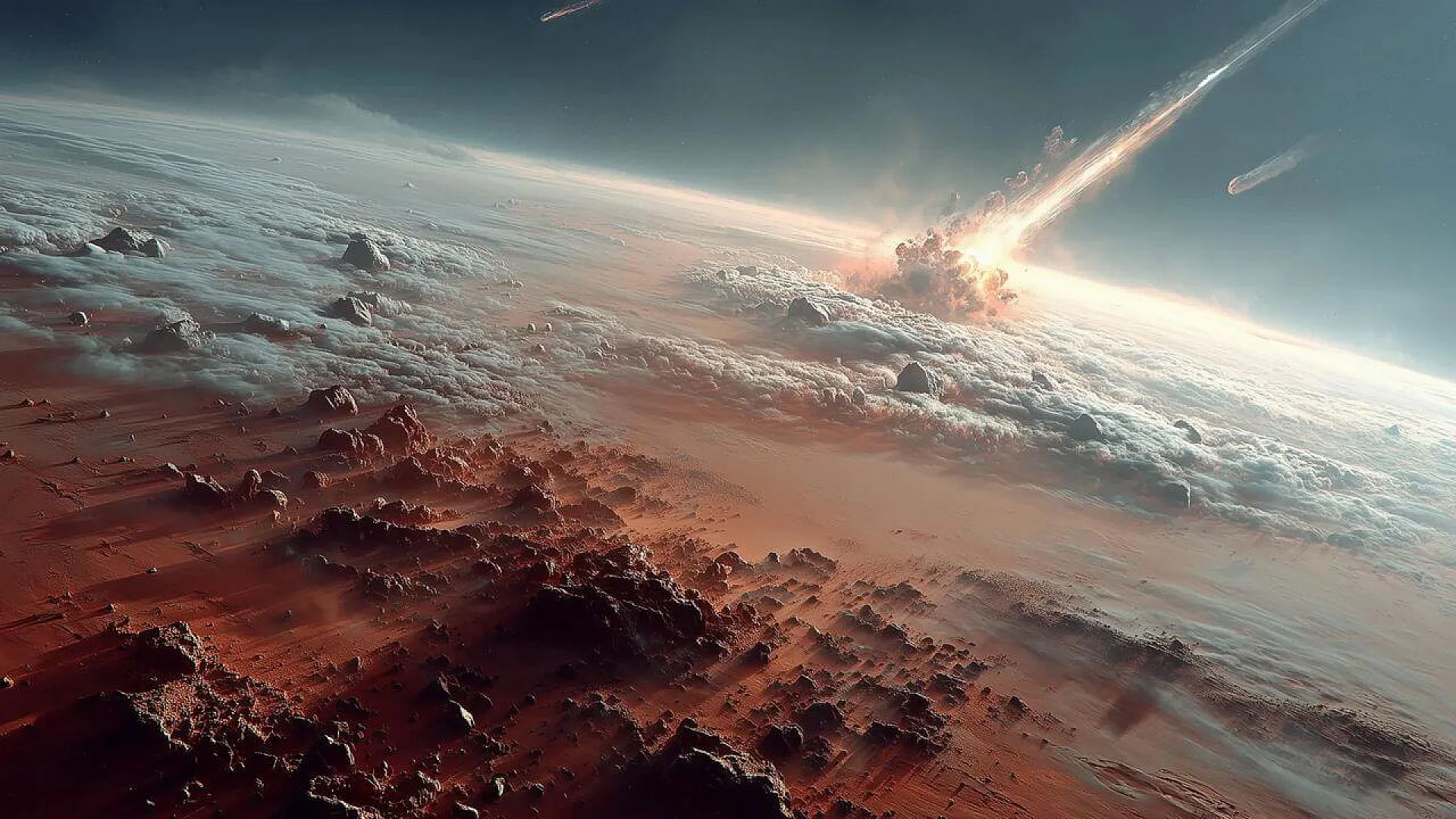
For centuries, scientists and philosophers have wondered whether life is confined to its birthplace, or whether it can travel between worlds.
The idea that organisms might hop from planet to planet inside shattered rock fragments, known as panspermia, has long occupied the fringes of scientific debate. It proposes that when asteroids strike a planet with enough force, debris can be launched into space, potentially carrying microscopic passengers. If those fragments later collide with another world, life might gain a foothold far from its origin.
Skeptics have often pointed to one brutal obstacle. The violence of impact itself.
Asteroid strikes generate immense shock pressures in fractions of a second. Rocks fracture. Temperatures spike. Materials experience extreme compression before being flung into space. Even if microbes could survive radiation, vacuum, and cold during the journey, could they possibly endure the explosive launch?
A new study suggests at least one organism can.
Researchers report that the remarkably resilient bacterium Deinococcus radiodurans can withstand transient shock pressures up to 3 gigapascals, levels comparable to those associated with impact-induced ejection from Mars. The findings were published in PNAS Nexus.
The results do not prove that life has traveled between planets. But they do strengthen the case that it could.
Recreating a Planetary Catapult
When a large asteroid strikes a planet such as Mars, the collision produces extreme pressures that propagate through the surrounding rock. In certain regions near the surface, fragments can be accelerated to speeds high enough to escape the planet’s gravity.
Previous modeling studies have suggested that ejecta from Mars could reach pressures ranging from roughly 1 to 5 gigapascals, depending on the impact conditions and location within the rock. These pressures last only microseconds, but they are intense.
The central question of the new research was deceptively simple. Can microbes survive such a violent, instantaneous shock?
To test this, the team selected Deinococcus radiodurans, widely regarded as one of the toughest known life forms. Sometimes described as a polyextremophile, it is famous for surviving extraordinary doses of radiation that would shred most organisms’ DNA beyond repair. It also tolerates dehydration, cold, vacuum, and acidic environments.
If any microbe had a chance of enduring an impact launch, this was it.
Using specialized high-pressure experimental equipment, the researchers subjected samples of the bacterium to rapid compression pulses designed to mimic the shock conditions of an asteroid strike. Pressures were increased stepwise, reaching as high as 3 gigapascals.
The goal was not only to determine whether cells remained alive, but also to understand what was happening inside them.
Survival Under Shock
The outcome surprised even the investigators.
At pressures where the team expected widespread cellular death, significant fractions of the bacterial population remained viable. As the shock intensity increased, signs of biological stress became more pronounced, yet survival persisted.
To probe the cells’ internal state, the researchers extracted and analyzed RNA from the impacted samples. RNA molecules act as intermediaries between genes and proteins, and changes in RNA expression can reveal how cells respond to stress.
The transcriptional analysis showed that as pressure rose, the bacterium activated stress-related pathways. This indicated that the cells were not unaffected. They were responding, mobilizing repair systems, and coping with the damage.
Still, many survived.
At the highest tested pressure of 3 gigapascals, viability remained measurable. The bacteria were not merely intact under a microscope. They were capable of growth afterward, indicating that critical cellular systems had endured the shock.
In fact, the experimental setup itself reached operational limits before all microbial survival was extinguished.
What Happens Inside a Shocked Cell
Beyond survival counts, the team sought structural evidence of damage.
Using transmission electron microscopy, they compared untreated control cells with those exposed to 1.4 and 2.4 gigapascals of pressure. At higher pressures, visible structural and morphological changes appeared. Cellular components showed signs of compression-related alteration.
Yet the overall integrity of many cells remained sufficient for recovery.
This distinction matters. A microbe does not need to emerge from impact unscathed. It only needs to retain enough functional capacity to repair itself afterward.
Deinococcus radiodurans is particularly adept at reconstructing fragmented DNA. Its genome is organized in ways that facilitate accurate repair after severe damage. This ability likely contributes to its resilience under shock, just as it does under radiation exposure.
The findings suggest that transient high pressure alone may not be the insurmountable barrier once assumed.
From Mars to Earth, or the Reverse?
The implications extend in two directions.
One concerns the possibility that life originated on Earth after arriving from elsewhere. Mars is often cited in this discussion because meteorites known to originate from Mars have been found on Earth. These rocks were ejected by ancient impacts and later crossed interplanetary space.
If microbes were embedded inside such rocks, shielded from ultraviolet radiation and cosmic rays, survival might be plausible.
The second implication runs the other way.
Space agencies operate under strict planetary protection protocols to avoid contaminating other worlds with terrestrial life. If hardy organisms can endure impact-level pressures, then accidental transport becomes a more tangible concern. Microbes clinging to spacecraft hardware might survive launch stresses, space travel, and even crash landings.
The new findings underscore the need for careful sterilization and monitoring practices, especially for missions targeting potentially habitable environments.
Why This Matters
The study refines our understanding of life’s physical limits.
For decades, researchers have mapped how organisms respond to extremes of temperature, radiation, salinity, and pressure. Each time a boundary is extended, it reshapes the conditions under which life might exist beyond Earth.
Impact ejection represents one of the most violent conceivable transitions between worlds. Demonstrating that at least one microbe can survive comparable pressures strengthens the scientific plausibility of interplanetary transfer.
It also reframes discussions about how life may have originated here.
While the research does not claim that panspermia occurred, it removes a major physical objection. Survival of launch shock is possible, at least under some conditions.
Important Caveats
As compelling as the results are, they come with limitations.
First, the experiments tested a single species under controlled laboratory conditions. Deinococcus radiodurans is exceptional. Most microbes are far less robust. The findings cannot be generalized to all life.
Second, surviving shock is only one step in a complex journey. After ejection, microbes would face prolonged exposure to space radiation, vacuum, temperature extremes, and eventual atmospheric entry on another planet. Each stage imposes additional stresses.
Third, the experiments simulated transient pressures but did not reproduce every aspect of a natural impact environment, such as simultaneous heating or complex rock-microbe interactions.
In real planetary collisions, outcomes would vary widely depending on impact angle, velocity, rock composition, and depth of microbial burial.
Nonetheless, the study addresses one of the most extreme components of the scenario and demonstrates that survival is not impossible.
Expanding the Boundaries of Astrobiology
Astrobiology seeks to answer one of humanity’s most profound questions. Is life a rare accident confined to a single planet, or is it a persistent phenomenon that spreads when conditions allow?
Each new discovery of microbial resilience complicates assumptions about fragility.
Deinococcus radiodurans has already reshaped thinking about radiation tolerance. Its ability to endure desiccation and vacuum exposure has informed studies of survival in space. Now, its resilience to impact-level pressures adds another piece to the puzzle.
The research suggests that the transfer of life between planets is physically feasible under at least some circumstances.
That does not confirm it happened. But it narrows the gap between theoretical possibility and biological reality.
A Universe Less Isolated Than We Thought?
Meteorites from Mars routinely arrive on Earth. Evidence shows that rocks can travel between planetary bodies within our Solar System. If microorganisms can endure the initial launch phase, the door to interplanetary migration stands slightly more open.
It is a reminder that planetary systems are not perfectly sealed compartments. Over billions of years, material exchange has likely been common.
Whether life rode along remains uncertain.
But in controlled laboratory conditions, at least one organism has demonstrated that the first hurdle, surviving the blast itself, may not be as prohibitive as once imagined.
In the ongoing effort to define life’s limits, that is a significant step.
The study was published in PNAS Nexus on March 03, 2026.
This content has been reviewed by subject-matter experts to ensure scientific accuracy. Learn more about us and our editorial process.
Last reviewed on .
Article history
- Latest version
Reference(s)
- Zhao, Lily., et al. “Extremophile survives the transient pressures associated with impact-induced ejection from Mars.”, vol. 5, no. 3, 03 March 2026, doi: 10.1093/pnasnexus/pgag018. <https://doi.org/10.1093/pnasnexus/pgag018>.
Cite this page:
- Posted by Elizabeth Taylor