Could Crater-First Nuclear Explosions Save Earth From Late-Discovered Asteroids
Scientists propose buried nuclear blasts that create craters to transfer energy, gradually nudging hazardous asteroids onto safer paths.

Scientists have modeled a worst‑case scenario in which a sizable near‑Earth asteroid is spotted only days before a close encounter, leaving little time for conventional mitigation measures.
Earlier planetary‑defense tests, such as NASA’s 2022 DART mission, showed that a kinetic impact can nudge the orbit of a small moonlet called Dimorphos. That experiment proved the principle that a modest change in velocity can shift an asteroid’s trajectory, but the target was a harmless fragment rather than a continent‑level threat.
The new analysis concentrates on objects larger than 140 meters, a size range capable of producing intercontinental or global damage. Researchers also highlighted the difficulty posed by bodies that remain hidden until shortly before a close approach. The asteroid 2024 MK, roughly 150 meters across, was discovered with only about 13 days of warning, according to the study.
Limitations of Straightforward Nuclear Detonations in Space
The research examined how a nuclear blast behaves in the vacuum of space and concluded that simply exploding a device near an asteroid does not guarantee optimal deflection. Without an atmosphere, a shock wave cannot propagate, so the effectiveness of the blast depends largely on how much explosive energy actually couples into the asteroid’s material.
The authors describe this as energy coupling – the fraction of the blast that translates into momentum transfer. A surface‑level explosion can vaporize and eject material, producing a recoil that pushes the body in the opposite direction.
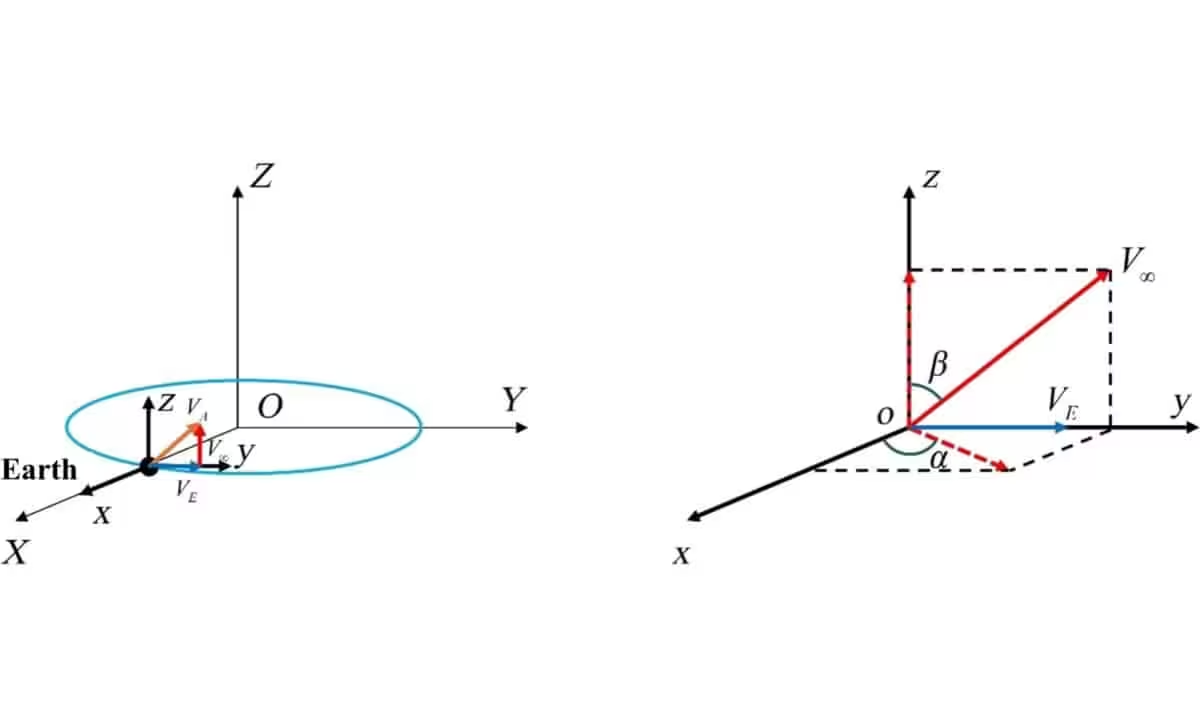
Researchers from the China Academy of Launch Vehicle Technology suggest a “direct‑impact” concept: a spacecraft would race toward the asteroid, strike it at high speed, and then trigger a nuclear device in the immediate vicinity of the impact point. This rapid‑response tactic could be viable when warning time is extremely limited, because it relies on speed and a relatively simple mission architecture.
However, the approach raises engineering hurdles. A high‑velocity impact would likely produce a shallow, irregular crater, demanding precise timing for the subsequent detonation. Moreover, the vehicle carrying the nuclear payload would have to endure debris generated by the initial collision.
Creating a Pre‑Drilled Cavity Before Detonation Boosts Efficiency
An alternative scenario explored in the study involves preparing the asteroid’s surface before the nuclear blast. Instead of an immediate explosion, a probe would first survey the body, then use conventional impactors to carve a deeper cavity.
After the crater is formed, the nuclear device would be positioned inside the pit and detonated. The goal is not to pulverize the asteroid, but to eject material in a controlled manner that nudges the trajectory away from Earth.
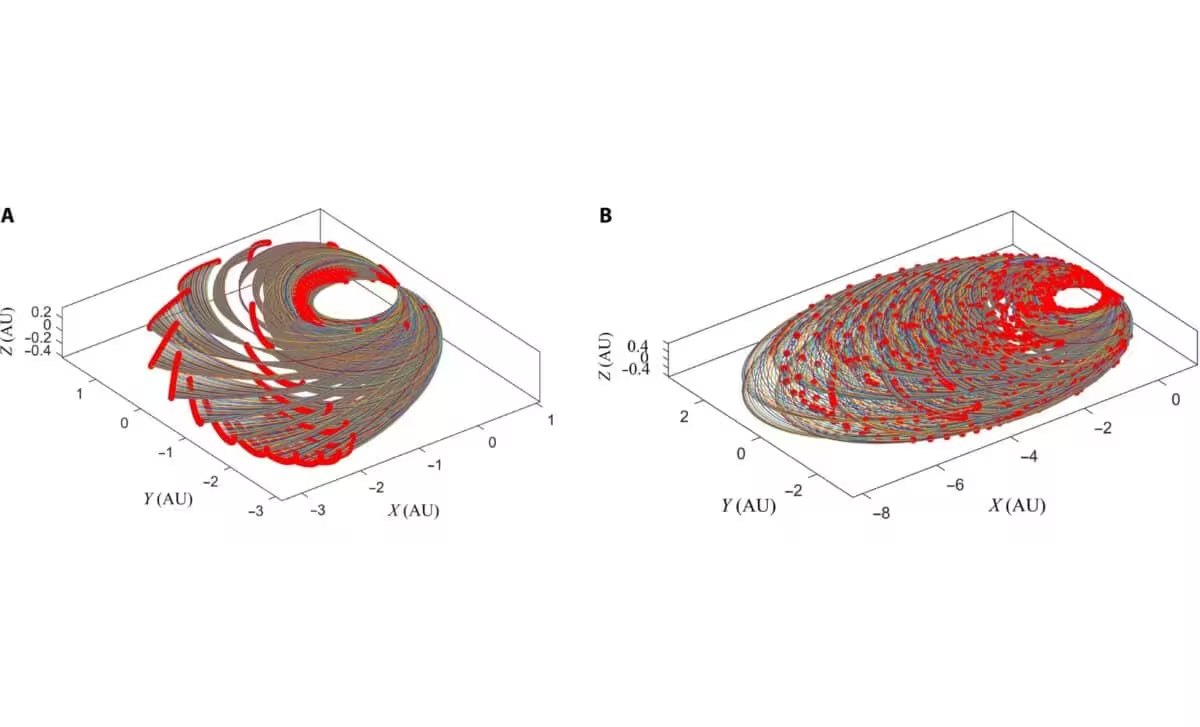
To evaluate the concept, the team built a virtual catalog of hazardous asteroids, simulated their possible orbits, and tested a range of interception tactics. Their models indicate that a spacecraft equipped with a transfer platform capable of delivering a 10 kilometer‑per‑second velocity increment could engage nearly every threat in the database.
Implementing this method would require a heavier launch vehicle and a dedicated space‑based transfer stage, but the extra preparation time would allow engineers to inspect the target, select an optimal excavation site, and configure the detonation environment.
Strategic Planning for Infrequent Yet Catastrophic Asteroid Encounters
The authors stress that the study does not advocate the immediate use of nuclear explosives against asteroids. Rather, it proposes a contingency option for scenarios where traditional deflection techniques are impractical due to a short warning interval.
Early detection remains the cornerstone of planetary defense, because modest trajectory adjustments applied years in advance can be highly effective. Techniques such as kinetic‑impact missions or gravitational‑tractor maneuvers rely on having sufficient lead time to alter an object’s path.
By expanding the portfolio of possible responses, scientists aim to address the evolving and incomplete picture of the near‑Earth asteroid population surrounding our planet. While a buried‑detonation strategy poses significant engineering challenges, the new analysis adds another viable tool for confronting large asteroids that are discovered too late for slower, more measured interventions.
This article has been fact checked for accuracy, with information verified against reputable sources. Learn more about us and our editorial process.
Last reviewed on .
Article history
- Latest version
Reference(s)
- “Most Potential City-Killer Asteroids Lurk Undiscovered Near Earth.” Forbes <https://www.forbes.com/sites/ericmack/2023/07/14/most-potential-city-killer-asteroids-lurk-undiscovered-near-earth/>.
- <https://en.wikipedia.org/wiki/2024_MK>.
- Wang, Xiaowei., et al. “Analysis of Defense Technology for Large-Sized Near-Earth Asteroids.” Space: Science & Technology, vol. 6, May 18, 2026 American Association for the Advancement of Science (AAAS), doi: 10.34133/space.0504. <https://spj.science.org/doi/10.34133/space.0504>.
Cite this page:
- Posted by Karan Das