Scientists Plan To Spray Chemicals Into Earth’s Magnetic Field To Shield Us From Solar Storms
New spacecraft could shield Earth by deploying an artificial plasma barrier in the magnetosphere against solar storms.
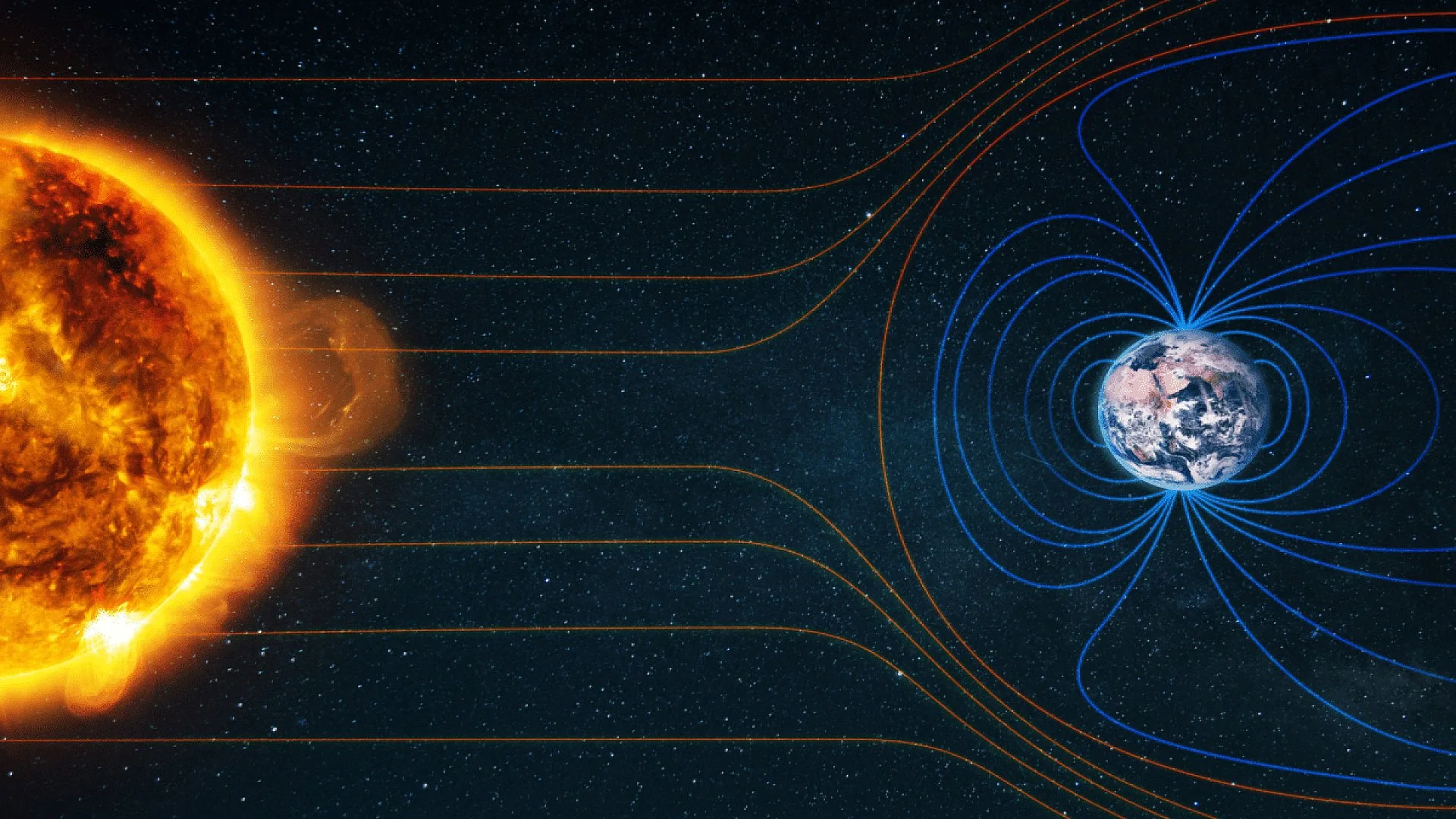
Researchers have unveiled a bold plan to boost Earth’s magnetic shield against intense solar eruptions by adding a man‑made plasma layer. The study, published in Space Weather, proposes launching a fleet of satellites that would disperse ionized compounds into near‑Earth space, forming a synthetic barrier designed to soften the blow of geomagnetic disturbances.
Building a “StormWall” Around the Planet
The Earth’s magnetosphere normally diverts the sun’s charged particles, but extreme events can overwhelm it, threatening satellites, GPS navigation, power grids and global communications. Until now, mitigation has relied on forecasting and operational precautions. Lead author Brian Walsh of Boston University argues that an active defense could be feasible.
“People have always thought, ‘space is huge, the sun is massive, we just have to sit here and take whatever it gives us,’” Walsh said in a statement. “But what we found is that we can impact it.”
The “StormWall” concept envisions six spacecraft positioned in geosynchronous orbit, each stocked with a “mass‑loading” substance such as barium, lithium, sodium or calcium. When a solar storm is detected, the payload would be vaporized; sunlight would instantly ionize the material, creating a cloud of plasma that drifts toward the sun‑facing edge of the magnetosphere.
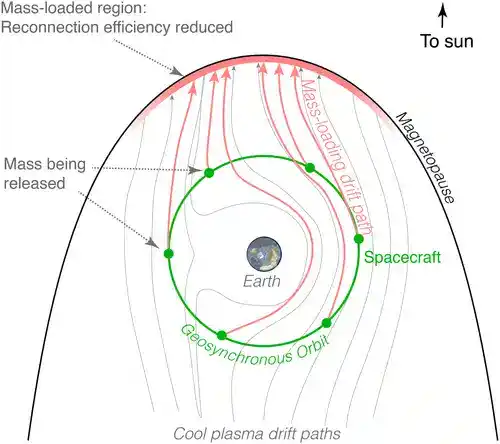
Credit: Space Weather
By thickening the magnetopause, the artificial plasma would interfere with magnetic reconnection—the process that normally opens a gateway for solar energy to pour into near‑Earth space. Walsh likens the approach to constructing a flood barrier for a village threatened by rising waters.
“It’s like people in a village who see a river flooding, maybe they can predict when that will happen, but probably what’s even better is if they could build a storm wall,” he said. “That’s what we’re proposing here.”
Modeling the Mother’s Day Superstorm
To gauge effectiveness, the team ran simulations of the May 2024 “Mother’s Day” geomagnetic storm, comparing a baseline run with one that included the engineered plasma shield. The model showed that while the wall would not eliminate a storm, it could cut peak intensity by more than half, potentially preserving satellite operations and terrestrial infrastructure.
“When you apply some really serious physics to it, it does work,” Walsh noted. “And the amount of mass we need, the launch capacities, it’s all within our capabilities.” The paper, available in Space Weather, stresses that the plasma cloud would dissipate after roughly six hours, so each storm would require a fresh deployment.
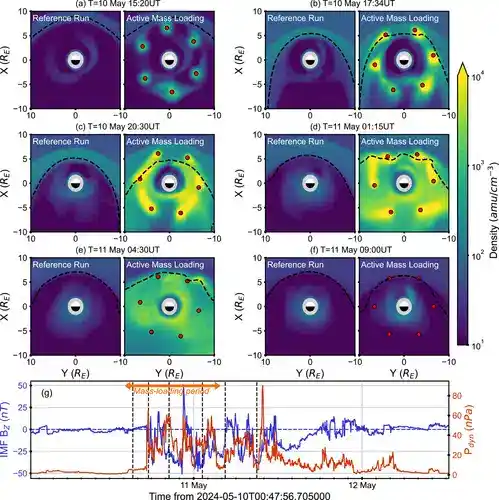
Credit: Space Weather
Implications for Global Space Safety
A key advantage of the StormWall design is its planet‑wide reach. Because the plasma shield encircles the entire magnetopause, every nation and commercial satellite operator would benefit from a single deployment. “If you built it, if it was deployed, it would help all people on the planet,” Walsh emphasized, noting that no single country could monopolize the protection.
As commercial launch activity accelerates, the economic case for a proactive planetary shield may strengthen. The researchers also point out that the ionized particles would be swiftly swept away by the solar wind, minimizing long‑term environmental concerns.
This article has been fact checked for accuracy, with information verified against reputable sources. Learn more about us and our editorial process.
Last reviewed on .
Article history
- Latest version
Reference(s)
- Walsh, B. M.., et al. “Terrestrial Space Weather Protection Through Human‐Produced Mass‐Loading.” Space Weather, vol. 24, no. 6, June 2, 2026 American Geophysical Union (AGU), doi: 10.1029/2025SW004846. <https://agupubs.onlinelibrary.wiley.com/doi/full/10.1029/2025SW004846>.
Cite this page:
- Posted by Karan Das