Giant Concentric Rings Discovered In Venus’ Upper Atmosphere Reveal Hidden Wave Activity
Giant ring-like structures spotted in Venus’s upper atmosphere reveal fresh insights into the planet’s complex dynamics.
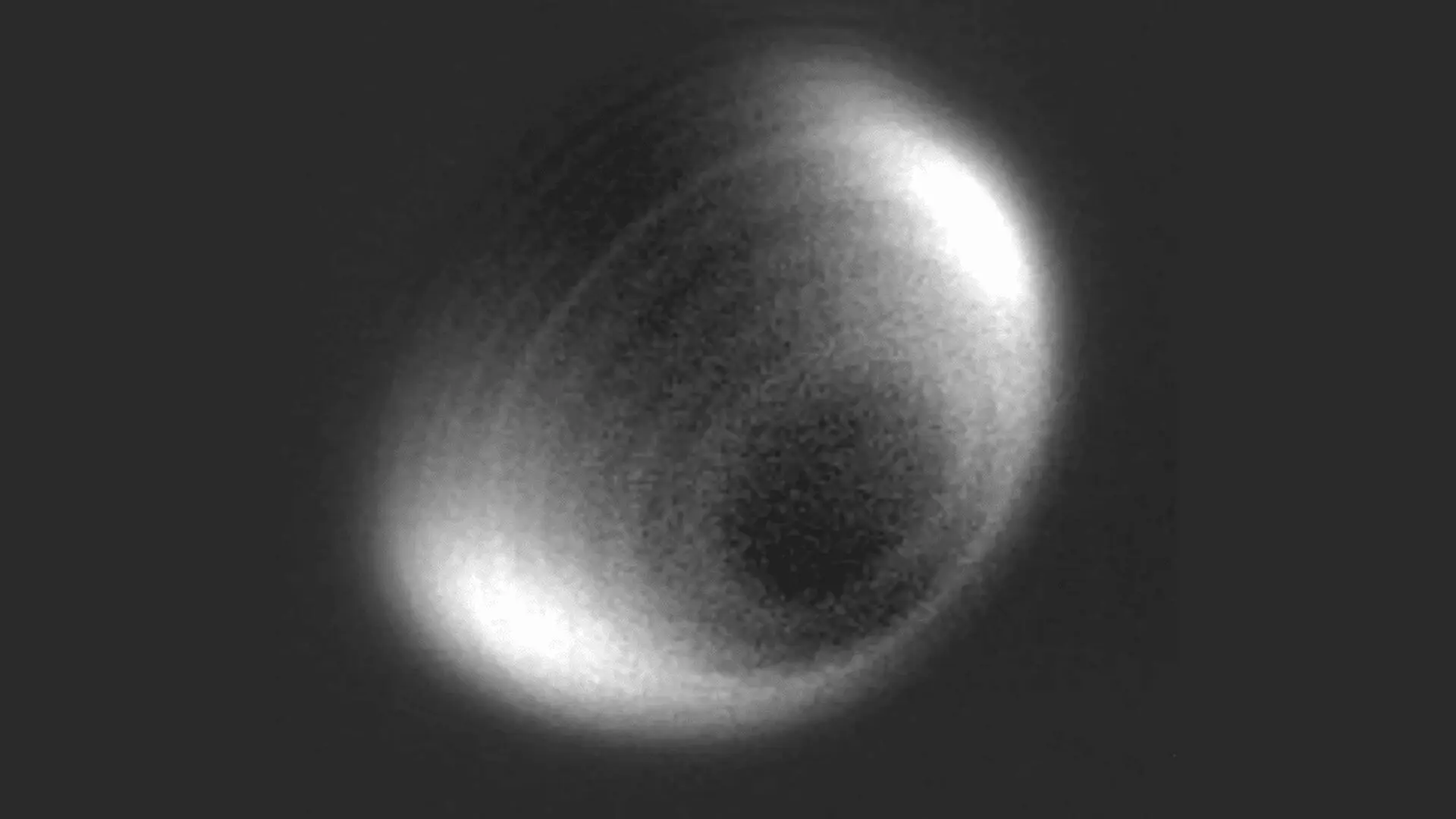
A team of planetary scientists has identified massive, concentric ring formations high above Venus, a finding that could reshape our understanding of atmospheric circulation and energy transfer on the planet. Reported in The Planetary Science Journal, the structures appear to be linked to large‑scale atmospheric waves rather than instrumental artifacts.
Unexpected Concentric Features Around Venus
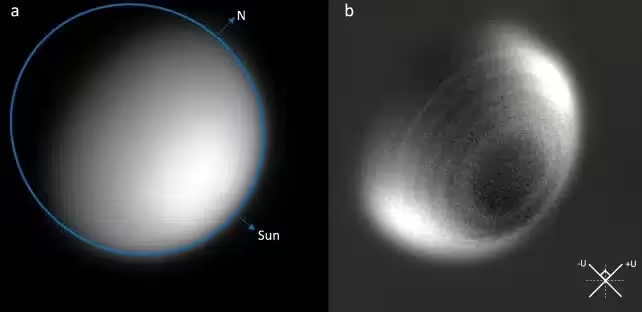
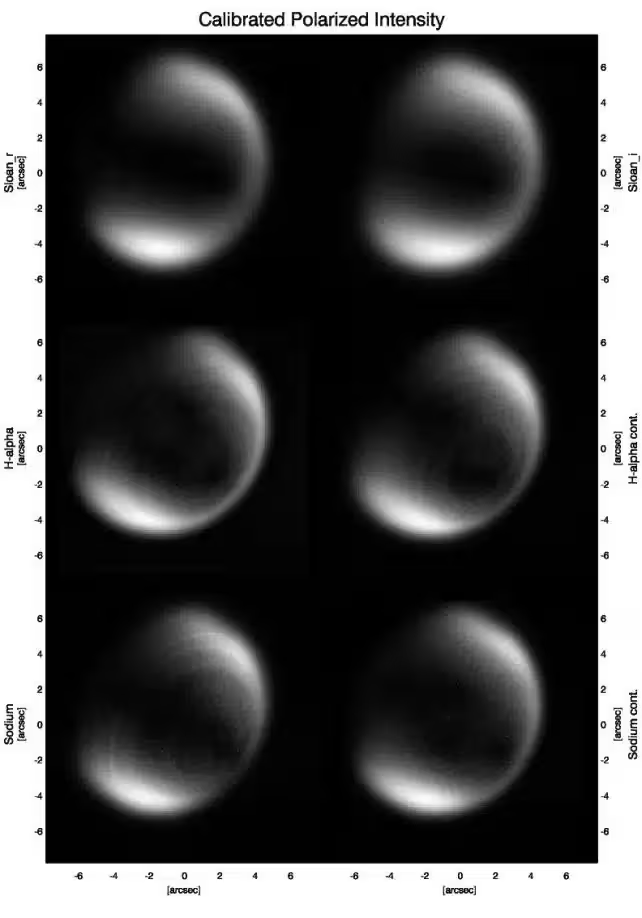
Analysis of Venus’ upper atmosphere revealed a series of expansive, ring‑like patterns encircling a bright region on the planet. The symmetry and scale of the formations differ from any previously recorded atmospheric phenomena on Venus.
Initially, the research team considered the possibility that the rings resulted from detector anomalies or data processing quirks, given their perfect alignment with the brightest observed area.
“The first thoughts were that they were due to an instrumental effect, especially because the rings seem to be concentric around the brightest area on the planet: They could be due to a digitization process in the detector or somehow smearing of the signal,” Mahapatra explained.
Further scrutiny, combined with existing knowledge of Venusian atmospheric dynamics, suggested that the rings might represent genuine physical structures generated by planet‑wide atmospheric processes.
Wave Activity as the Likely Driver
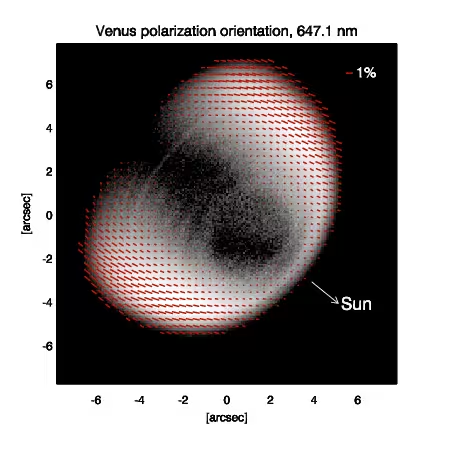
The study, published in The Planetary Science Journal, examines how atmospheric waves could organize material into the observed ring patterns, allowing coherent structures to persist across vast distances.
Venus possesses one of the Solar System’s most extreme atmospheres: scorching temperatures, a dense carbon‑dioxide envelope, and sulfuric‑acid clouds create a natural laboratory for planetary climate research.
The authors propose that upper‑atmospheric waves may be responsible for the newly detected rings, arranging gases into organized, observable features.
“If they are confirmed, I think the most important result would be evidence that large-scale wave activity can produce coherent density structures across enormous regions of Venus’s upper atmosphere,” Mahapatra said.
Rather than indicating an entirely new atmospheric mechanism, the rings may provide a novel observational window onto processes that spacecraft data and models have long hinted at.
“We regard our observations not as evidence for a completely unknown kind of atmospheric physics, but potentially as a new way of observing atmospheric dynamics that we already have tantalizing evidence for from spacecraft measurements,” Mahapatra said.
Clues to the Mystery of Superrotation
Venus’ atmospheric superrotation—where cloud layers circle the planet far faster than the solid body—remains a central puzzle in planetary science. The newly identified rings could shed light on how energy propagates through the atmosphere, potentially sustaining this rapid circulation.
If large‑scale waves are indeed ferrying energy across the planet, they may play a crucial role in maintaining the extreme velocity of the upper cloud deck.
“That is exciting because these waves transport energy across the planet. Such processes may ultimately be important for understanding one of the long‑standing mysteries of Venus: atmospheric superrotation, where the clouds circulate around the planet much faster than the solid planet rotates!”
Insights gained from Venus may also inform the study of atmospheres on other worlds, since fundamental physical principles apply across diverse planetary environments.
“Indeed, while Venus has a very different atmosphere than the Earth – much thicker, hotter, with a different composition and sulfuric acid clouds – a better understanding of Venus also helps to better understand the Earth, because the underlying physical processes are the same.”
A Fresh Perspective on Planetary Atmospheres
The detection underscores how remote sensing can uncover dynamic processes that elude surface‑based observations, even on a planet studied for decades. Upcoming Venus missions equipped with next‑generation instruments may determine whether the rings are persistent features, transient events, or components of a broader wave‑driven system.
“Venus helps to test and improve our fundamental knowledge about atmospheres, including the Earth’s.”
As interest in Venus exploration grows, future spacecraft are poised to probe the planet’s climate, geology, and evolutionary history, offering fresh opportunities to decode the mechanisms that transformed an Earth‑size world into a hostile, yet scientifically rich, environment.
The giant concentric structures now observed around Venus add another piece to the puzzle of planetary atmospheric dynamics, highlighting the value of comparative studies across the Solar System.
This article has been fact checked for accuracy, with information verified against reputable sources. Learn more about us and our editorial process.
Last reviewed on .
Article history
- Latest version
Reference(s)
- Mahapatra, Gourav., et al. “Planet-wide, Concentric Density Waves in Venus’s Upper Atmosphere Revealed through Polarimetry?.” The Planetary Science Journal, vol. 7, no. 7, July 9, 2026, pp. 169 American Astronomical Society, doi: 10.3847/PSJ/ae7e6f. <https://iopscience.iop.org/article/10.3847/PSJ/ae7e6f>.
Cite this page:
- Posted by Vikram Desai