Juno Reveals Hidden Heat Just Feet Beneath Io’s Surface, Unveiling Volcanic Secrets
Juno’s first underground temperature readings of Io expose hidden heat sources fueling Jupiter’s most volcanic moon.
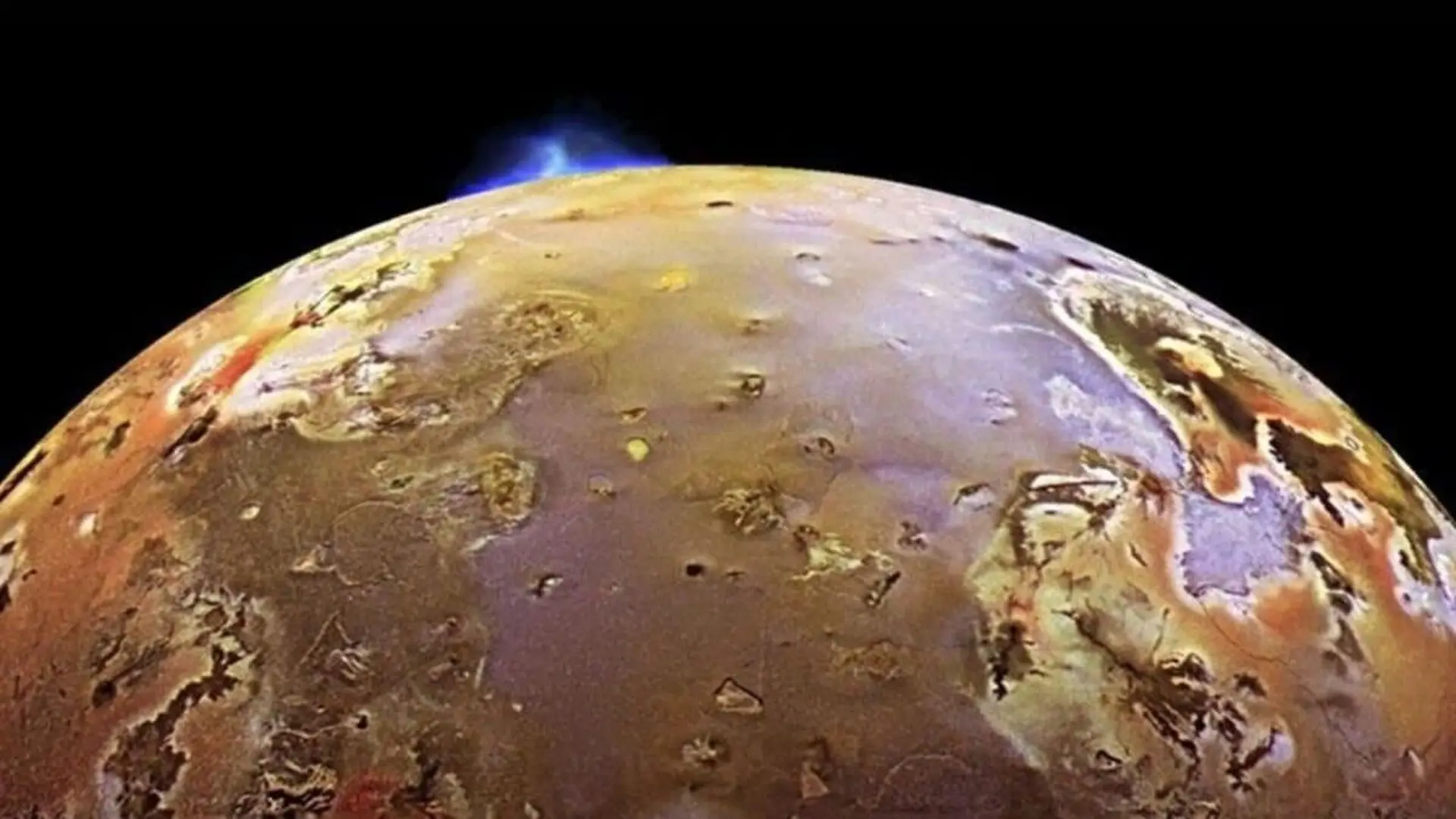
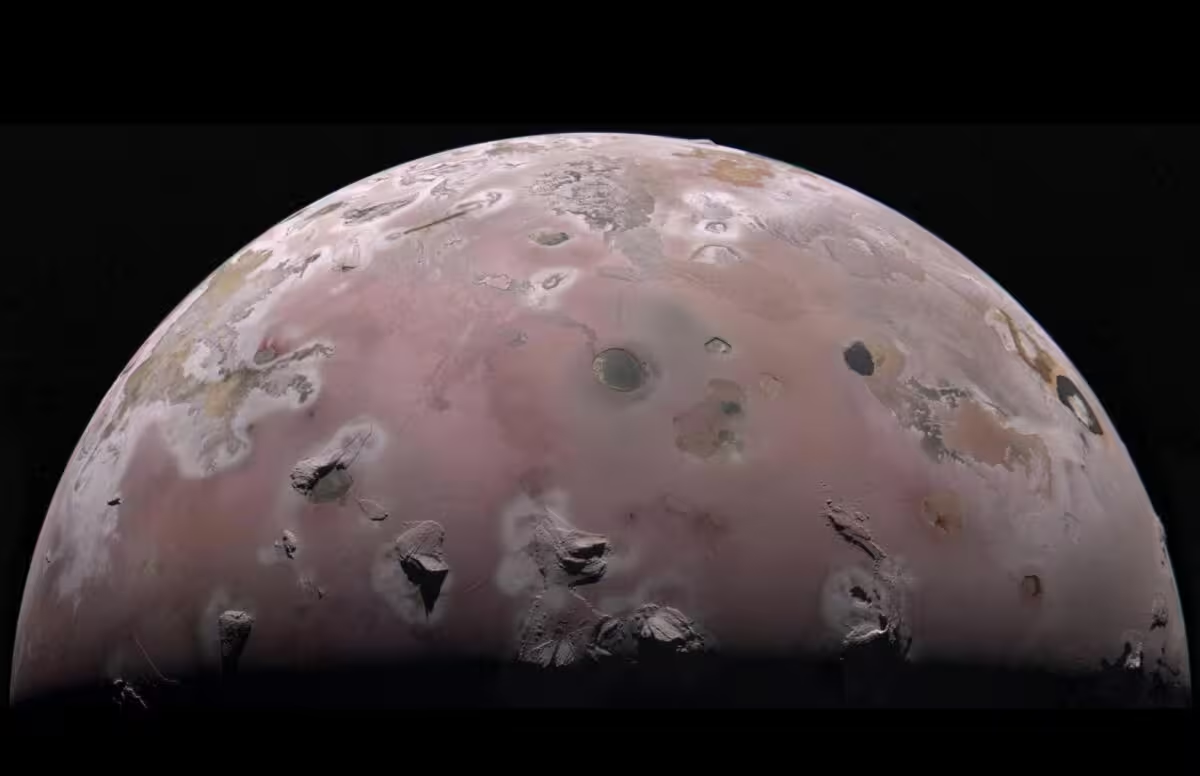
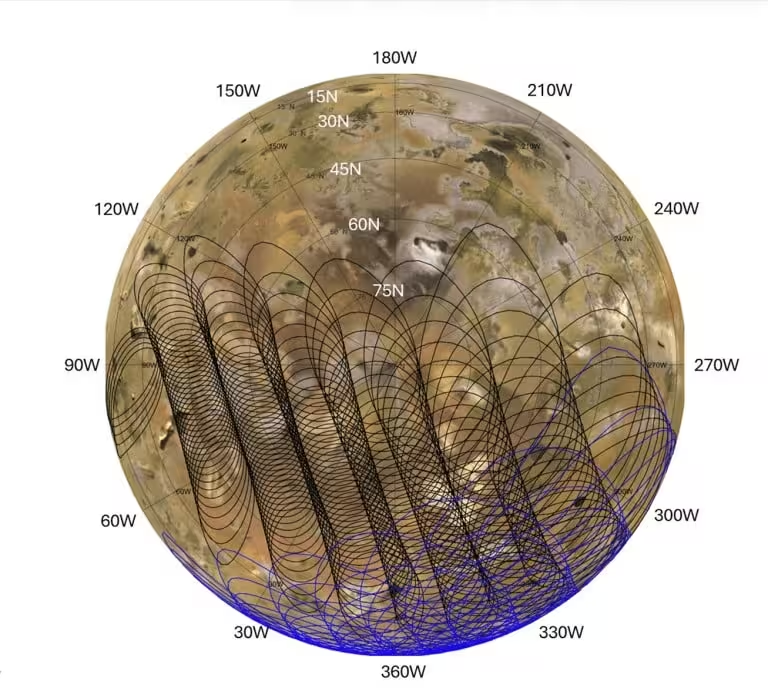
During two close flybys in late 2023 and early 2024, NASA’s Juno spacecraft skimmed Io at a distance of roughly 1,500 km (930 mi) and employed its Microwave Radiometer (MWR) to probe the moon’s interior. The instrument’s measurements revealed a sharp rise in temperature just beneath the surface, offering the first direct view of Io’s subsurface heat.
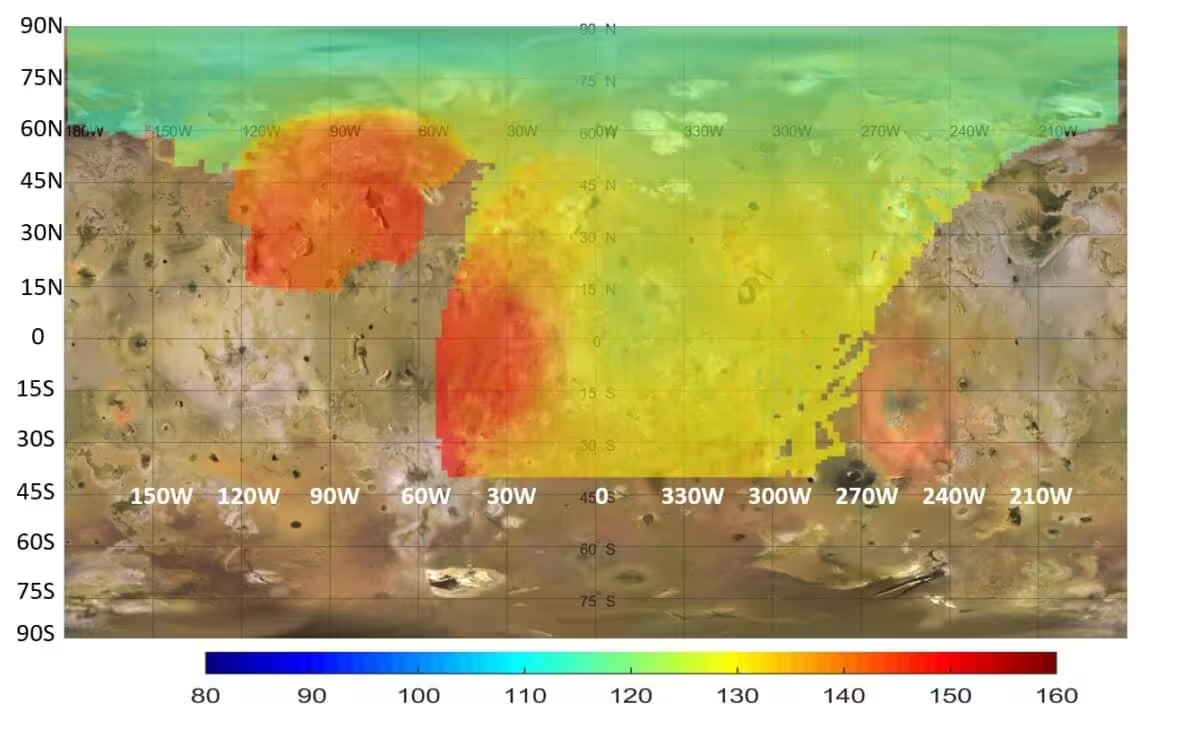
Io’s surface is generally frigid, averaging about –143 °C (–230 °F), but volcanic hotspots can be dramatically warmer. One prominent region registers near 17 °C (60 °F), underscoring the stark contrast between the moon’s icy exterior and its heated interior.
Microwave Radiometer Maps Hidden Heat Layers
Juno’s MWR captures microwave emissions at multiple wavelengths, each penetrating to a different depth. By analyzing the spectrum of signals, scientists can reconstruct temperature profiles from a few inches down to several tens of feet beneath Io’s crust.
“The technique is novel in that each wavelength explores different depths, providing a new way to characterize the deep atmosphere of giant planets and the subsurface crusts of icy and rocky moons,” said Scott Bolton, Juno’s principal investigator at the Southwest Research Institute.
Lead author Shannon Brown of NASA’s Jet Propulsion Laboratory explained that the MWR detected thermal emissions from layers spanning a few inches to dozens of feet. “Everywhere we looked, we found the temperature rising by more than 40 degrees Fahrenheit just several feet into the surface,” Brown said, noting that solar heating alone cannot account for such a steep gradient.
Researchers are evaluating several mechanisms that could generate the observed heat surge, including upward conduction of internal thermal energy, concealed lava flows, and widespread venting across Io’s landscape.
Jupiter’s Tidal Pull Fuels the Moon’s Volcanoes
Io’s extraordinary activity stems from its elliptical orbit around Jupiter, which varies its distance by roughly 3,500 km each revolution. This orbital eccentricity produces fluctuating gravitational forces that flex the moon’s interior.
A study in JGR Planets identifies tidal heating—the continual stretching and squeezing of Io’s crust—as the primary engine behind its prolific volcanism. Jupiter’s gravity can raise and lower the surface by up to 100 m (300 ft), converting mechanical stress into internal heat that erupts as lava and radiates infrared energy.
“Io provides a unique window into learning how tidal heating works throughout the cosmos, a fundamental process that provides energy and heat to worlds that are far from their parent star,” Bolton explained.
The same tidal‑heating mechanism is thought to sustain subsurface oceans on other Jovian moons such as Europa and Ganymede, underscoring its broader relevance across the solar system.
Smooth Plains Hint at Low‑Density Surface Material
Juno’s close approaches also uncovered extensive, unusually flat regions on Io, some stretching over 100 km (60 mi). Researchers liken these terrains to Earth’s Great Plains, a surprising contrast to the moon’s typically chaotic volcanic topography.
The smooth expanses may consist of low‑density material such as pumice or volcanic ash rather than solid rock, suggesting that some of Io’s surface is built from loosely consolidated ejecta.
Beyond planetary science, the ability of Juno’s MWR to detect subsurface heat has implications for Earth‑bound volcanology. Bolton noted, “The surprising discovery that we could see below a rocky moon’s surface has important implications for studying Earth’s volcanoes.”
This article has been fact checked for accuracy, with information verified against reputable sources. Learn more about us and our editorial process.
Last reviewed on .
Article history
- Latest version
Reference(s)
- Society, The. “Scott Bolton.”, April 4, 2012 The Planetary Society <https://www.planetary.org/profiles/scott-bolton>.
- “Research at JPL | Profile Shannon Brown.” <https://www.jpl.nasa.gov/site/research/brownst/>.
- Brown, Shannon., et al. “Io Sub‐Surface Temperature Profile Observed by the Juno Microwave Radiometer.” Journal of Geophysical Research: Planets, vol. 131, no. 7, July 22, 2026 American Geophysical Union (AGU), doi: 10.1029/2025JE009622. <https://agupubs.onlinelibrary.wiley.com/doi/10.1029/2025JE009622>.
Cite this page:
- Posted by Vikram Desai