Senescent Cell Secrets Reveal Why Lung Cancer Resists Immunotherapy
Biology

Senescent Cell Secrets Reveal Why Lung Cancer Resists Immunotherapy

A newly developed machine learning score based on aging cell signals predicts patient survival and treatment resistance in lung adenocarcinoma.
By Priya Sharma
Published:
Email this Article
Senescent Cell Secrets Reveal Why Lung Cancer Resists Immunotherapy
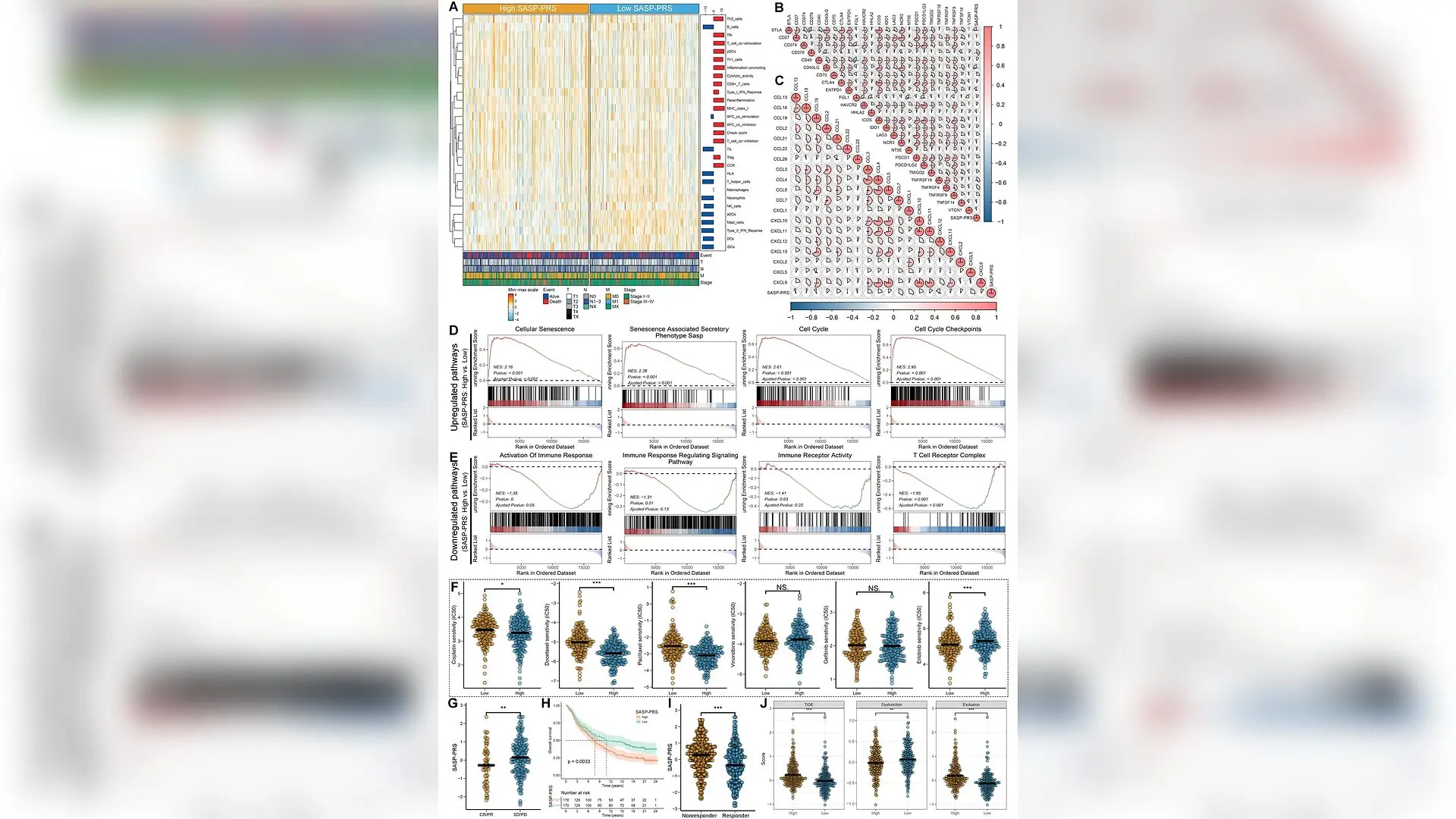
Exploration of the relationship between the senescence-associated secretory phenotype (SASP) score, immune microenvironment, biological functions, and treatment response. (A) Hierarchical clustering heatmap from single-sample Gene Set Enrichment Analysis (ssGSEA) comparing immune infiltration and functional differences between high and low SASP score groups in lung adenocarcinoma (LUAD) patients. (B–C) Correlation heatmap depicting the relationship between the SASP score with immune checkpoint-related genes (B) and chemokine-related genes (C). (D) Gene Set Enrichment Analysis (GSEA) showing significant activation of biological processes related to cellular senescence, SASP, and the cell cycle in patients with high SASP scores. (E) GSEA indicates significant suppression of antitumor immunity-related processes in patients with high versus low SASP scores. (F) Analysis of the relationship between SASP score and estimated IC50 of various chemotherapeutic and targeted drugs in LUAD. (G) Ass Xiaoning Chang et al. / PeerJ

Lung adenocarcinoma, the most common subtype of non-small cell lung cancer, accounts for roughly 40 percent of all lung cancer diagnoses and claims more than 1.8 million lives each year worldwide. Although immune checkpoint inhibitors have revolutionized oncology by unleashing the body’s immune defenses against tumors, only 15 percent to 40 percent of patients achieve durable responses, and both intrinsic and acquired resistance remain major clinical roadblocks.

To unravel why certain tumors evade treatment so effectively, a research team led by scientists at Shandong Cancer Hospital investigated how senescent, or aging, cancer cells shape their surrounding environment. As cells undergo stress or DNA damage, they enter an irreversible arrest and start secreting a potent cocktail of inflammatory factors known as the senescence-associated secretory phenotype, or SASP. This secretory profile acts as a double-edged sword, capable of either summoning immune cells to clear out damaged tissue or driving chronic inflammation and immune evasion. The researchers published their findings in PeerJ.

How Cellular Senescence Divides Tumors Into Two Worlds

Using bioinformatic tools and machine learning algorithms on public transcriptomic datasets including The Cancer Genome Atlas, the authors mapped the expression patterns of 191 unique SASP-related genes. They applied non-negative matrix factorization, a mathematical technique that groups complex biological data into distinct patterns, to classify lung adenocarcinoma patients into two distinct molecular subtypes. Patients falling into Cluster 1 experienced significantly poorer overall survival and presented with a higher proportion of advanced-stage disease compared to those in Cluster 2.
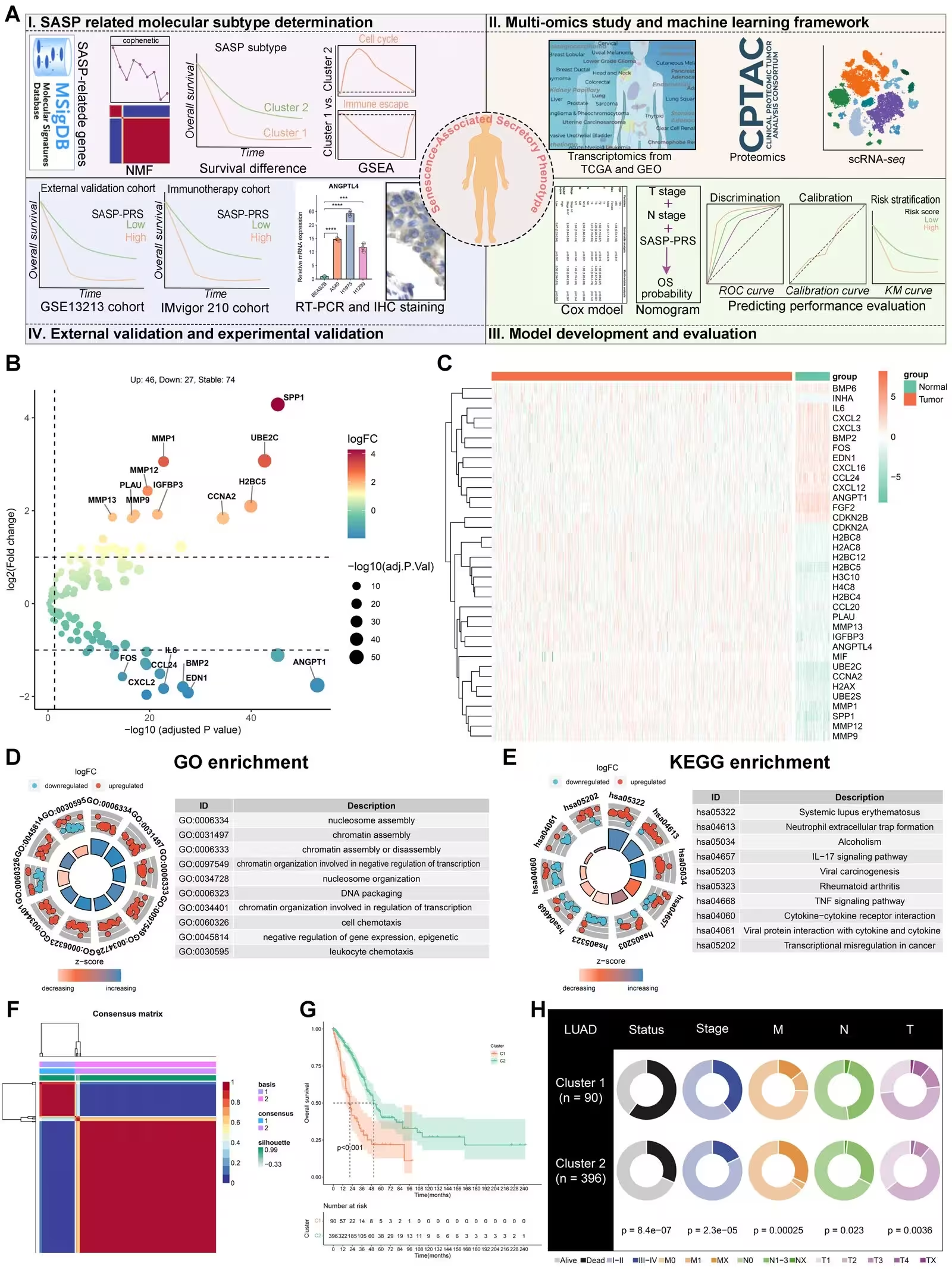
Figure 1: Analysis of senescence-associated secretory phenotype (SASP) genes in lung adenocarcinoma (LUAD). (A) Overview of the study design and methodology. (B–C) Differential expression analysis visualized by a volcano plot (B) and hierarchical clustering heatmap (C), showing SASP gene expression profiles in The Cancer Genome Atlas (TCGA)-LUAD cohort. (D–E) Gene Ontology (GO) (D) and Kyoto Encyclopedia of Genes and Genomes (KEGG) (E) enrichment analyses highlighting the top 20 pathways associated with differentially expressed SASP genes. (F) Classification of LUAD patients into two subtypes using Non-negative Matrix Factorization (NMF) based on SASP gene expression patterns. (G) Kaplan–Meier survival analysis comparing overall survival (OS) between the two subtypes. (H) Pie chart illustrating the relationship between SASP subtypes and clinicopathological characteristics.
Analysis of senescence-associated secretory phenotype (SASP) genes in lung adenocarcinoma (LUAD). (A) Overview of the study design and methodology. (B–C) Differential expression analysis visualized by a volcano plot (B) and hierarchical clustering heatmap (C), showing SASP gene expression profiles in The Cancer Genome Atlas (TCGA)-LUAD cohort. (D–E) Gene Ontology (GO) (D) and Kyoto Encyclopedia of Genes and Genomes (KEGG) (E) enrichment analyses highlighting the top 20 pathways associated with differentially expressed SASP genes. (F) Classification of LUAD patients into two subtypes using Non-negative Matrix Factorization (NMF) based on SASP gene expression patterns. (G) Kaplan–Meier survival analysis comparing overall survival (OS) between the two subtypes. (H) Pie chart illustrating the relationship between SASP subtypes and clinicopathological characteristics. Credit: Xiaoning Chang et al. / PeerJ

Gene set enrichment analyses revealed that Cluster 1 tumors exhibited intense activation of cell cycle and cellular senescence pathways alongside a muted antitumor immune response. Computational estimations using immune deconvolution algorithms showed that Cluster 1 tumors harbored fewer infiltrating CD8+ positive T cells, natural killer cells, and dendritic cells, creating an immunosuppressive microenvironment that allows cancer cells to thrive unchecked.

Five Core Genes That Predict Survival Outcomes

To narrow down the most influential drivers within the SASP network, the team integrated three advanced machine learning methods, specifically least absolute shrinkage and selection operator regression, Random Forest, and extreme gradient boosting. This intersectional filtering isolated five core prognostic genes, namely ANGPTL4, CDKN2A, H2AX, MMP1, and CCL20. Transcriptomic and proteomic data confirmed that these five genes were significantly upregulated in tumor tissues compared to adjacent healthy lung tissue.

Building upon these core genes, the investigators calculated a composite metric known as the SASP Protein Regulator Score to stratify patients into high-risk and low-risk groups. Patients with high scores consistently demonstrated shorter overall survival times across multiple validation cohorts. Furthermore, time-dependent receiver operating characteristic curve analyses verified that the score possessed reliable prognostic performance for predicting one-year, three-year, and five-year survival rates.
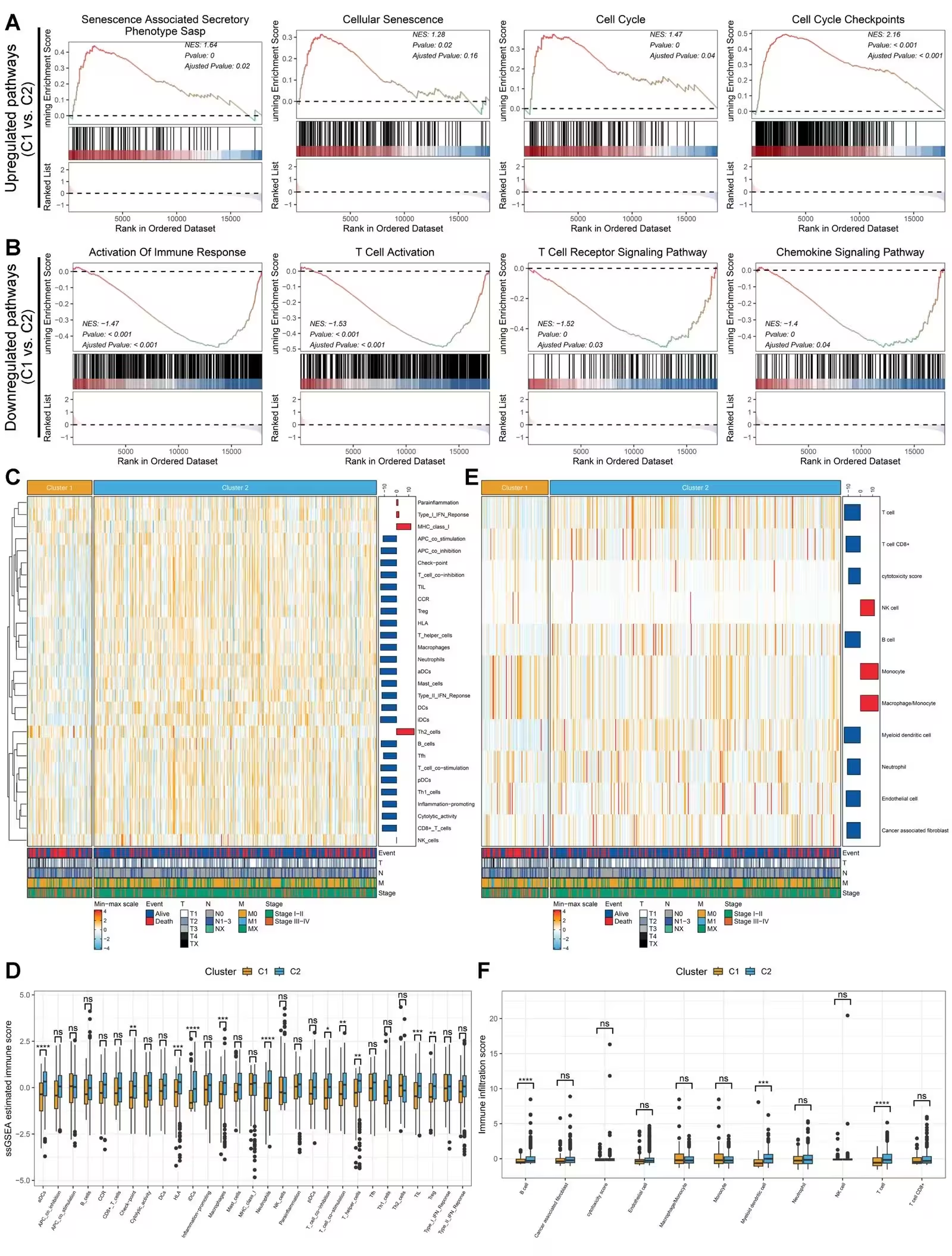
Figure 2: Investigation of biological functions and immune infiltration in distinct senescence-associated secretory phenotype (SASP) subtypes of lung adenocarcinoma (LUAD). (A) Gene Set Enrichment Analysis (GSEA) demonstrates significant activation of biological processes related to SASP, cellular senescence, and the cell cycle in Cluster 1 relative to Cluster 2 among LUAD patients. (B) GSEA reveals significant impairment in processes associated with T cell activation and antitumor immunity in Cluster 1 compared to Cluster 2. (C–D) A clustering heatmap and statistical analysis chart utilizing single-sample GSEA (ssGSEA) estimate immune cell infiltration and immune function across Cluster 1 and Cluster 2 in LUAD patients. (E–F) A clustering heatmap and statistical analysis chart using the MCPcounter algorithm evaluate immune cell infiltration and immune functions within the LUAD subtypes.
Investigation of biological functions and immune infiltration in distinct senescence-associated secretory phenotype (SASP) subtypes of lung adenocarcinoma (LUAD). (A) Gene Set Enrichment Analysis (GSEA) demonstrates significant activation of biological processes related to SASP, cellular senescence, and the cell cycle in Cluster 1 relative to Cluster 2 among LUAD patients. (B) GSEA reveals significant impairment in processes associated with T cell activation and antitumor immunity in Cluster 1 compared to Cluster 2. (C–D) A clustering heatmap and statistical analysis chart utilizing single-sample GSEA (ssGSEA) estimate immune cell infiltration and immune function across Cluster 1 and Cluster 2 in LUAD patients. (E–F) A clustering heatmap and statistical analysis chart using the MCPcounter algorithm evaluate immune cell infiltration and immune functions within the LUAD subtypes. Credit: Xiaoning Chang et al. / PeerJ

Implications for Immunotherapy and Chemotherapy Resistance

The study also explored how the SASP score correlates with predicted responses to modern therapies. High-scoring patients tended to display features of immune exclusion, where suppressive cell types form a physical or chemical barrier blocking active T cells from infiltrating the tumor core. Consequently, high scores correlated with non-responder status and poorer survival outcomes in independent immunotherapy cohorts, including patients treated with anti-programmed death-ligand 1 antibodies.

Interestingly, drug-sensitivity prediction models suggested that high-scoring tumors might exhibit greater sensitivity to standard chemotherapeutic agents such as cisplatin, docetaxel, and paclitaxel, whereas low-scoring patients appeared more responsive to targeted therapies like erlotinib. The authors combined the SASP score with clinical parameters like tumor and node stages to construct a predictive nomogram, which demonstrated good calibration and net clinical benefit in estimating individual survival probabilities.
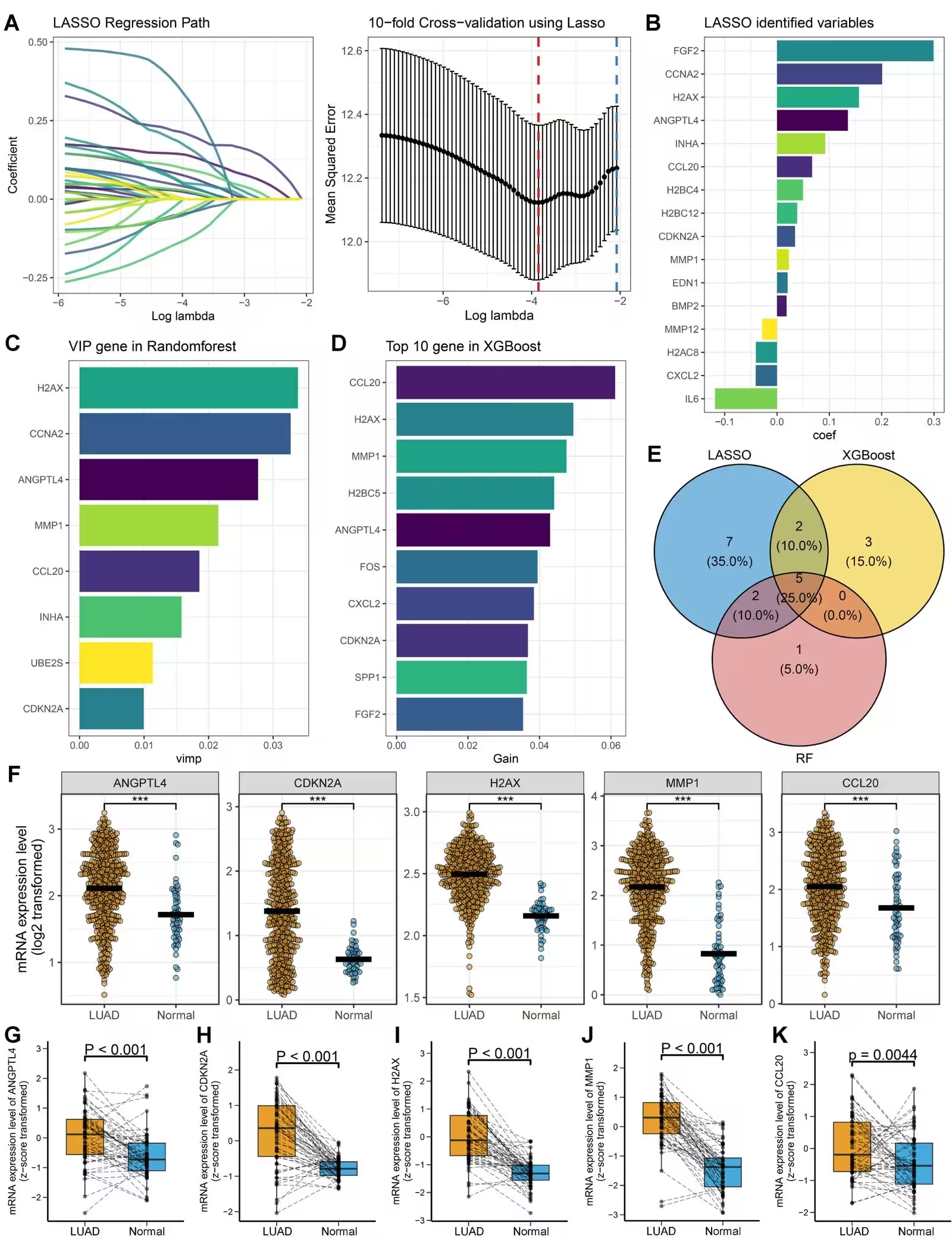
Figure 3: Identification of key senescence-associated secretory phenotype (SASP) genes linked to lung adenocarcinoma (LUAD) prognosis using machine learning algorithms. (A) Least Absolute Shrinkage and Selection Operator (LASSO) regression path and 10-fold cross-validation for identifying key SASP genes. The left panel illustrates the variation in the number of candidate genes with different penalty parameters (Lambda), while the right panel displays the 10-fold cross-validation results. The blue dashed line indicates the number of variables with non-zero regression coefficients at lambda.1se, and the red dashed line indicates the number at lambda.min. (B) Ranking of regression coefficients for variables identified by LASSO. (C) Ranking of key SASP genes based on variable importance from the Random Forest algorithm. (D) Ranking the top 10 SASP genes by importance, identified by the Extreme Gradient Boosting (XGBoost) algorithm. (E) Venn diagram showing the overlap of key SASP genes identified by
Identification of key senescence-associated secretory phenotype (SASP) genes linked to lung adenocarcinoma (LUAD) prognosis using machine learning algorithms. (A) Least Absolute Shrinkage and Selection Operator (LASSO) regression path and 10-fold cross-validation for identifying key SASP genes. The left panel illustrates the variation in the number of candidate genes with different penalty parameters (Lambda), while the right panel displays the 10-fold cross-validation results. The blue dashed line indicates the number of variables with non-zero regression coefficients at lambda.1se, and the red dashed line indicates the number at lambda.min. (B) Ranking of regression coefficients for variables identified by LASSO. (C) Ranking of key SASP genes based on variable importance from the Random Forest algorithm. (D) Ranking the top 10 SASP genes by importance, identified by the Extreme Gradient Boosting (XGBoost) algorithm. (E) Venn diagram showing the overlap of key SASP genes identified by Credit: Xiaoning Chang et al. / PeerJ

Study Limitations and Next Steps

Despite these promising correlations, the authors noted several important limitations. Because the study relied largely on retrospective data from public repositories, potential selection biases remain, and crucial clinical variables such as patient smoking history were occasionally missing. Furthermore, quantitative reverse transcription polymerase chain reaction and immunohistochemical stainings of cell lines and clinical specimens revealed heterogeneous expression patterns that did not always align perfectly with bulk transcriptomic trends.

The authors emphasize that predicted drug responses and immune cell infiltrations were computationally derived rather than directly measured through functional assays or multiplex tissue imaging. Therefore, prospective clinical trials and mechanistic laboratory studies are urgently needed to validate the clinical utility of the SASP score before it can be applied to guide personalized treatment decisions in patients with lung adenocarcinoma.

The research was published in PeerJ on January 1, 2026.

Fact Checked

This article has been fact checked for accuracy, with information verified against reputable sources. Learn more about us and our editorial process.

Last reviewed on .

Article history

  • Latest version

Reference(s)

  1. Chang, Xiaoning., et al. “Machine learning–derived intracellular protein–based prognostic model reflecting a senescence-associated secretory phenotype-driven immunosuppressive microenvironment in lung adenocarcinoma.” PeerJ, vol. 14, October 21, 2026, pp. e21835 PeerJ, doi: 10.7717/peerj.21835. <https://doi.org/10.7717/peerj.21835>.

Cite this page:

Sharma, Priya. “Senescent Cell Secrets Reveal Why Lung Cancer Resists Immunotherapy.” BioScience. BioScience ISSN 2521-5760, 26 October 2026. <https://www.bioscience.com.pk/en/subject/biology/machine-learning-derived-intracellular-protein-based-prognostic-model-reflecting-a-senescence-associated-secretory-phenotype-driven-immunosuppressive-microenvironment-in-lung-adenocarcinoma>. Sharma, P. (2026, October 26). “Senescent Cell Secrets Reveal Why Lung Cancer Resists Immunotherapy.” BioScience. ISSN 2521-5760. Retrieved October 26, 2026 from https://www.bioscience.com.pk/en/subject/biology/machine-learning-derived-intracellular-protein-based-prognostic-model-reflecting-a-senescence-associated-secretory-phenotype-driven-immunosuppressive-microenvironment-in-lung-adenocarcinoma Sharma, Priya. “Senescent Cell Secrets Reveal Why Lung Cancer Resists Immunotherapy.” BioScience. ISSN 2521-5760. https://www.bioscience.com.pk/en/subject/biology/machine-learning-derived-intracellular-protein-based-prognostic-model-reflecting-a-senescence-associated-secretory-phenotype-driven-immunosuppressive-microenvironment-in-lung-adenocarcinoma (accessed October 26, 2026).
End of the article