Central European Lynx Populations Fall Short of Genetic Stability Goals
Mathematical models show that reintroduced wild cats need much larger groups and active migration corridors to escape long-term inbreeding.
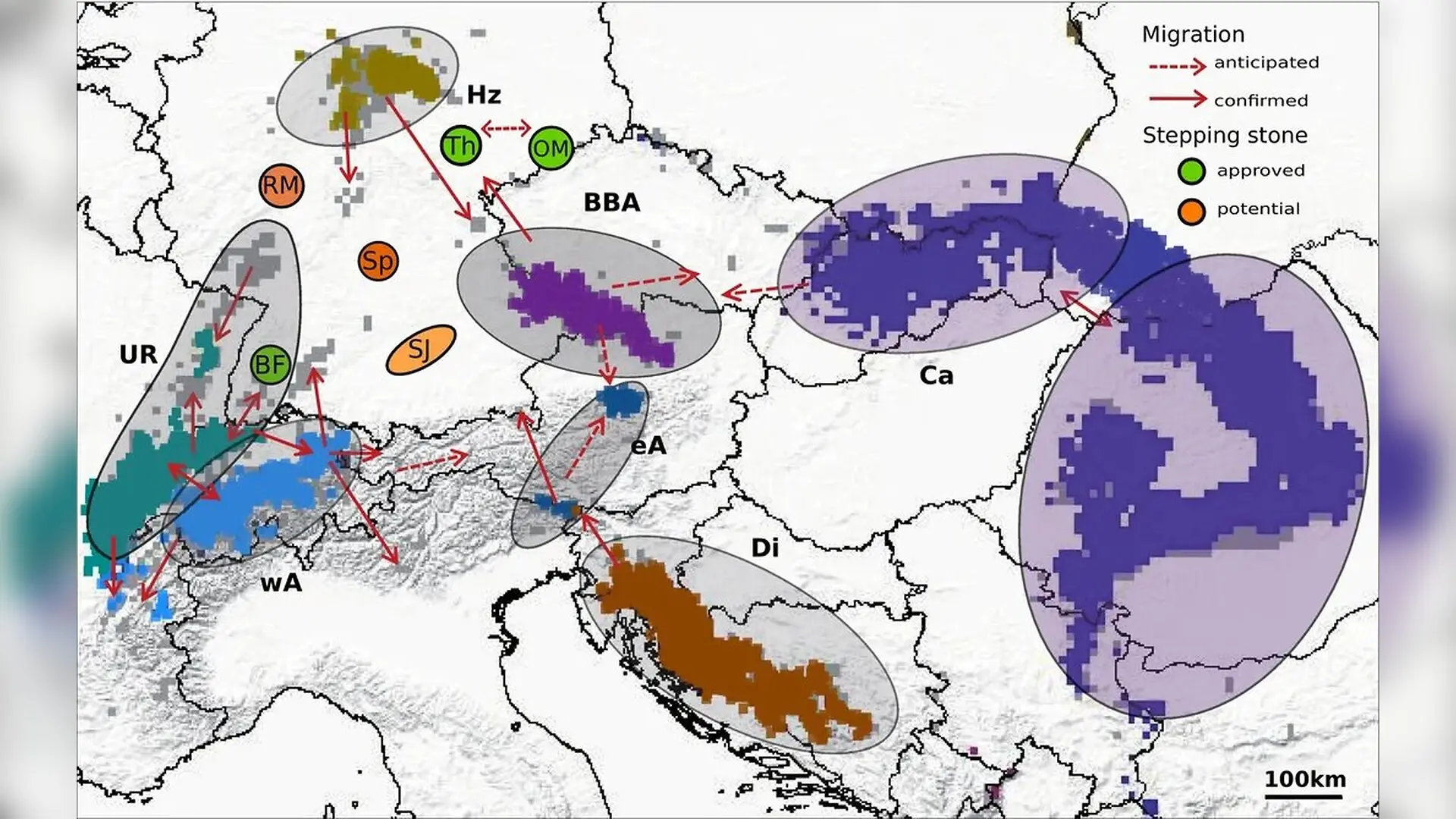
Vulnerable Eurasian lynx populations scattered across Central Europe fall far short of genetic stability goals under current conservation strategies, according to a recent mathematical model. Without major increases in local group sizes and active migration corridors, these fragmented wild cat communities face a high risk of long-term inbreeding.
Reintroducing apex predators like the Eurasian lynx (Lynx lynx) into human-dominated landscapes is an uphill battle against habitat fragmentation, busy roads, and geographic isolation. Researchers recently investigated these dynamics published in Evolutionary Applications to evaluate whether current and planned reintroduction networks can sustain genetic health over time.
Conservation biologists measure genetic viability using effective population size, which represents the number of breeding individuals in an ideal population that would lose genetic diversity at the same rate as the real group. To avoid dangerous levels of inbreeding and maintain evolutionary potential, populations should ideally clear established genetic benchmarks known as the fifty-slash-five-hundred rule.
Why Current Lynx Networks Fail Long-Term Benchmarks
The study analyzed ten different scenarios involving core groups and newly established stepping-stone populations across Central Europe. These include reintroductions in the Harz Mountains, the Bohemian Forest, the Black Forest, the Thuringian Forest, and the Ore Mountains, alongside older populations in the Alps and the Dinaric region.
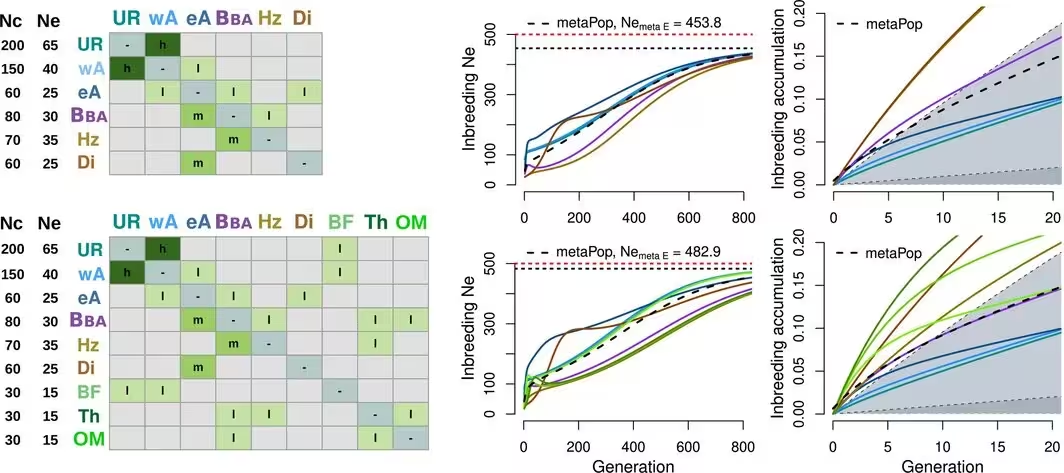
The modeling revealed that current reintroduction frameworks and near-future plans will fail to reach the long-term genetic benchmark of a metapopulation effective size above five hundred, even if simulated across eight hundred generations. Under baseline conditions, the effective size hovered below one hundred after fifty generations. While short-term inbreeding remained manageable in some areas, isolated demes in the Harz Mountains and Dinaric region struggled to meet safe thresholds.
How Increased Migration and Larger Demes Change the Math
To overcome these genetic bottlenecks, the analytical models tested what changes would be necessary to achieve a stable, interconnected metapopulation network. Researchers found that achieving long-term viability requires expanding overall census numbers by up to one hundred and fifty percent across regional groups, alongside significant boosts in migration rates.
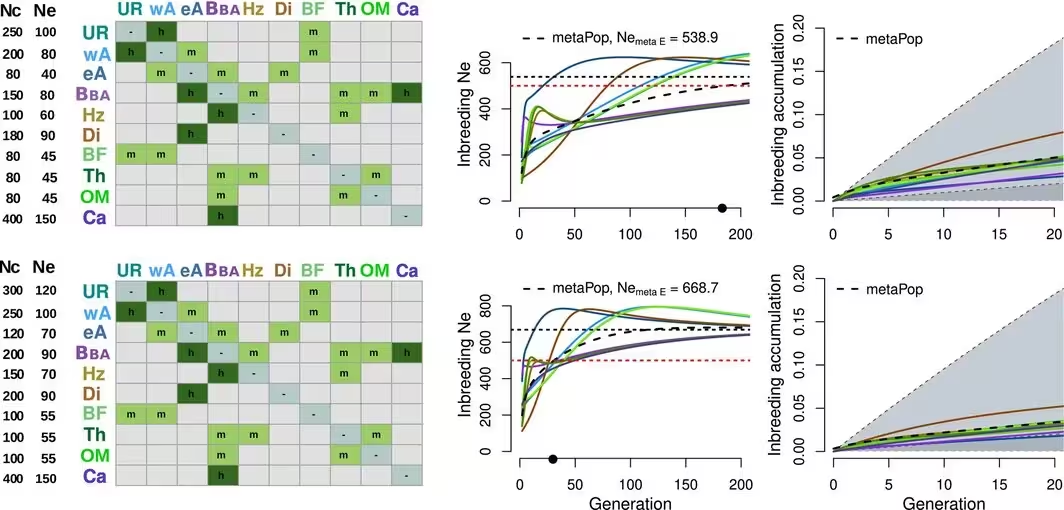
Specifically, successful configurations require an average pairwise migration rate exceeding ten percent between connected patches. For instance, the models indicate that regional hubs need to exchange roughly three to nine effective migrants per generation. Furthermore, linking the Central European network directly to the large, native Carpathian population proved essential for securing long-term genetic health.
What Conservationists Should Do Next
The findings offer practical guidance for wildlife managers facing difficult choices over where to direct limited conservation resources. Rather than spreading efforts thin by founding entirely new groups in untried areas, the authors advise prioritizing the reinforcement of existing populations and building secure wildlife corridors.
Because animal dispersal is often limited by human infrastructure and illegal poaching outside protected zones, deliberate assisted migration remains vital. Without active human intervention to boost local population sizes and connect isolated forest patches, Central Europe’s reintroduced lynx risk remaining genetically vulnerable for generations to come.
The research was published in Evolutionary applications on October 1, 2026.
This article has been fact checked for accuracy, with information verified against reputable sources. Learn more about us and our editorial process.
Last reviewed on .
Article history
- Latest version
Reference(s)
- Rolshausen, Gregor., et al. “A Conservation Roadmap for the Anticipated Eurasian lynx ( Lynx lynx ) Metapopulation in Central Europe—Modelling Effective Deme Sizes and Connectivity.” Evolutionary Applications, vol. 19, no. 10, October 24, 2026 Wiley, doi: 10.1111/eva.70340. <https://doi.org/10.1111/eva.70340>.
Cite this page:
- Posted by Priya Sharma