Immune Cells Control Hair Growth Cycles and Trigger Hair Loss
Review reveals how specialized immune cells patrolling hair follicles dictate growth phases, shield tissue, and drive autoimmune hair loss when stressed.
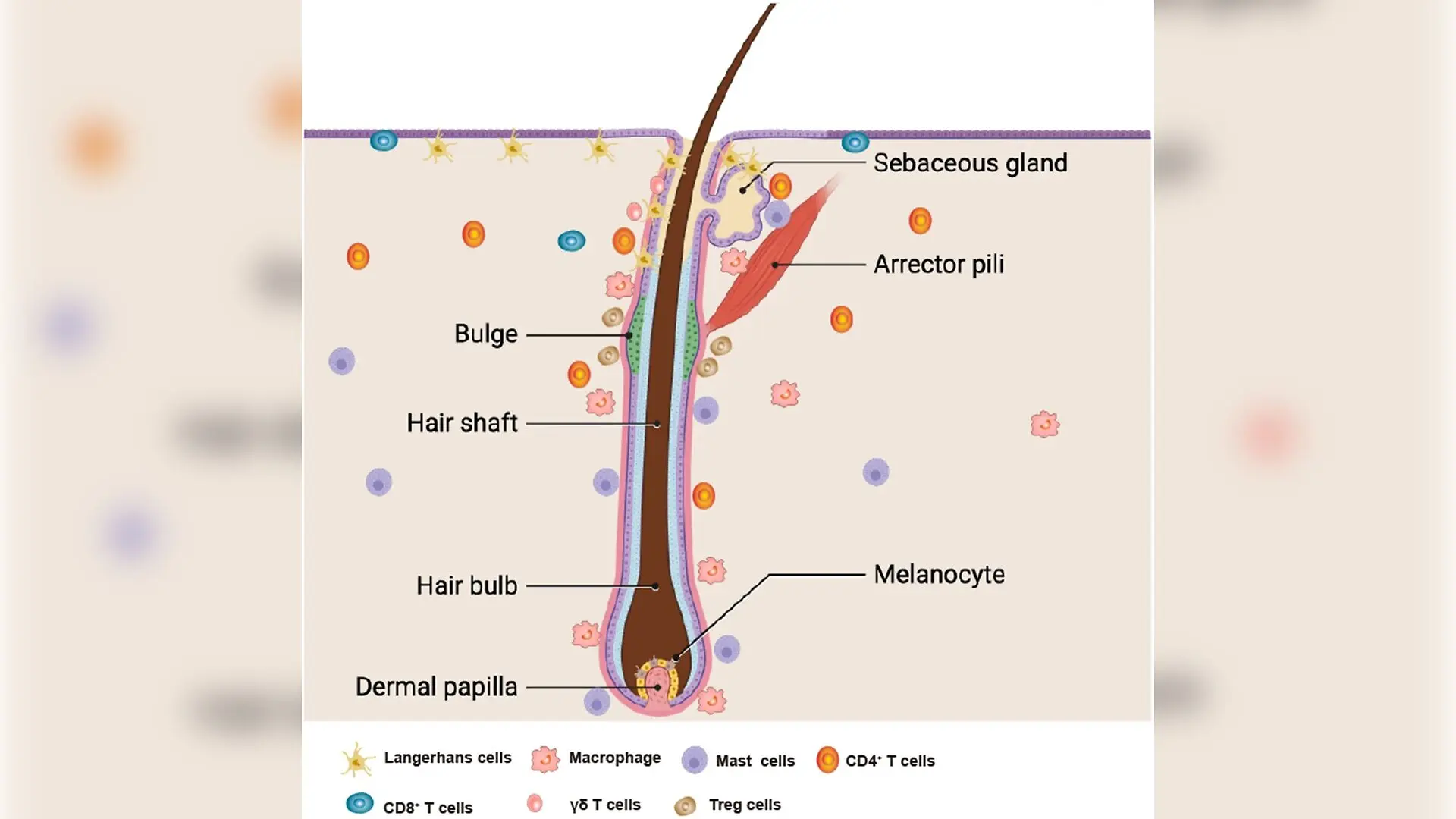
A bustling community of specialized immune cells patrols human hair follicles, acting as master regulators that directly control whether hair grows, rests, or falls out. Researchers have mapped how these resident guards shape skin health, revealing why psychological stress and immune breakdowns trigger stubborn hair loss disorders.
The hair follicle operates as a sophisticated mini-organ with intrinsic cyclic activity, constantly shifting between an active growth phase known as an anagen, a regression phase called catagen, and a resting phase known as telogen. Nestled tightly around these follicles is a delicate immune microenvironment populated by macrophages, mast cells, T cells, and Langerhans cells. Rather than just fighting off infections, these cells execute vital physiological tasks, such as activating hair follicle stem cells, which are responsible for generating new hair shafts. The findings were detailed in a comprehensive review published in Clinical, Cosmetic and Investigational Dermatology, outlining how immune populations maintain normal tissue homeostasis.
How Resident Immune Guards Direct the Hair Growth Cycle
During a healthy hair cycle, different immune cells take turns signaling to the surrounding tissue. Macrophages serve as core innate immune effector cells, undergoing dramatic quantitative and phenotypic shifts as the cycle turns. When macrophages undergo programmed cell death, or apoptosis, they release Wnt family molecules that activate the Wnt/beta-catenin signaling pathway in hair follicle stem cells. This chemical signal breaks stem cell quiescence, sparking cell proliferation and initiating a new anagen growth phase.
Other immune populations play equally specialized roles in orchestrating hair transitions. Skin-resident regulatory T cells, often called Tregs, accumulate heavily around the hair follicle bulge during the resting telogen phase. They directly promote stem cell proliferation and differentiation through the Jag1-Notch signaling axis, effectively acting as key switches that wake up dormant follicles. Conversely, specialized macrophages expressing the TREM2 receptor secrete oncostatin M, a protein that binds to receptors on stem cells and activates the JAK-STAT5 pathway to suppress hair growth and maintain dormancy until the timing is right.
What Happens When Stress and Inflammation Break Immune Privilege
Hair follicles maintain a specialized state of immune privilege, meaning they exhibit low levels of major histocompatibility complex class I molecules to shield themselves from autoimmune damage. When this delicate defense breaks down, severe pathological conditions can emerge. In autoimmune disorders like alopecia areata, massive expansion and infiltration of cytotoxic CD8 plus T cells target autologous hair follicles, leading to arrested hair growth and localized hair loss. Research highlighted in the review demonstrates that specific depletion of these infiltrating CD8 plus T cells can restore follicular structural integrity and allow hair regrowth.
External pressures like psychological stress and physical trauma also exploit this immune network. Under chronic stress, cutaneous nerve fibers ramp up production of the neuropeptide substance P. This chemical stimulates perifollicular mast cells to degranulate via neurokinin-1 receptors, producing reactive oxygen species that drive premature regression of the hair follicle. Simultaneously, sympathetic nerves release norepinephrine, prompting macrophages to adopt an inflammatory profile that secretes interleukin-1 beta and interleukin-1 alpha, synergistically inducing stem cell apoptosis and stress-related hair shedding.
Opening New Avenues for Targeted Dermatological Treatments
Understanding the dual nature of perifollicular immune cells shifts how scientists view common inflammatory skin disorders. For instance, in lichen planopilaris, a scarring alopecia characterized by permanent hair destruction, mast cells and M2 macrophages drive abnormal collagen deposition and irreversible follicular scarring via the interleukin-23 and interleukin-17 inflammatory axis. Similarly, in conditions like folliculitis decalvans, neutrophils swarm bacterial invasions of Staphylococcus aureus, triggering chronic inflammation that destroys sebaceous glands.
By mapping out the precise molecular dialogues between immune cells and stem cell niches, the authors emphasize that therapies targeting specific immune modulation could soon transform clinical care. Rather than relying on broad immunosuppressants, future interventions may focus on fine-tuning individual cell subsets like regulatory T cells or blocking specific cytokine pathways to restore immune privilege and restart dormant hair follicles.
The research was published in Clinical, cosmetic and investigational dermatology on January 1, 2026.
This article has been fact checked for accuracy, with information verified against reputable sources. Learn more about us and our editorial process.
Last reviewed on .
Article history
- Latest version
Reference(s)
- Dai, Chan., et al. “Immune Cells in Hair Follicle Physiology and Pathology.” Clinical, Cosmetic and Investigational Dermatology, vol. Volume 19, October 1, 2026, pp. 1-15. Informa UK Limited, doi: 10.2147/CCID.S594805. <https://doi.org/10.2147/CCID.S594805>.
Cite this page:
- Posted by Priya Sharma