Blueberry Picker Finds Hidden WWII Plane Wreckage in Polish Forest
British markings, charred ammunition and disturbed soil point to a missing Allied aircraft, uncovering a haunting relic still hidden beneath the ground.
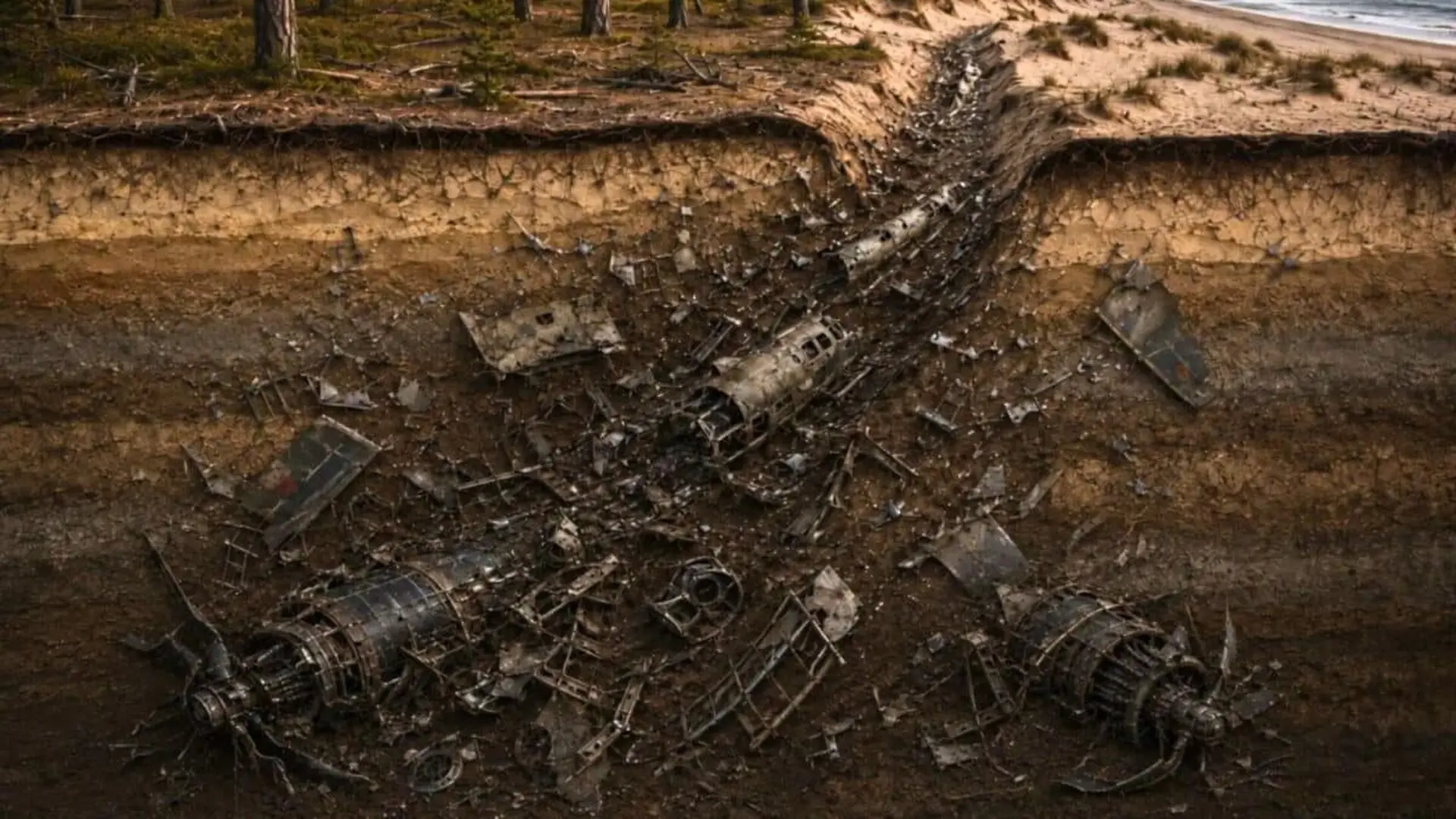
While searching for wild blueberries in a forest on the eastern edge of Świnoujście, a local discovered a shallow pit surrounded by fragments of aluminum and scattered, charred ammunition. He brought one of the metal pieces to the Underground City—a former Cold War command bunker now incorporated into the Museum of Coastal Defense at Fort Gerhard—where curators traced the find back into the woods and uncovered dozens of additional shards.
The first museum specialist to inspect the material, Wiktor Czeszewski, noted that the thin aluminium sheets, their rivet patterns, and the burned ammunition bore the hallmarks of aircraft construction rather than ordinary scrap metal, according to a report posted on the Polish aviation portal dlapilota.pl. “The sheet metal, the riveting, and the remnants of aircraft‑type ordnance all point to an aircraft fragment,” he wrote.
Based on the distribution of debris and the specific technical characteristics observed, museum researchers concluded that the site most likely represents the wreckage of an Allied World War II aircraft. The forest lies along the right bank of the Świnoujście channel, close to Fort Gerhard and the Underground City, an area layered with wartime remnants.
British Identifiers on Ammunition and Tubing
Among the recovered items, a piece of burnt ammunition attracted immediate scrutiny. Preliminary analysis identified it as .303 British calibre, the round commonly used in the Browning machine guns of Royal Air Force aircraft, suggesting a British‑type plane or an Allied aircraft equipped with British‑standard armament.
Cleaning of the fragments revealed a seamless copper tube marked with the code “T7.” Researcher Kacper Stachula explained that, according to RAF technical manuals, the “T7” stamp denotes copper tubing employed in fuel, oil, gas, ignition and other onboard systems. “The T7 marking, per British RAF documentation, identifies seamless copper tubing used for oil, fuel, gas, starter and related aircraft systems,” he said, as cited by dlapilota.pl.

The copper tube also featured an Avimo high‑pressure connector, a fitting typical of British aircraft fuel and hydraulic lines and commonly found in the cooling circuits of Rolls‑Royce Merlin engines. Researcher Milan Litwinowicz said that the combination of the T7 stamp and the Avimo connector makes a British‑origin aircraft virtually certain, though pinpointing the exact model remains difficult because the Merlin powered several types, including the Avro Lancaster, de Havilland Mosquito and the Supermarine Spitfire.
A Nearby Lancaster Wing May Share the Same Crash Site
The Museum of Coastal Defense already possesses a fragment of an Avro Lancaster wing, roughly 16 feet long, recovered by fishermen from the Baltic Sea in 2009. That find lies about 0.6 miles from the forest clearing where the new debris was uncovered. Museum director Piotr Piwowarczyk told the Polish Press Agency, cited in a Discover Magazine report, that the two discoveries could belong to the same aircraft.
Archival research linked the 2009 wing to three crew members whose names appear in mission logs for a Lancaster that flew over Świnoujście en route to targets near Police or Szczecin. The flight path would have taken the aircraft directly above the coastal strip where the forest site is located, reinforcing the hypothesis of a shared crash location.

During the final months of the war, the Świnoujście area—then known as Swinemünde—served as a heavily defended naval base, guarded by coastal artillery and anti‑aircraft batteries. Allied bombers, Mosquito fast‑bomber‑reconnaissance aircraft, fighters and Soviet planes all traversed the region, striking the port, the Świna strait and nearby industrial zones. The last aircraft reported shot down over the town before the cease‑fire is believed to have been a Soviet plane.
Potential War Grave Beneath the Forest Floor
Observations of the terrain around the discovery indicate uneven rises and depressions that do not match the natural topography, suggesting a sizable structure may still lie beneath the soil. Museum staff therefore suspect that the aircraft’s fuselage and possibly the cockpit section remain buried at the site.
If the main wreckage is intact, the location could also contain the remains of the crew. “We cannot rule out that the airmen’s bodies are still in the ground. Consequently, the site should be professionally secured and investigated without delay,” Wiktor Czeszewski warned. This raises the issue of the site being treated as a military war grave, subject to specific legal and ethical protections.
The museum has alerted the Regional Conservator of Historic Monuments, the Międzyzdroje Forest District and the agencies responsible for wartime graves. Authorities have requested that the area not be marked publicly and that amateurs refrain from excavating or removing artifacts. No official excavation schedule has been announced.
This article has been fact checked for accuracy, with information verified against reputable sources. Learn more about us and our editorial process.
Last reviewed on .
Article history
- Latest version
Reference(s)
- “Aliancki samolot w lesie pod Świnoujściem?.”, July 21, 2026 dlapilota.pl <https://dlapilota.pl/wiadomosci/polska/aliancki-samolot-w-lesie-pod-swinoujsciem-sensacyjne-odkrycie-w-nadmorskim-lesie>.
- “Elementy%20alianckiego%20samolotu%20w%20lesie%20pod%20%C5%9Awinouj%C5%9Bciem%2C%20fot.%20%C5%BAr%C3%B3d%C5%82o %20Muzeum%20Obrony%20Wybrze%C5%BCa%20w%20%C5%9Awinouj%C5%9Bciu.” <https://dlapilota.pl/sites/default/files/styles/article_popup/public/media/images/2026-07/Elementy%20alianckiego%20samolotu%20w%20lesie%20pod%20%C5%9Awinouj%C5%9Bciem%2C%20fot.%20%C5%BAr%C3%B3d%C5%82o_%20Muzeum%20Obrony%20Wybrze%C5%BCa%20w%20%C5%9Awinouj%C5%9Bciu.jpeg?itok=-szkEvn5>.
- Scott, Anastasia. “A Downed WWII Plane May Be Buried in This Polish Forest, and Its Crew Might Still Be There.”, July 24, 2026 Discover Magazine <https://www.discovermagazine.com/a-downed-wwii-plane-may-be-buried-in-this-polish-forest-and-its-crew-might-still-be-there-49452>.
- “Elementy%20alianckiego%20samolotu%20w%20lesie%20pod%20%C5%9Awinouj%C5%9Bciem%2C%20fot.%20%C5%BAr%C3%B3d%C5%82o %20Muzeum%20Obrony%20Wybrze%C5%BCa%20w%20%C5%9Awinouj%C5%9Bciu 2.” <https://dlapilota.pl/sites/default/files/media/images/2026-07/Elementy%20alianckiego%20samolotu%20w%20lesie%20pod%20%C5%9Awinouj%C5%9Bciem%2C%20fot.%20%C5%BAr%C3%B3d%C5%82o_%20Muzeum%20Obrony%20Wybrze%C5%BCa%20w%20%C5%9Awinouj%C5%9Bciu_2.png>.
Cite this page:
- Posted by Vikram Desai