NASA’s Curiosity Rover Accidentally Pulled Up a 29-Pound Mars Rock That Held It Hostage for Nearly a Week
After thirteen years exploring Mars, nothing—not even the planet’s harshest challenges—had ever halted Curiosity’s progress like this.
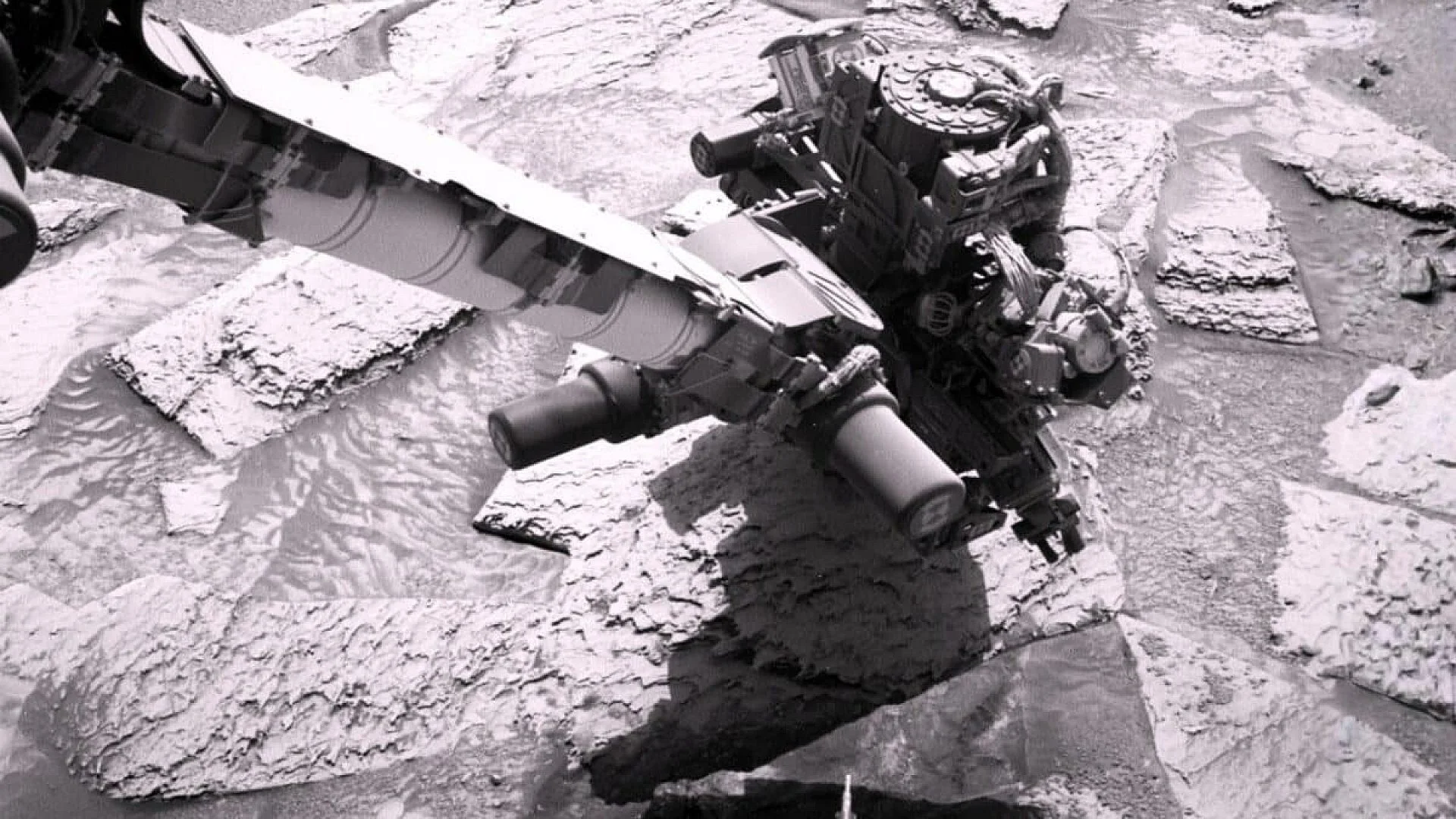
On May 11, 2026, NASA unveiled a series of striking images capturing an extraordinary moment on Mars. The Curiosity rover, a machine that has withstood brutal radiation and dust storms for over a decade, was temporarily halted not by a mechanical failure or a software glitch, but by a single rock that refused to let go.
The rock, nicknamed “Atacama,” weighed approximately 29 pounds, measured about 1.5 feet wide at its base, and stood six inches thick. When Curiosity drilled into it on April 25 to collect a sample, the entire chunk tore free from the Martian surface and remained clamped to the rover’s fixed drill sleeve.
According to NASA’s Jet Propulsion Laboratory, which manages the mission for NASA’s Science Mission Directorate in Washington, this was the first time in Curiosity’s more than 13 years on Mars that an entire rock remained attached to the drill sleeve after sampling. Every previous drilling target had either cracked apart or separated along natural faults. Atacama did neither.
A First in Over 13 Years of Mars Drilling
Curiosity’s drill is designed to reduce rock to powder for onboard chemical analysis, not to extract unbroken slabs from the ground. When the robotic arm pulled back after drilling, the force lifted Atacama whole and jammed it against the sleeve that steadies the spinning bit. The rover then sat still, its science work paused, while engineers at JPL began working the problem from roughly 140 million miles away.
The full sequence was captured by Curiosity’s front-mounted black-and-white hazard cameras and its mast-mounted navigation cameras. NASA later released the footage as animated GIFs through the agency’s Planetary Photojournal, including a timestamped version of the primary sequence. The images show the arm holding the rock aloft, sand spilling from it during vibration attempts, and the eventual moment of release.

Three Attempts Across Six Days
The first move came on April 25, the same day the rock attached itself. Engineers activated the drill’s vibration mechanism to shake Atacama loose. The rock did not budge.
On April 29, the team repositioned Curiosity’s robotic arm and triggered another vibration sequence. Cameras recorded sand shaking free from the surface of the rock as it moved, a small visible change that turned out to lead nowhere. Atacama held tight.
The breakthrough came on May 1. Engineers tilted the drill to steeper angles and combined drill rotation, vibration, and rapid spinning of the bit into a single sequence. They had prepared to run through the approach multiple times. They did not need to. On the first attempt, Atacama broke free, struck the Martian surface below the arm, and fractured on impact.
What Made Atacama Hold On
The precise geological properties that caused Atacama to behave as it did are not identified in NASA’s report, but the sequence of events points to an unusually strong mechanical bond between the rock and the drill sleeve. Under normal conditions, Curiosity’s drill penetrates a rock, collects a powder sample, and the arm retracts while the rock remains in place. Atacama came out whole.
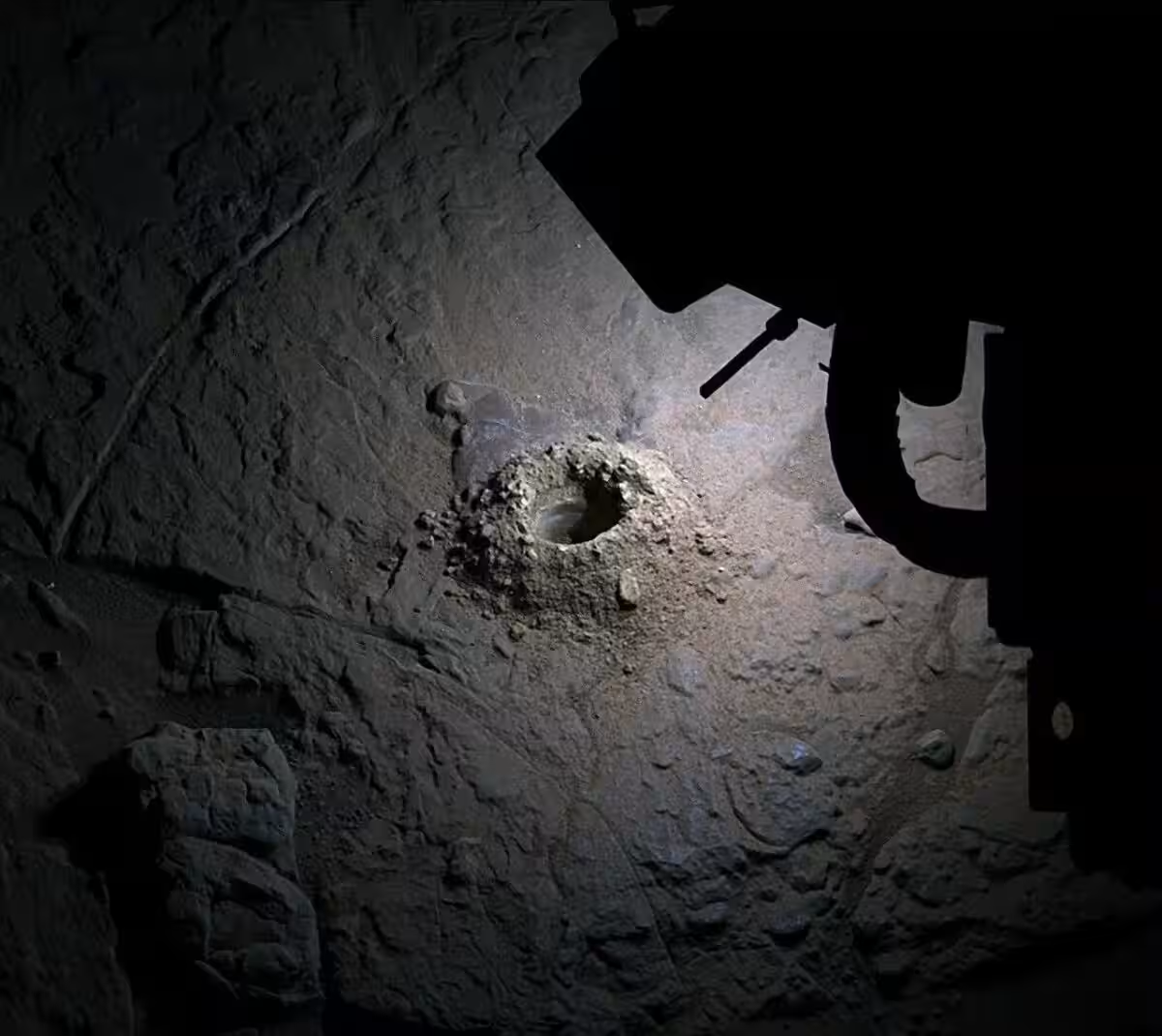
The fact that vibration alone failed twice before the combined approach succeeded suggests the attachment was not simply frictional. Sand was observed spilling from the rock during the second vibration attempt, confirming the drill had disrupted Atacama’s internal structure, but not enough to break contact with the sleeve. It took steeper angles and simultaneous rotation to finally dislodge it.
Curiosity’s Cameras Caught Everything
The footage released by NASA gives an unusually close look at a mechanical problem unfolding in real time on another planet. Most of what Curiosity’s cameras capture involves terrain surveys, atmospheric readings, and rock formations. A six-day incident in which a single 29-pound rock stayed physically clamped to the spacecraft is a different kind of documentation.
Both camera systems contributed distinct angles. The hazard cameras provided close-up detail of the drill sleeve and the attached rock. The navigation cameras on the mast captured a wider view of the arm’s position and movement across each attempt. NASA released both perspectives, along with a timestamped version, through its Planetary Photojournal.
With Atacama on the ground and the drill confirmed intact, Curiosity returned to normal Mars science operations. JPL’s team resumed sampling and analysis work inside Gale Crater, where the rover has been investigating the region’s geology as part of NASA’s broader Mars Exploration Program.
Enjoyed this article?
This article has been fact checked for accuracy, with information verified against reputable sources. Learn more about us and our editorial process.
Last reviewed on .
Article history
- Latest version
Reference(s)
- “PIA26723 FigA.” <https://assets.science.nasa.gov/content/dam/science/psd/photojournal/pia/pia26/pia26723/figures/PIA26723_figA.gif?w=1024&h=1024&fit=clip&crop=faces%2Cfocalpoint>.
- “PIA26723 FigB.” <https://assets.science.nasa.gov/content/dam/science/psd/photojournal/pia/pia26/pia26723/figures/PIA26723_figB.gif?w=1024&h=1024&fit=clip&crop=faces%2Cfocalpoint>.
Cite this page:
- Posted by Vikram Desai