New Acoustic Black Hole Radiator Dramatically Boosts Ultrasonic Power
By merging dual acoustic black hole profiles with a unique vibration mode conversion architecture, scientists have engineered a compact ultrasonic radiator with dramatically amplified sound pressure and superior energy focusing.
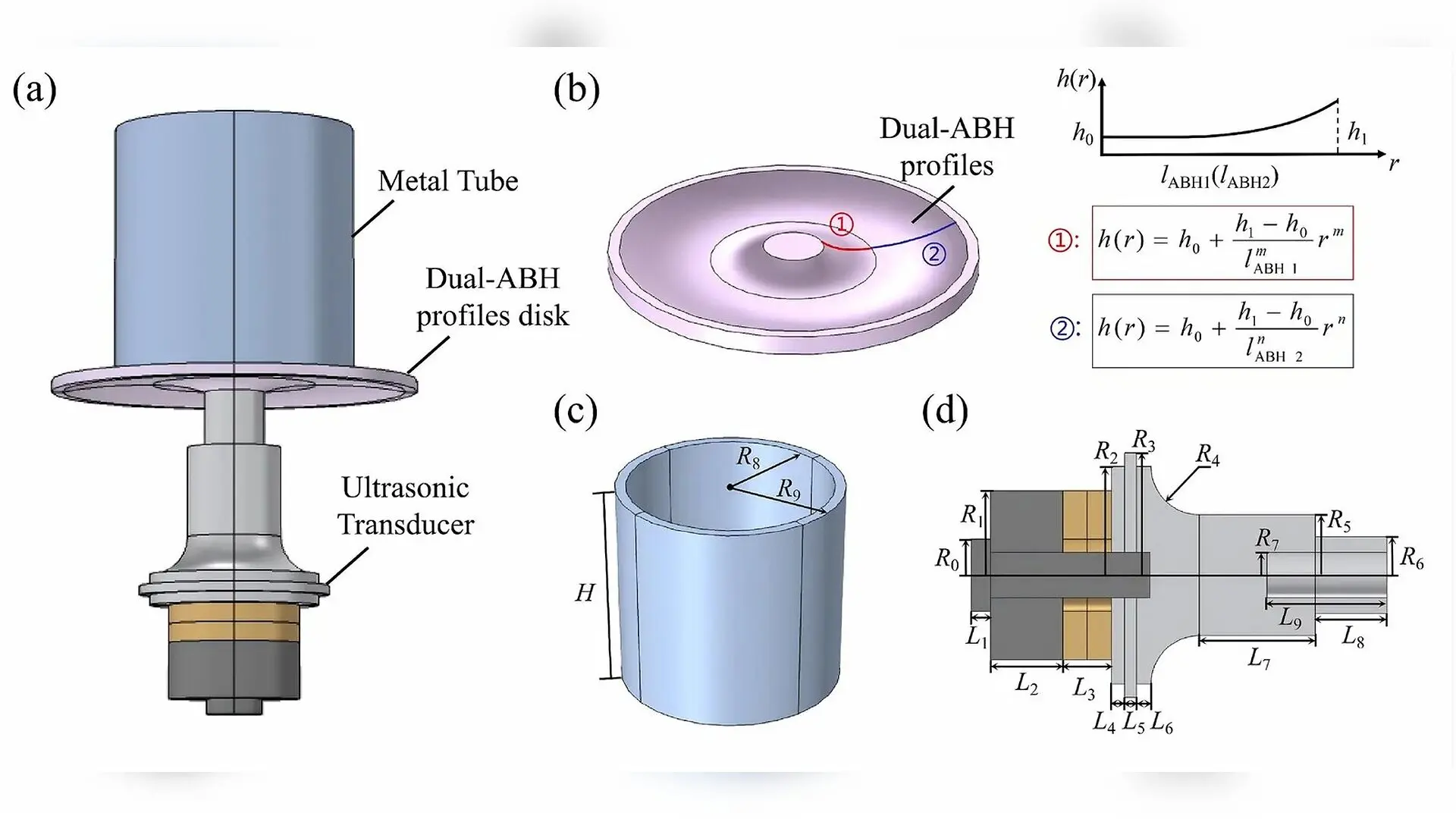
Acoustic technologies that rely on cavitation, such as ultrasonic cleaning, nanostructuring, and chemical oxidation, depend heavily on the ability to concentrate wave energy into tightly defined focal zones. Traditional ultrasonic probes typically suffer from restricted high-energy regions located strictly at the transducer tip, limiting their practical efficiency. To address this persistent limitation, researchers have engineered an innovative acoustic black hole cup-type radiator that merges structural wave trapping with efficient vibration mode conversion.
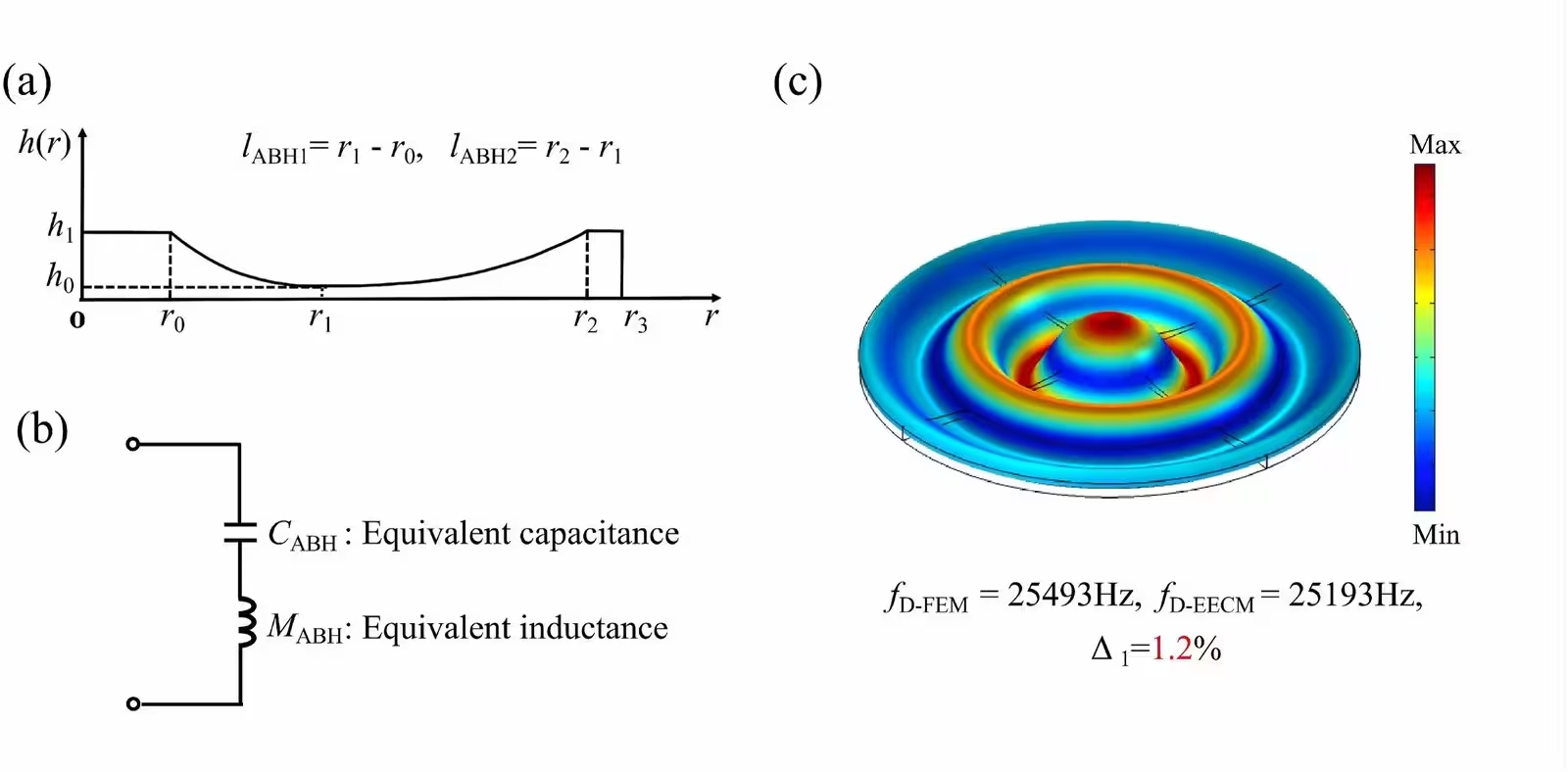
The core innovation, published in Ultrasonics Sonochemistry, centers on a multi-component assembly comprising an ultrasonic transducer, a specially contoured dual acoustic black hole disk, and an outer metal tube. When the transducer is driven electrically, its longitudinal motion excites high-order flexural vibrations across the disk. Because the disk incorporates sequential thickness profiles that obey a power-law mathematical function, it slows down flexural waves and traps acoustic energy near its thinnest region.
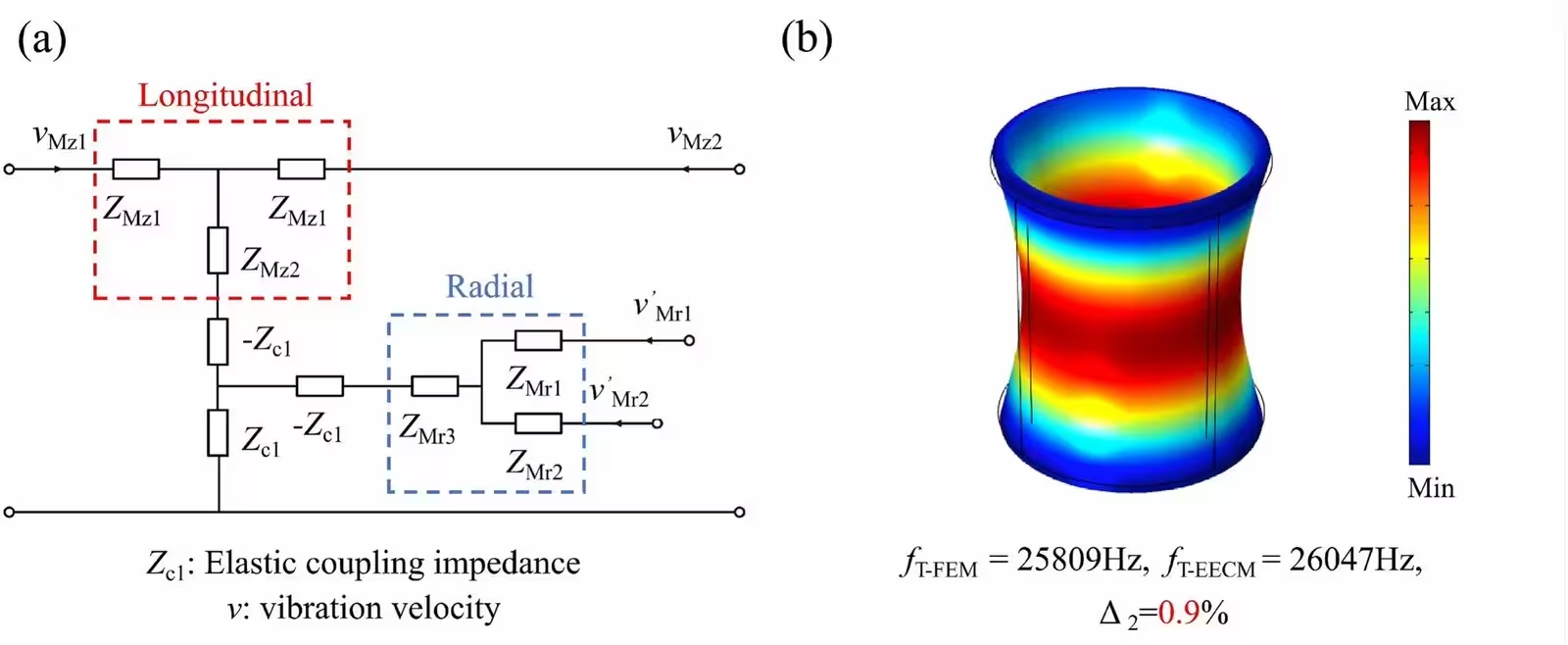
This localized mechanical amplification then excites the surrounding metal tube into a powerful longitudinal-radial coupled vibration via the Poisson effect. The resulting movement radiates focused acoustic waves inward, which superimpose with the axial sound field generated directly by the disk. The outcome is a concentrated, high-intensity superimposed acoustic field that runs down the central axis of the tubular reactor.
Validating Theoretical Models Through Simulation and Experiment
To verify the design, the research team constructed comprehensive electromechanical equivalent circuit models for each individual component, incorporating mechanical impedances, equivalent capacitances, and inductances. Using finite element method simulations in COMSOL, they calculated the expected modal frequencies and displacement profiles. The relative errors between the theoretical circuit equations and the finite element predictions remained remarkably low, generally sitting well below two percent and confirming the structural stability of the framework.
Physical prototypes were subsequently fabricated from structural steel and aluminum. Laser scanning vibrometry measurements revealed that the dual acoustic black hole disk achieved maximum flexural displacements roughly seven times greater than a conventional double-conical reference design. Similarly, the maximum radial displacement of the metal tube experienced a dramatic boost, showing that the acoustic black hole structure successfully improves energy transfer efficiency from the disk to the surrounding fluid medium.
Superior Acoustic Performance in Air and Water
Performance evaluations conducted in both air and water media highlighted the practical advantages of the new configuration. In air-coupled testing environments, the radiator generated sound pressure amplitudes along the central axis that significantly outperformed conventional models, exhibiting peak increases of over thirty percent. Underwater tests inside a filled liquid column showed even more dramatic improvements, with axial sound pressure reaching levels nearly seventy-six percent higher than the control group under identical electrical excitation conditions.
Furthermore, ultrasonic emulsification tests using an oil-and-water mixture demonstrated that the upgraded radiator creates a stable, milky white emulsion much more rapidly and homogeneously. Conductivity measurements tracking ion concentration changes confirmed that the novel design achieved a remarkable conductivity reduction of over ninety-three percent, pointing to a much finer and more thorough dispersion of oil droplets.
By delivering intense energy localization without requiring bulky, high-power electrical supplies, the acoustic black hole cup-type radiator offers a robust, scalable platform for future developments in sonochemical synthesis, advanced wastewater treatment, and targeted medical ultrasonics.
The research was published in Ultrasonics sonochemistry on October 1, 2026.
This article has been fact checked for accuracy, with information verified against reputable sources. Learn more about us and our editorial process.
Last reviewed on .
Article history
- Latest version
Reference(s)
- Zhou, Mengyuan., et al. “Systematic investigation of the ultrasonic cup-type radiator based on acoustic black hole for efficient focalization and cavitation.” Ultrasonics Sonochemistry, vol. 133, October 1, 2026, pp. 108027 Elsevier BV, doi: 10.1016/j.ultsonch.2026.108027. <https://doi.org/10.1016/j.ultsonch.2026.108027>.
Cite this page:
- Posted by John Williams