Meteor Lights Up Arizona Sky In Stunning Celestial Display Above Kitt Peak Observatory
Meteor crosses Arizona’s Kitt Peak Observatory in stunning astrophotographer Petr Horálek’s NOIRLab snapshot
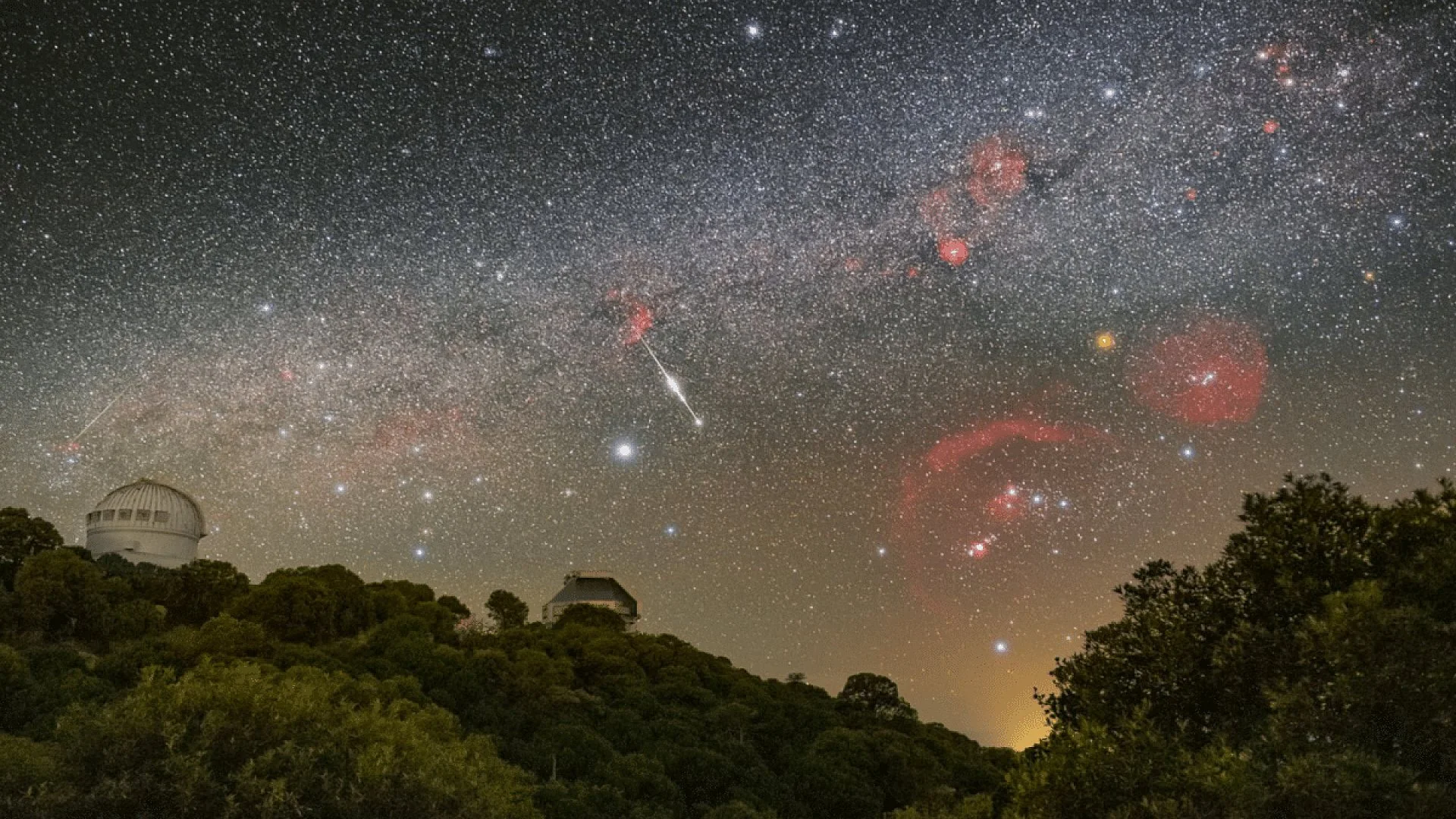
An awe‑inspiring meteor blazed across the darkness above southern Arizona, captured by astrophotographer Petr Horálek. Highlighted by NOIRLab, the image places the glowing visitor over the domes of Kitt Peak National Observatory, juxtaposing the raw energy of a celestial visitor with the precise instruments of modern astronomy.
A Meteor Caught Over Kitt Peak
Snaring a meteor in the act of streaking is exceptionally challenging, as these bright trails typically last only a heartbeat. Horálek’s timing and expertise enabled him to freeze the phenomenon while it passed the telescope domes, producing a composition that underscores both human curiosity and the expanse of space.
The image also showcases the WIYN 0.9‑meter and 3.5‑meter instruments positioned beneath the luminous path, silently monitoring the heavens as the meteor arced overhead. In the background, the constellations Orion and Canis Major are visible, along with vivid red emission nebulae that illuminate the desert night.
The Observatory at the Center of the Frame
Nestled in the Sonoran Desert on land belonging to the Tohono O’odham Nation, Kitt Peak National Observatory operates under the umbrella of NOIRLab, the National Optical‑Infrared Astronomy Research Laboratory. The site has long served as a hub for U.S. astronomical research, hosting a suite of telescopes that explore everything from nearby planets to the most distant galaxies.
By placing the meteor against this backdrop, the photograph highlights how natural sky events intersect with the scientific infrastructure that enables astronomers to track and study the cosmos with exceptional accuracy.
Desert Night Reveals Cosmic Motion
Meteors are typically fragments of comets or asteroids that ignite as they plunge into Earth’s atmosphere, creating brief but striking light shows. While casual observers may catch a fleeting glimpse, documenting such an event on film demands both patience and technical skill.
Horálek’s picture not only preserves the transient blaze but also frames it within the surrounding landscape and research equipment, weaving a visual story of celestial dynamics set against a foundation of human inquiry.
This article has been fact checked for accuracy, with information verified against reputable sources. Learn more about us and our editorial process.
Last reviewed on .
Article history
- Latest version
Reference(s)
- “Don’t Miss the Meteor!.” www.noirlab.edu <https://noirlab.edu/public/images/iotw2622a/>.
Cite this page:
- Posted by Karan Das