Astronomers May Have Found the Best Way Yet to Detect the Universe’s Hidden Black Hole Pairs
Repeating starlight flashes may reveal hidden supermassive black holes soon
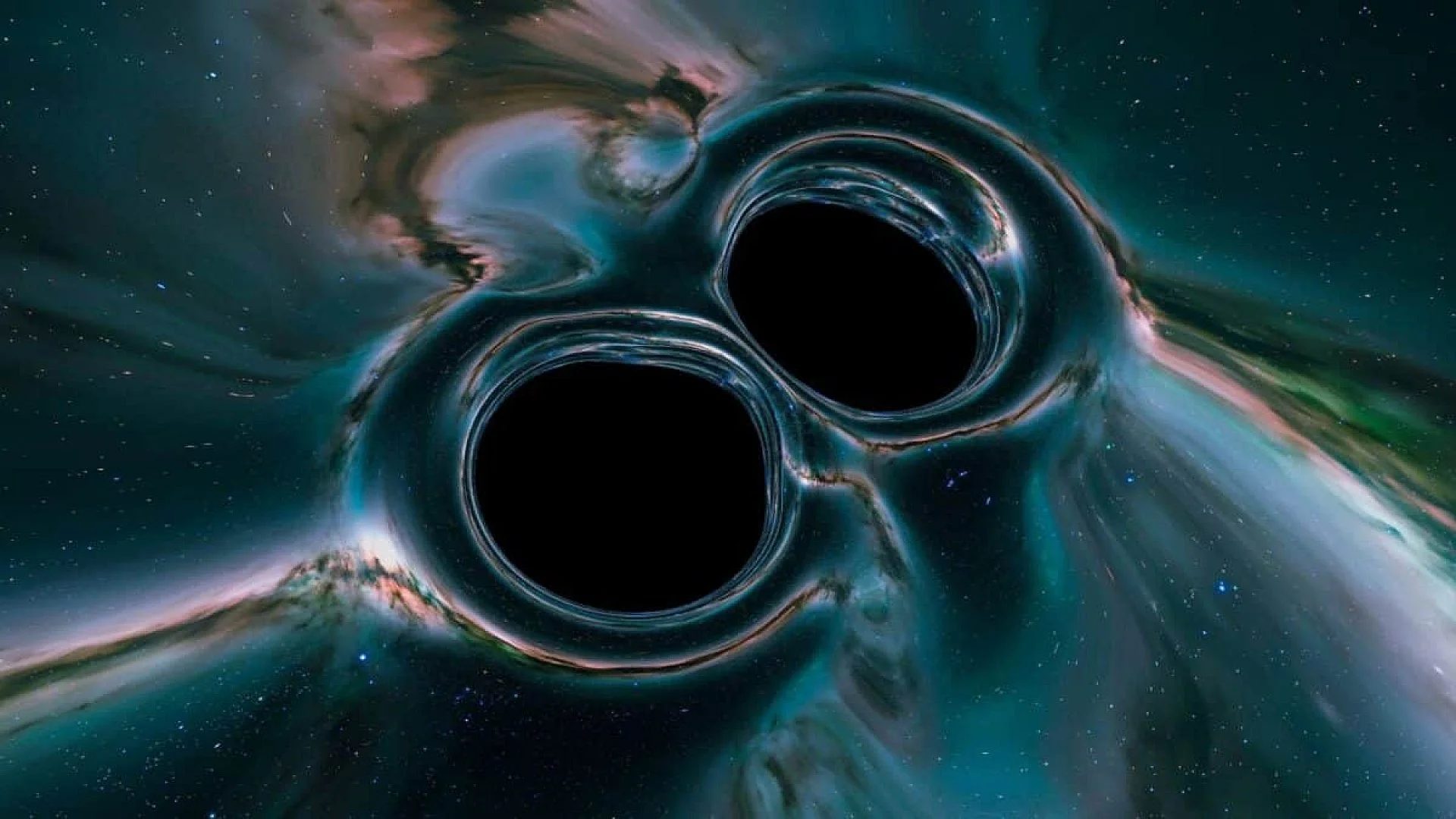
A new theoretical analysis suggests that astronomers could identify tightly bound supermassive black‑hole pairs by watching for recurring bursts of light from stars situated behind them. The proposed signal would appear as a series of bright flashes, each triggered when the binary’s gravitational lens sweeps across a background star.
The research, conducted by scientists at the University of Oxford and the Max Planck Institute for Gravitational Physics, appears in Physical Review Letters. The authors argue that the combined gravity of two orbiting supermassive black holes can focus starlight in a distinctive way, offering a potential shortcut to detection while future space‑based gravitational‑wave observatories are still under development.
Identifying close‑separation black‑hole binaries has proved difficult. Although astronomers have catalogued a handful of widely spaced supermassive black holes, the tighter systems that should emerge after galaxy mergers remain largely invisible, despite their importance for models of galaxy growth.
Binary Giants Expected From Merging Galaxies
Most massive galaxies are thought to harbour a supermassive black hole at their core. When two galaxies collide, their central black holes can become gravitationally bound, forming a supermassive black‑hole binary. Theory predicts that such pairs should be common throughout the cosmos, yet their proximity makes direct observation extremely challenging.
According to the study, available on Physical Review Letters, these binaries are also expected to emit strong gravitational‑wave signals. Space missions slated for the next decade aim to capture those ripples directly, but until then researchers are exploring indirect signatures such as the lensing effect described here.
Lensing Effects From Paired Black Holes
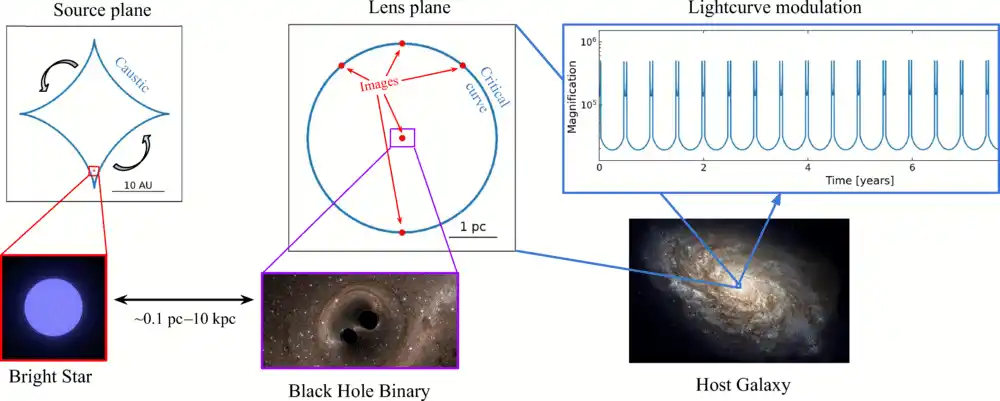
Gravitational lensing occurs when massive objects bend the path of light. “Supermassive black holes act as natural telescopes,” said Dr Miguel Zumalacárregui of the Max Planck Institute for Gravitational Physics. “Because of their enormous mass and compact size, they strongly bend passing light. Starlight from the same host galaxy can be focused into extraordinarily bright images, a phenomenon known as gravitational lensing.”
A solitary black hole can magnify a background star only when the three‑body alignment is extremely precise. In a binary, however, the two massive objects generate a larger region of strong magnification, forming a diamond‑shaped caustic curve. When a star traverses this area, its observed brightness can increase dramatically. Although an ideal point‑like source would experience infinite magnification, real stars have finite sizes that cap the amplification.
“The chances of starlight being hugely amplified increase enormously for a binary compared to a single black hole,” said Professor Bence Kocsis from the University of Oxford.
Because the caustic region is larger and moves with the orbit, the probability of catching a lensing event rises substantially compared with a lone black hole.
Repeating Brightening as a Binary Signature
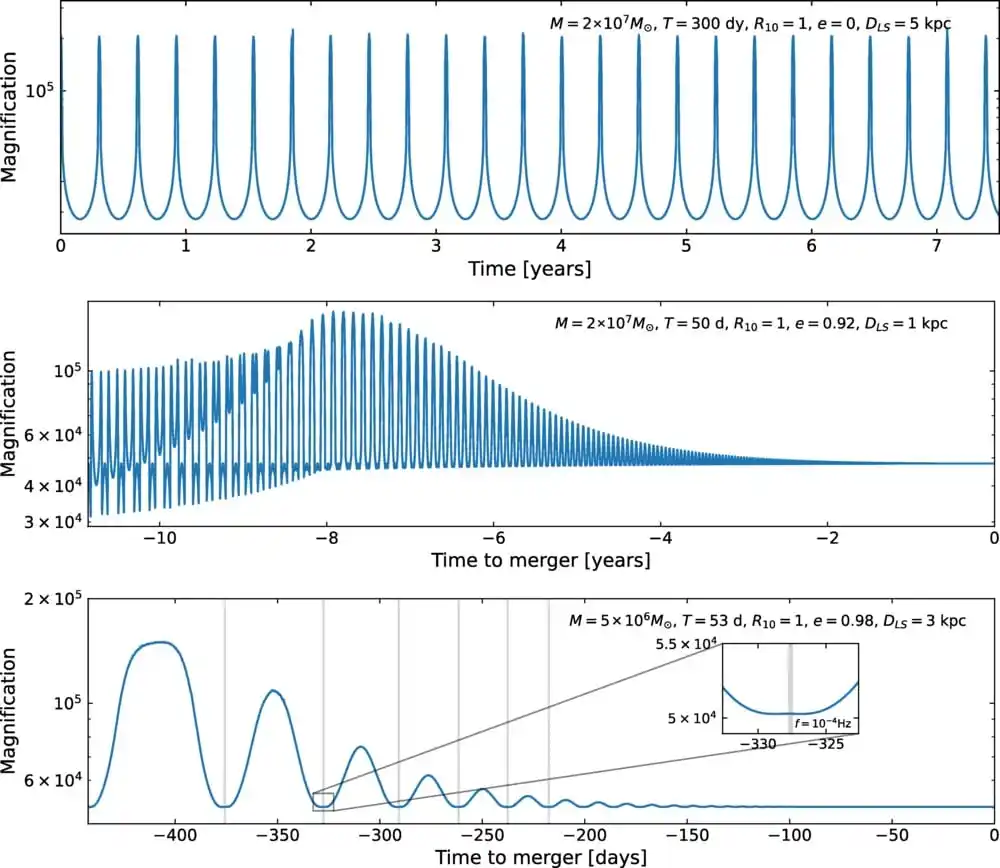
As the two black holes spiral inward, they lose energy through gravitational‑wave emission, causing their orbit to shrink. This evolution makes the caustic curve rotate and change shape, sweeping across a wide swath of background stars. Each crossing can generate a brief, intense flash of light.
Lead author Hanxi Wang explained, “As the binary moves, the caustic curve rotates and changes shape, sweeping across a large volume of stars behind it. If a bright star lies within this region, it can produce an extraordinarily bright flash each time the caustic passes over it.”
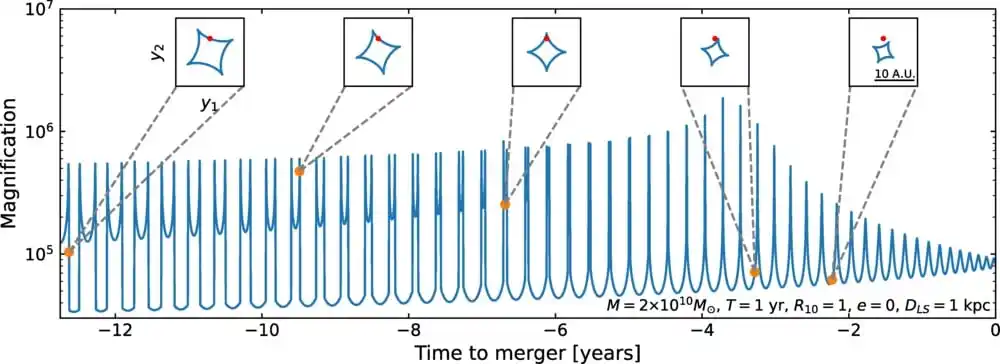
The resulting pattern of recurring flashes could reveal both the masses of the black holes and the rate at which their orbit is decaying. Upcoming facilities such as the Vera C. Rubin Observatory and the Nancy Grace Roman Space Telescope are expected to monitor large swaths of the sky for exactly this kind of periodic brightening, potentially opening a new window onto a class of black‑hole binaries that has so far evaded detection.
This article has been fact checked for accuracy, with information verified against reputable sources. Learn more about us and our editorial process.
Last reviewed on .
Article history
- Latest version
Reference(s)
- Wang, Hanxi., et al. “Black Holes as Telescopes: Discovering Supermassive Binaries through Quasiperiodic Lensed Starlight.” Physical Review Letters, vol. 136, no. 6, February 12, 2026 American Physical Society (APS), doi: 10.1103/1sfl-87t4. <https://journals.aps.org/prl/abstract/10.1103/1sfl-87t4>.
- “Dr. Miguel Zumalacarregui | Max Planck Institute for Gravitational Physics (Albert Einstein Institute).” <https://www.aei.mpg.de/person/104068>.
- “Bence Kocsis.” University of Oxford Department of Physics <https://www.physics.ox.ac.uk/our-people/kocsis>.
- <https://www.researchgate.net/profile/Hanxi-Wang-5>.
- Cermak, Alicia. “Nancy Grace Roman Space Telescope - NASA Science.”, June 15, 2023 NASA <https://science.nasa.gov/mission/roman-space-telescope/>.
Cite this page:
- Posted by Karan Das