A Mars Crescent Captured by a Tiny Spacecraft Reveals Never-Before-Seen Details
This small probe has unveiled Mars in a way that was previously unimaginable, revealing a side of the Red Planet that had remained hidden from view.
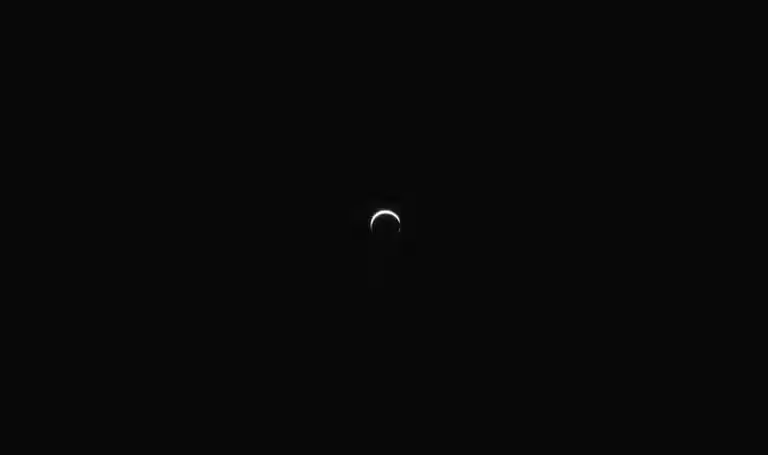
NASA’s Psyche mission has captured a breathtaking image of Mars, taken from a staggering 3 million miles away. The photograph, snapped ahead of a crucial gravity assist maneuver set for May 15, provides a unique glimpse into the Red Planet’s atmosphere and surface. This image is a vital piece of data for the mission, offering insights into the Martian environment that will aid the spacecraft’s journey to its ultimate destination, the metal-rich asteroid Psyche, in 2029.
The Psyche mission, which aims to explore the enigmatic asteroid Psyche, has been taking a circuitous route to its destination. Since its successful launch in 2023, the spacecraft has been hurtling through space, utilizing gravitational assists to gain speed and adjust its trajectory. The upcoming flyby of Mars will give the spacecraft the necessary boost to propel it towards Psyche, marking a significant milestone in its journey.
Unveiling the Crescent Shape of Mars
Captured from a high-angle perspective, the image presents Mars as a slender crescent, reminiscent of the way Earth’s Moon appears during its new phase. According to NASA, the photograph was taken using the spacecraft’s multispectral imager with a panchromatic filter and a brief 2-millisecond exposure. Despite the short exposure time, the bright crescent of Mars is clearly visible, with certain areas appearing oversaturated due to the scattering of sunlight by the Martian atmosphere.
The dusty Martian atmosphere plays a crucial role in this phenomenon, with dust particles reflecting and scattering sunlight, bending the light around the planet and extending the visible crescent. The degree of brightness is influenced by the dust content in the atmosphere, making it challenging to predict the exact appearance of the crescent in advance.
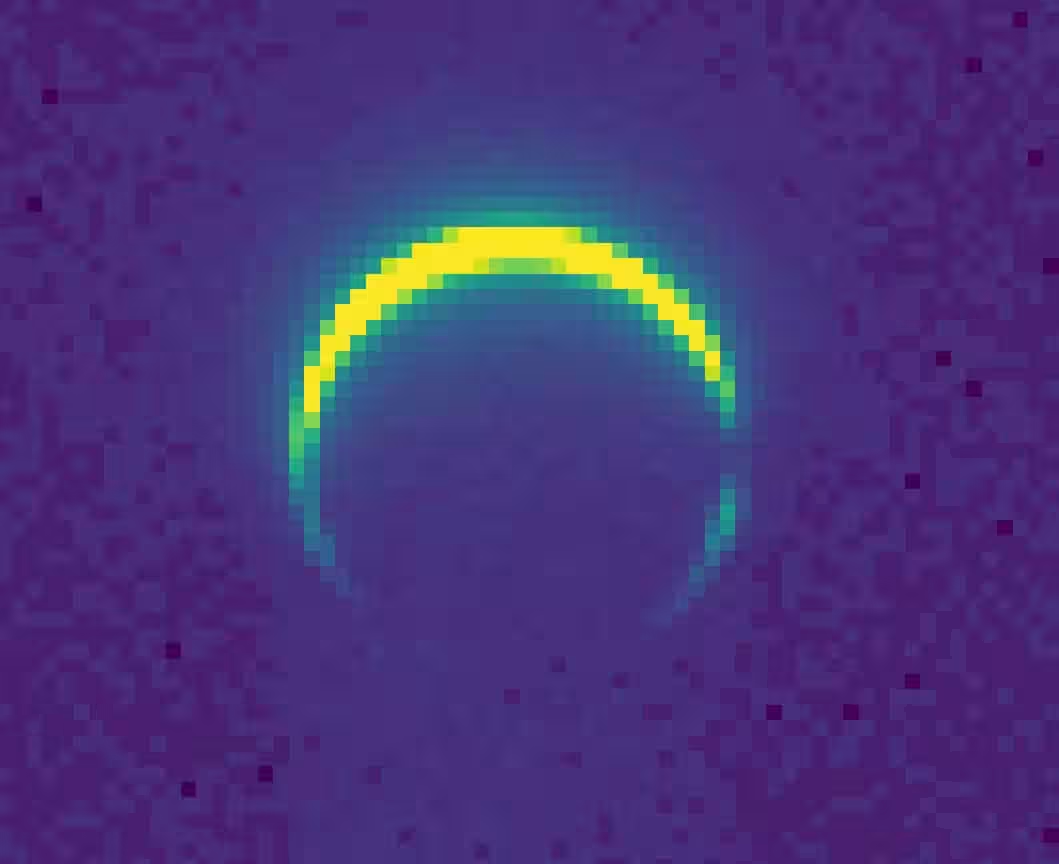
The Martian atmosphere’s dust content is not uniform, with variations in the distribution of dust around the planet. These seasonal fluctuations can significantly impact the overall brightness of Mars, which has important implications for future missions. The gap seen on the right side of the crescent, where Mars’ north polar cap lies, may be experiencing seasonal changes that could influence its atmospheric conditions.
Seasonal Shifts at the North Pole
An interesting feature in the image is the gap seen on the right side of the crescent, where Mars’ north polar cap lies. Currently in winter, this region of the planet may be experiencing seasonal changes that could influence its atmospheric conditions. NASA scientists speculate that the gap corresponds to clouds or hazes forming over the polar region, which may prevent the dust in Mars’ atmosphere from scattering sunlight in the same way it does elsewhere.
The presence of these seasonal clouds may alter how sunlight interacts with the planet, and studying them will help scientists understand Mars’ ever-changing climate. The Martian atmosphere’s dust content is not uniform, with variations in the distribution of dust around the planet. These seasonal fluctuations can significantly impact the overall brightness of Mars, which has important implications for future missions.
Preparing for the Journey Ahead
The photograph of Mars is part of the broader preparation process for the Psyche mission. As the spacecraft approaches its next major objective, these tests allow the team to refine their techniques and improve the quality of future images. According to the U.S. Space Agency release:
“The Psyche mission’s imager team will be acquiring, processing, and interpreting similar images in the lead-up to the close approach on May 15. The images are primarily designed to calibrate the cameras and to characterize their performance in flight as a practice run for the approach to asteroid Psyche in 2029.”
This article has been fact checked for accuracy, with information verified against reputable sources. Learn more about us and our editorial process.
Last reviewed on .
Article history
- Latest version
Cite this page:
- Posted by Karan Das