Europe Reveals A Rocket That Could Outperform SpaceX’s Starship Efficiency
Europe introduces the RLV C5, a partially reusable rocket engineered to compete with SpaceX’s Starship by offering enhanced efficiency and forward-thinking design.

In a groundbreaking move that could revolutionize the heavy-lift rocketry industry, Europe has unveiled plans for a partially reusable launch vehicle capable of lifting over 70 tons into orbit. According to a recent analysis in the CEAS Space Journal, this innovative concept could provide a more efficient and sustainable alternative to SpaceX’s Starship, which has already made history with its record-breaking tests.
A New Era for Spaceflight
SpaceX’s Starship achieved a historic milestone in 2023, firing all 33 engines simultaneously and rising from Texas for the first time. While not flawless, these flights marked the start of a new era for spaceflight, demonstrating a fully reusable rocket capable of sending enormous payloads to orbit.
Independent studies from the German Aerospace Center (DLR), drawing on publicly available telemetry, confirm that Starship can currently deliver about 59 tons to low Earth orbit in reusable mode, approaching the payload capacity of a fully expendable Falcon Heavy. The implications are significant, as this technology could potentially disrupt the status quo in the space industry.

Credit: Steve Jurvetson
Future versions of Starship could push beyond 115 tons, potentially eclipsing the Saturn V. The global question is no longer if Starship will change the game, but how nations and private companies respond to this new reality.
Europe’s RLV C5: A Different Approach
DLR researchers have proposed the RLV C5, a European alternative designed with efficiency in mind. Instead of matching Starship’s raw size, the RLV C5 combines a winged reusable booster, inspired by the SpaceLiner project, with an expendable upper stage powered by liquid hydrogen and oxygen. This choice of propellant provides higher efficiency than Starship’s methane-oxygen engines.

Unlike Starship’s vertical landing method, the booster glides back through the atmosphere and is captured mid-air by a subsonic aircraft. This eliminates the need to reserve fuel for landing burns, allowing more of the rocket’s mass to contribute to reaching orbit. Early models suggest 74% of its launch mass becomes payload, compared to Starship’s 40%, demonstrating that strategic design can sometimes outweigh sheer size.
The RLV C5: A Strategic Choice
The RLV C5 and Starship illustrate different approaches to heavy-lift missions. Starship’s enormous capacity and rapid reuse make it ideal for lunar bases, Mars missions, and massive satellite constellations. The RLV C5, in contrast, offers Europe an intermediate step toward super-heavy lift capabilities without the extraordinary investment required for full reusability.
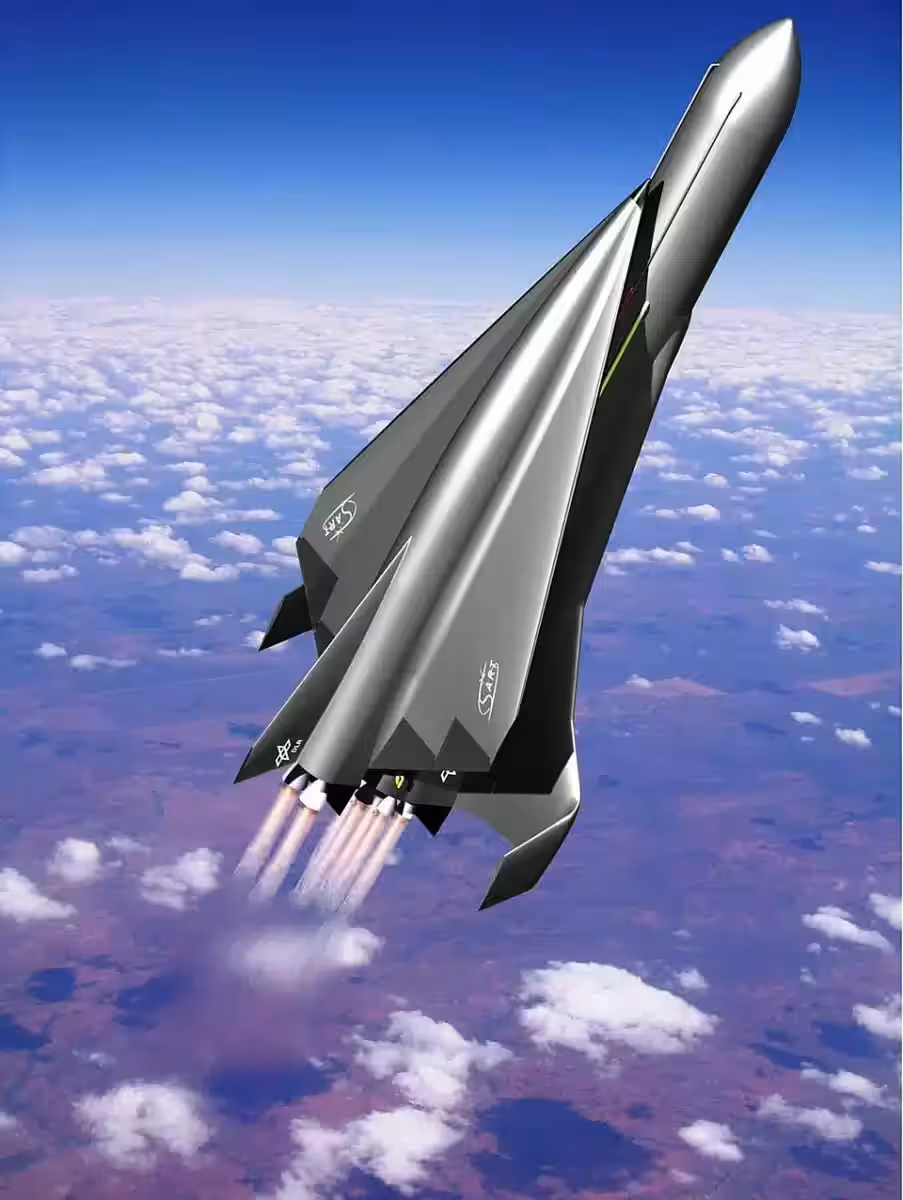
Credit: ToSch1983Deutsches Zentrum
DLR researchers emphasize that this is not a direct competition but a deliberate choice in approach. By focusing on efficiency, Europe could secure sovereign access to orbit while gradually developing the technologies for fully reusable vehicles.
The Challenges Ahead
Despite the conceptual promise of the RLV C5, Starship is already operational, even if early flights were imperfect. The German researchers caution that transitioning from concept to functioning hardware is a major challenge. Starship’s thermal protection system, for instance, required complete redesigns after damage during early tests.
Rapid reusability remains an unsolved engineering problem, and Europe faces the hurdle of turning the RLV C5 from paper into flight-ready reality. Yet, as lead author Moritz Herberhold notes in the CEAS Space Journal, the design offers a “practical path for Europe to independently develop partially reusable super-heavy launch capabilities,” highlighting that sometimes smarter engineering can outweigh being first.
Europe’s Path Forward
The RLV C5 could serve as a stepping stone within the broader SpaceLiner program, providing valuable experience in reusable vehicle operations while building a European heavy-lift ecosystem. By emphasizing fuel efficiency, simpler recovery methods, and intermediate scalability, the project could give Europe a unique position in the rapidly evolving landscape of space access. While Starship dominates headlines with its ambition and scale, the RLV C5 exemplifies a different philosophy: measured, efficient, and strategically sound development that could redefine Europe’s role in the new space era.
This article has been fact checked for accuracy, with information verified against reputable sources. Learn more about us and our editorial process.
Last reviewed on .
Article history
- Latest version
Reference(s)
- Herberhold, Moritz., et al. “Comparison of SpaceX’s Starship with winged heavy-lift launcher options for Europe.” CEAS Space Journal, vol. 18, no. 1, May 28, 2025, pp. 121-144. Springer Science and Business Media LLC, doi: 10.1007/s12567-025-00625-8. <https://link.springer.com/article/10.1007/s12567-025-00625-8>.
Cite this page:
- Posted by Karan Das