Astronomers Uncover Interstellar Comet Hiding In Earlier Telescope Images
Astronomers recently found that the Rubin Observatory had captured images of interstellar comet 3I/ATLAS a full ten days prior to its initial official identification.
A groundbreaking discovery has been made by astronomers, revealing that the interstellar comet 3I/ATLAS was actually captured in images taken by the Vera C. Rubin Observatory ten days before its official detection on July 1, 2025. Analysis of these early observations, published in The Astrophysical Journal Letters, provides a rare glimpse into the early journey of an interstellar object through our solar system, showcasing the comet’s activity and visibility even before its official recognition.
Unveiling the Hidden Potential of Rubin Observatory
Before 3I/ATLAS was officially recognized, the Vera C. Rubin Observatory in Chile had already imaged the comet during its science validation phase, which began on June 20, 2025. The telescope’s commissioning data revealed the comet on its very first night of practice imaging, a full ten days before the Asteroid Terrestrial-impact Last Alert System (ATLAS) identified it. Colin Orion Chandler of the University of Washington and his team sifted through this early data using a custom processing pipeline, as Rubin’s standard data-handling system was not yet operational.
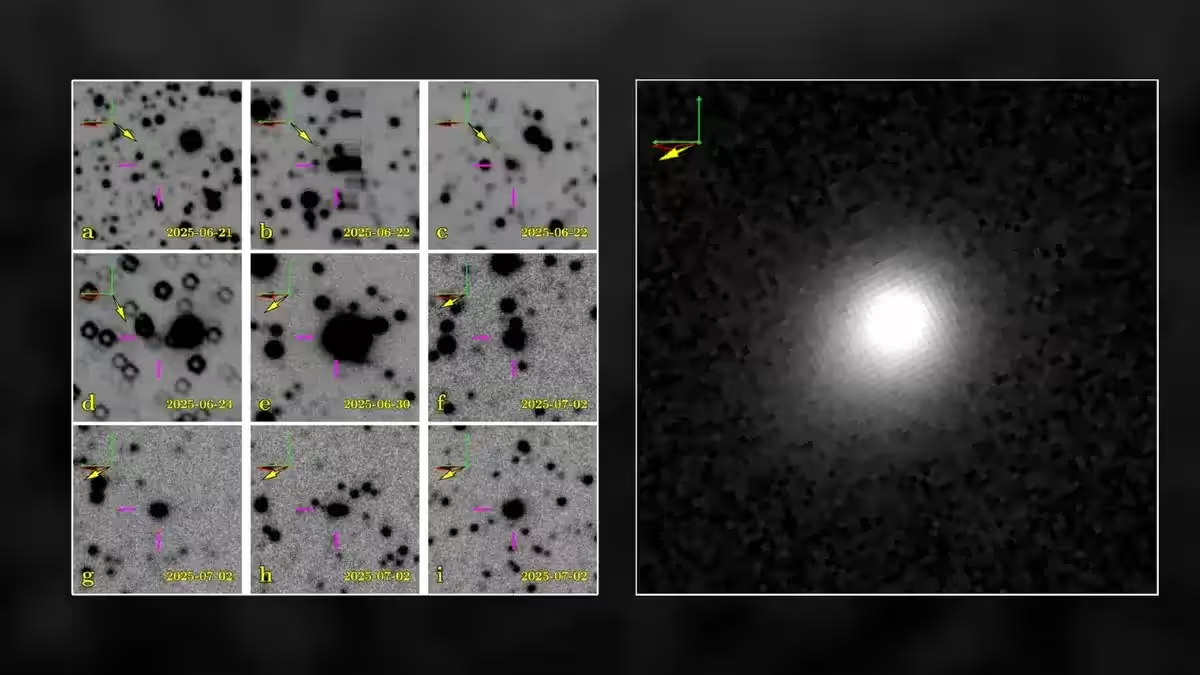
(Image credit: Chandler et al. 2026)
Chandler notes that Rubin’s early capture of 3I/ATLAS demonstrates the observatory’s potential: “If the science validation phase had begun a few weeks earlier, the telescope’s pipelines could have been fully functional in time to officially discover this interstellar visitor first.” Over the course of late June and July, Rubin imaged the comet multiple times, showing its active coma, a cloud of dust and gas, clearly visible as it heated up approaching the sun. These observations suggest that Rubin could detect many more interstellar comets in the future, possibly one per year, highlighting the promise of its Legacy Survey of Space and Time mission.
Joint Spacecraft Observations Unveil Chemical Secrets
3I/ATLAS has been closely monitored by spacecraft en route to Jupiter, including ESA’s JUICE and NASA’s Europa Clipper missions. These spacecraft coordinated observations when the comet passed between them in late 2025, with JUICE observing the dayside and Europa Clipper the nightside.
“As the comet passed between JUICE and Europa Clipper, we were able to informally coordinate observations between the two spacecraft,” said SwRI’s Kurt Retherford in a statement.
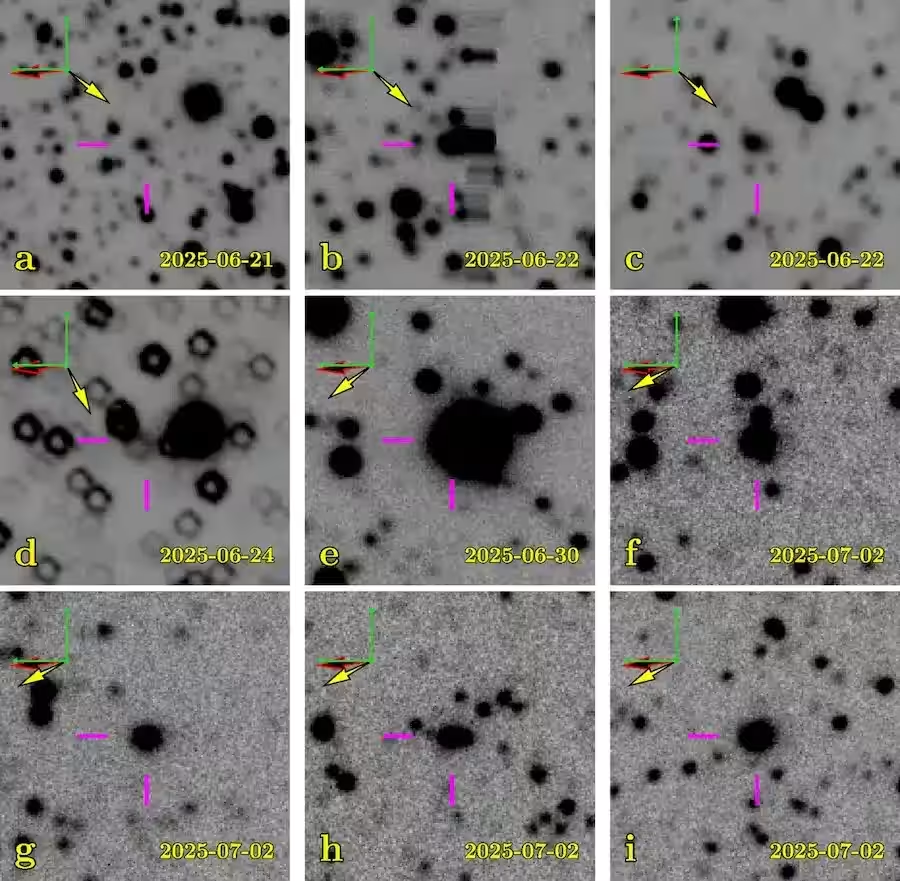
(Image credit: Chandler et al. 2026)
The ultraviolet spectrographs on both missions detected hydrogen, oxygen, and carbon atoms released when molecular gases from the comet’s nucleus were broken down by sunlight. The abundance of carbon in 3I/ATLAS exceeded what is typical for solar system comets, echoing earlier findings from the James Webb Space Telescope, which had observed excess carbon dioxide in the comet’s coma. These chemical signatures allow researchers to compare interstellar objects with local comets, shedding light on the environments where such bodies formed.
“By studying the ratio of water-ice and dry ice [i.e. carbon-dioxide ice], we can compare the composition of this interstellar comet to comets native to our solar system,” said SwRI’s Philippa Molyneux. “This helps us understand if the solar system where 3I/ATLAS formed is similar to ours or different.”
Unveiling the Secrets of an Ancient Traveler
Analysis of 3I/ATLAS shows it is likely between seven and twelve billion years old, with a nucleus roughly one kilometer wide and a high velocity of 140,000 mph (61 km/s). Its speed and composition suggest it has undergone multiple stellar encounters before entering our solar system. Observations during perihelion in October 2025, when the comet was hidden behind the sun from Earth, revealed active outgassing and reinforced earlier compositional findings.
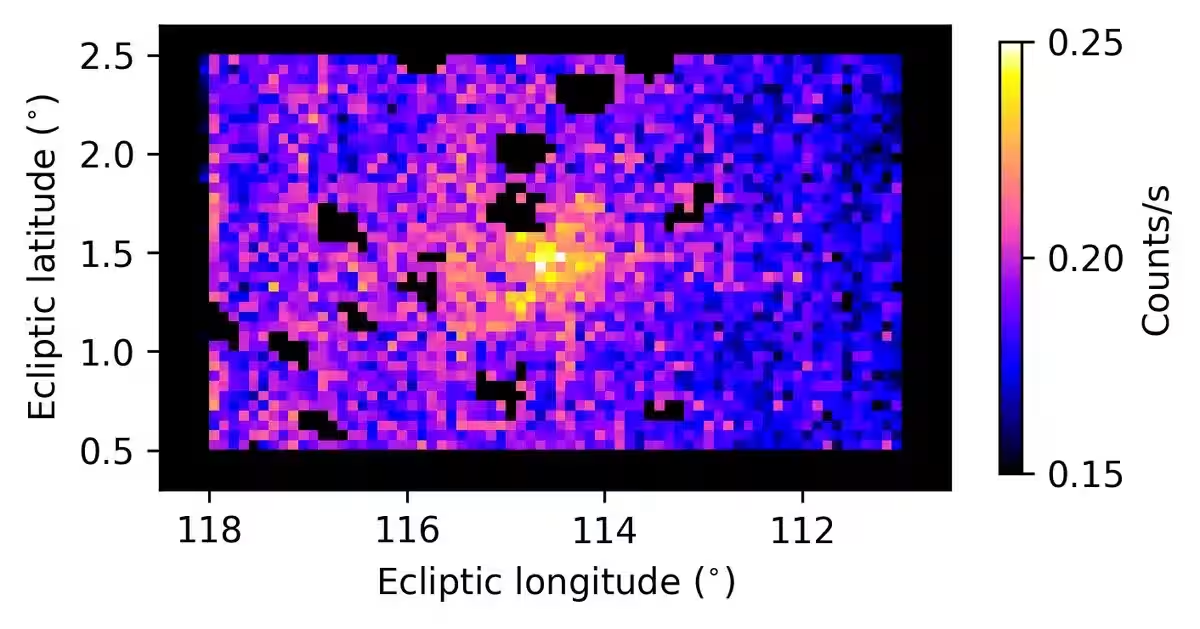
(Image credit: NASA/ESA/Southwest Research Institute)
The combined data from Rubin Observatory, published in The Astrophysical Journal Letters. and multiple space missions now provides a detailed portrait of an interstellar comet at an unprecedented level of resolution. As researchers continue to study 3I/ATLAS, these findings are expected to guide predictions of future interstellar visitors, helping scientists identify and characterize them more quickly as they pass through our solar system.
This article has been fact checked for accuracy, with information verified against reputable sources. Learn more about us and our editorial process.
Last reviewed on .
Article history
- Latest version
Reference(s)
- Chandler, Colin Orion., et al. “NSF-DOE Vera C. Rubin Observatory Observations of Interstellar Comet 3I/ATLAS (C/2025 N1).” The Astrophysical Journal Letters, vol. 1001, no. 2, April 20, 2026, pp. L35 American Astronomical Society, doi: 10.3847/2041-8213/ae4b3a. <https://iopscience.iop.org/article/10.3847/2041-8213/ae4b3a>.
Cite this page:
- Posted by Karan Das