NASA’s Psyche Probe Zooms Past Mars At 12,333 MPH Today
NASA’s Psyche spacecraft will make a close approach to Mars today, passing within 2,800 miles of the Red Planet to test its onboard instruments and receive a critical velocity boost en route to a distinctive metal-rich asteroid.
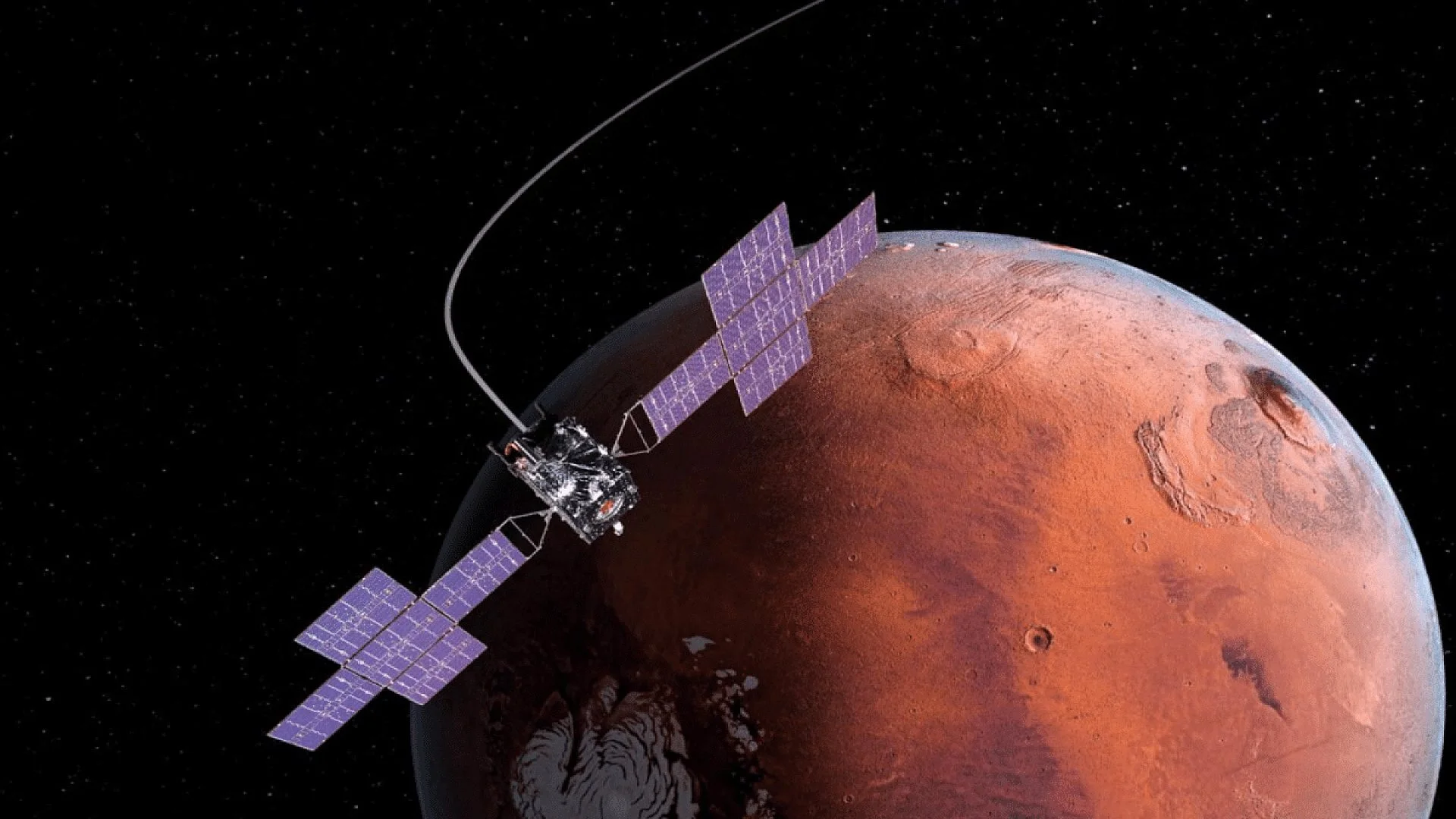
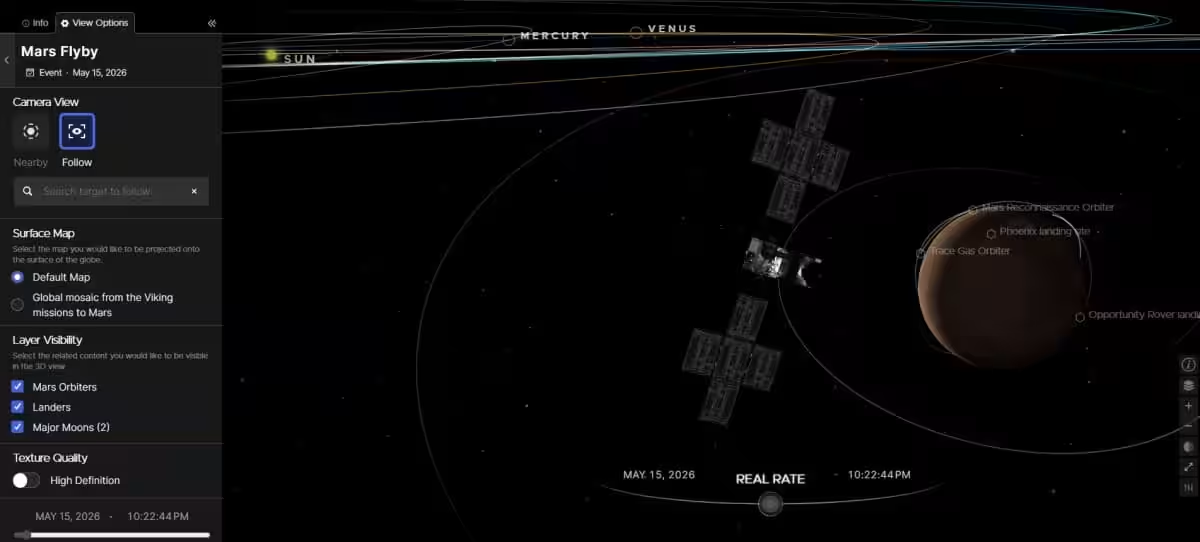
NASA’s Psihe spacecraft is set to make a groundbreaking close approach to Mars today, narrowly skirting the Red Planet at a distance of approximately 2,800 miles. This pivotal flyby marks a crucial milestone in the mission’s six-year odyssey to the 16 Psyche asteroid, a rare, metal-rich object residing in the main asteroid belt, according to NASA. As the spacecraft hurtles through space, the maneuver will not only accelerate its trajectory but also provide scientists with a unique opportunity to fine-tune its instruments on a planetary target before reaching its final destination in 2029.
Harnessing Mars’ Gravity: A Key to Interplanetary Travel
The flyby cleverly leverages Mars’ gravity to propel Psyche at an even greater velocity, conserving its xenon propellant for the arduous journey ahead. This ingenious maneuver, known as a gravity assist, is a cornerstone of interplanetary travel, enabling missions to reach distant targets with minimal fuel consumption.
The Psihe spacecraft embarked on its mission in October 2023, with the primary objective of exploring 16 Psyche, believed to be the exposed core of an ancient planetesimal. “We are now precisely on target for the flyby, and we’ve programmed the flight computer with every detail that the spacecraft will execute throughout May,” Sarah Bairstow, Psyche’s mission planning lead at NASA’s Jet Propulsion Laboratory in Southern California, stated in a NASA statement. “This is our first chance in flight to calibrate Psyche’s imager with something larger than a few pixels, and we’ll also make observations with the mission’s other science instruments.”
Credit: NASA
Unlocking the Secrets of Mars and Its Surroundings
During the close approach, Psyche’s multispectral imager will capture thousands of detailed observations of Mars, providing scientists with a wealth of information about the Red Planet’s subtle features. These images will not only calibrate the instruments for later asteroid observations but also help researchers study the Martian environment.
The mission team hopes to detect a faint dusty ring or torus around Mars, thought to form when micrometeorites strike its moons, Phobos and Deimos, ejecting tiny particles into space. Sunlight scattering through this dust could make it visible to Psyche’s instruments. The flyby also allows the team to search for small satellites around Mars, refining techniques that will later be used to identify tiny moonlets near the asteroid.
“If all our instruments are powered up, and we can do important testing and calibration of the science instruments, that would be the icing on the cake,” Lindy Elkins-Tanton, principal investigator for Psyche at the University of California, Berkeley, said.
Preparing for a Rare Asteroid Encounter
16 Psyche is unique because it is likely the exposed nickel-iron core of a planetesimal, offering a rare glimpse into the internal structure of a body similar to the cores of terrestrial planets. Studying it could answer fundamental questions about planetary formation and the early solar system.
Psihe’s Mars flyby is the mission’s first major planetary encounter and a critical rehearsal for its future work in the asteroid belt. Every observation taken during this pass, from planetary features to faint dust and potential satellites, enhances the mission’s readiness and the quality of data scientists hope to gather at 16 Psyche.
This article has been fact checked for accuracy, with information verified against reputable sources. Learn more about us and our editorial process.
Last reviewed on .
Article history
- Latest version
Reference(s)
- Carney, Stephen. “NASA’s Psyche Mission to Fly by Mars for Gravity Assist - NASA Science.”, May 8, 2026 NASA <https://science.nasa.gov/blogs/psyche/2026/05/08/nasas-psyche-mission-to-fly-by-mars-for-gravity-assist/>.
Cite this page:
- Posted by Karan Das