Old Space Junk From the 1960s Just Revealed a Hidden Effect of the Sun on Earth’s Orbit
Researchers recently uncovered an unusual solar phenomenon that accelerates the descent of space debris back to Earth far quicker than anticipated. This breakthrough emerged from analyzing remnants that have lingered in orbit since the 1960s.

Research published in Frontiers in Astronomy and Space Sciences reveals that space debris orbiting Earth loses altitude more rapidly when the Sun becomes highly active. Scientists observed that once solar activity reaches a certain intensity, atmospheric drag increases enough to accelerate the descent of debris in low Earth orbit.
The study sheds light on a growing issue for satellite operators and space agencies as low Earth orbit becomes increasingly crowded with active spacecraft and abandoned objects. Low Earth orbit, commonly referred to as LEO, is used by Earth-observation satellites, communications systems, and internet constellations such as Starlink. The region, located between about 400 and 2,000 kilometers above Earth, is also filled with debris from decades of launches and collisions. Old rocket stages, fragments from destroyed satellites, and inactive spacecraft continue orbiting the planet at high speed.
The Sun’s Cycles Directly Impact Orbital Decay
The Sun alternates between quiet and active periods in an approximately 11-year cycle. During active phases, sunspots become more numerous and solar emissions intensify, including ultraviolet radiation and charged particles. Researchers explain that this increase in solar energy heats the thermosphere, the upper layer of Earth’s atmosphere extending from around 100 to 1,000 kilometers in altitude. As temperatures rise, the thermosphere expands outward.
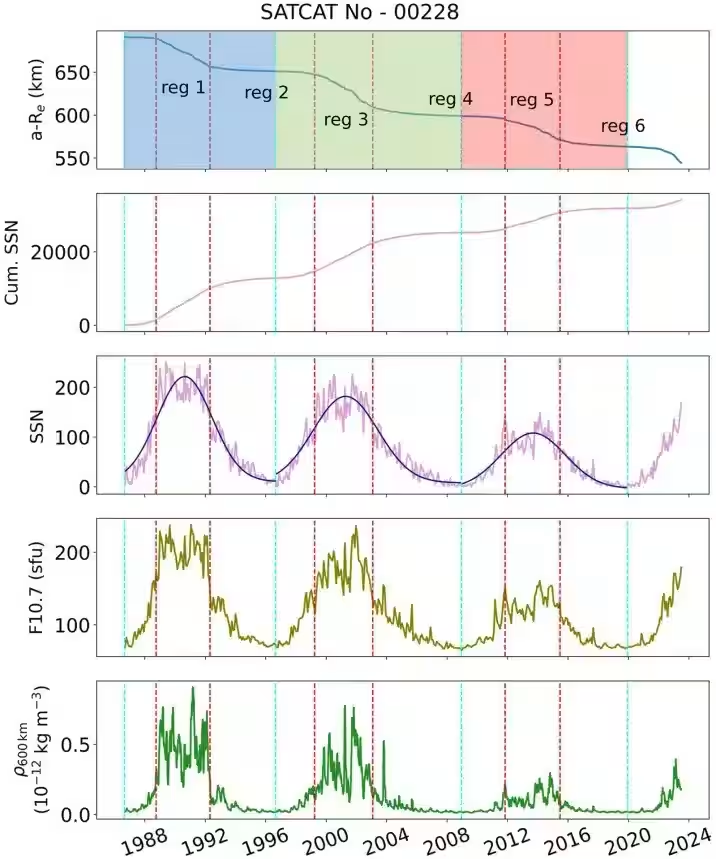
That expansion increases atmospheric density at orbital altitudes used by many satellites and debris objects. Denser atmospheric conditions create stronger drag, slowing objects and causing them to descend more quickly toward Earth.
“Here we show that space debris around Earth loses altitude much faster when the Sun is more active,”said Dr. Ayisha Ashruf of the Vikram Sarabhai Space Centre in the paper. She added that: “For the first time, we find that once solar activity passes a certain level, this loss of altitude happens noticeably more quickly.”
The study also refers to the most recent solar maximum in 2024, a period marked by elevated solar emissions. Those emissions were linked to stronger atmospheric drag on orbiting objects.
Long-Forgotten Debris Reveals New Insights
To analyze the phenomenon, the researchers tracked 17 debris objects in low Earth orbit over a period covering 36 years and spanning solar cycles 22 through 24. The objects orbit Earth between 600 and 800 kilometers above the surface and complete an orbit every 90 to 120 minutes. None of them has yet reentered the atmosphere.
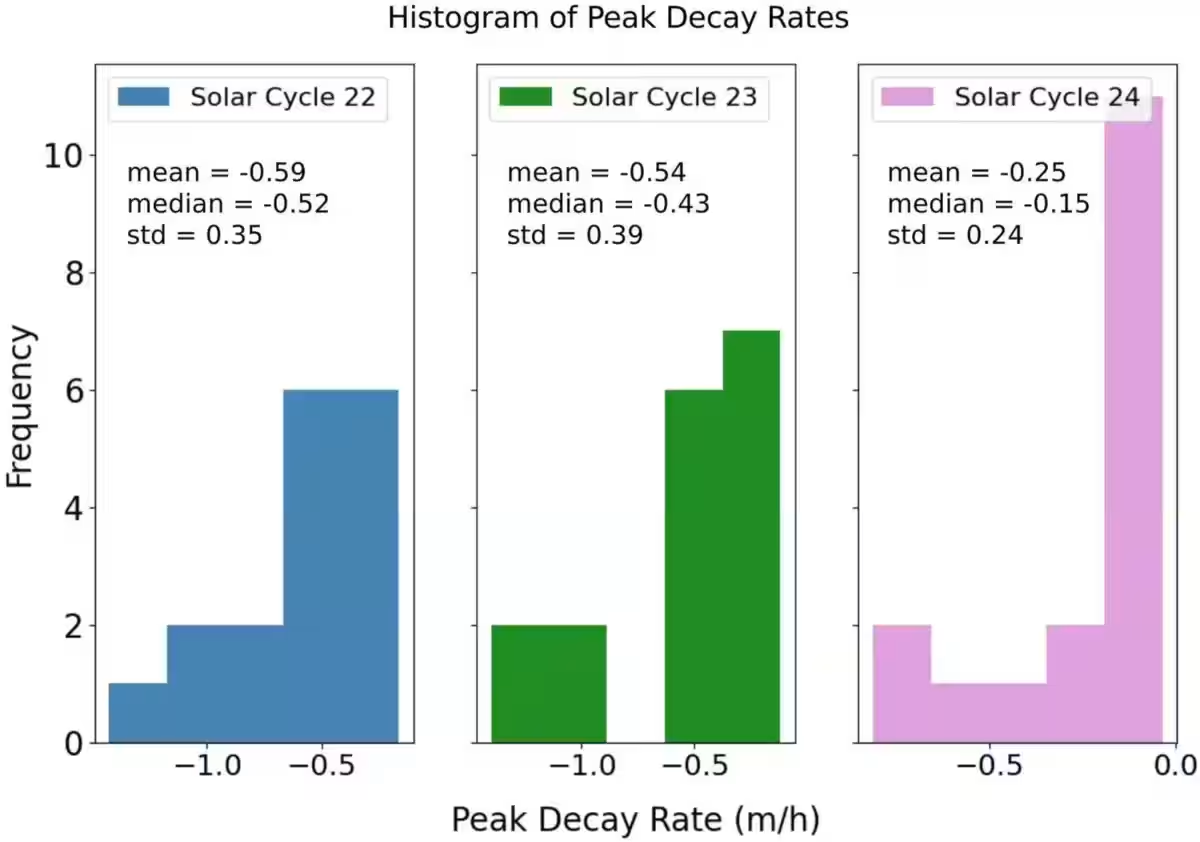
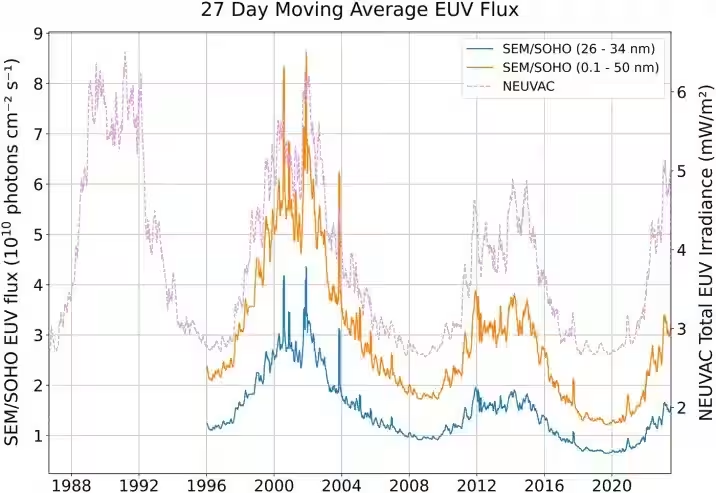
Unlike active satellites, debris objects do not use propulsion systems to maintain their altitude. The research team noted that this makes them useful indicators for measuring natural orbital decay caused by atmospheric conditions alone. The team compared the orbital histories of these objects with long-term records collected by the German Research Centre for Geosciences. The data included sunspot numbers and measurements of solar radio and extreme ultraviolet emissions.
Researchers discovered what they describe as a “transition boundary.” Once sunspot activity exceeded roughly two-thirds of its maximum intensity, orbital decay increased significantly.
“This threshold doesn’t seem to be tied to a fixed value of solar radiation,” Dr. Ashruf explained. “but rather to how close the Sun is to its peak activity.” The paper also suggests that stronger extreme ultraviolet emissions near solar maximum may contribute to the effect.
Implications for Satellite Operations
The findings could have direct consequences for satellite operations in low Earth orbit. Satellites experience the same drag forces as debris objects, meaning periods of strong solar activity may require more frequent adjustments to maintain stable orbits.
The journal Frontiers in Astronomy and Space Sciences notes that faster orbital decay affects both fuel consumption and mission duration. Satellites launched near solar maximum periods may need additional fuel reserves for orbit corrections.
“Our results imply that when solar activity passes certain levels, satellites — just like space junk — lose altitude faster so that more orbit corrections are required,” adding that: “What is most interesting is that all of this information comes from objects launched back in the 1960s. They are still contributing to science, serving as valuable tools for studying long-term effects of solar activity on the thermosphere.”
This article has been fact checked for accuracy, with information verified against reputable sources. Learn more about us and our editorial process.
Last reviewed on .
Article history
- Latest version
Reference(s)
- Ashruf, Ayisha. “Characterizing solar cycle influence on long-term orbital deterioration of low-earth orbiting space debris.” Frontiers in Astronomy and Space Sciences, vol. 13, May 6, 2026, pp. 1797886 Frontiers, doi: 10.3389/fspas.2026.1797886/full. <https://www.frontiersin.org/journals/astronomy-and-space-sciences/articles/10.3389/fspas.2026.1797886/full>.
- “Home.”, May 6, 2026 <https://www.gfz.de/en/>.
Cite this page:
- Posted by Karan Das