A Lost Moon Once Orbiting Saturn Might Have Given Birth to Its Icy Rings
Recent studies offer fresh insights into the formation of Saturn’s mesmerizing rings, proposing they might have emerged from the leftover fragments of a long-lost moon.
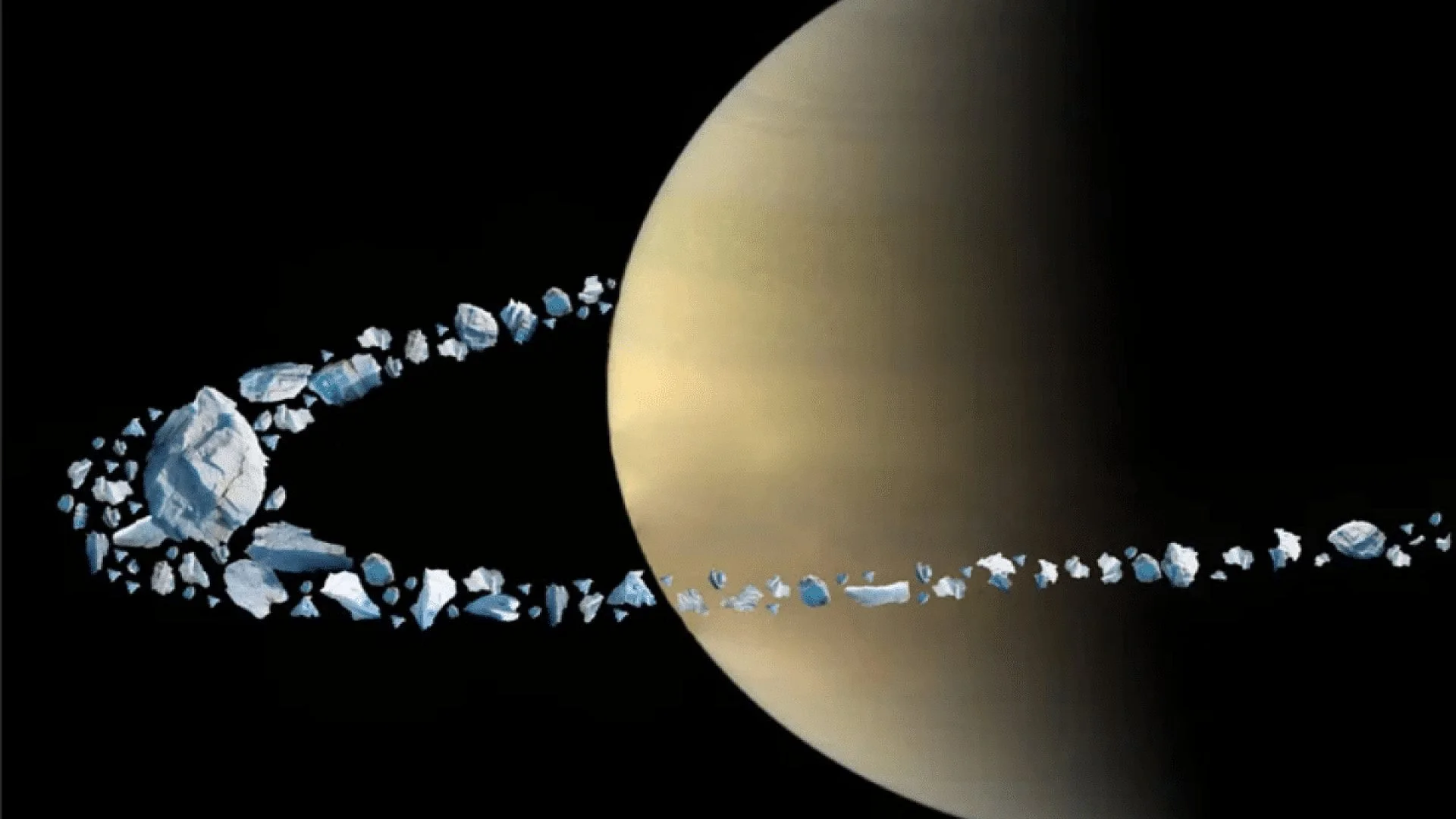
For centuries, Saturn’s majestic rings have captivated astronomers with their breathtaking beauty, visible even from Earth’s telescopes. However, the enigma surrounding their origin has long puzzled scientists. Was it the result of a cosmic collision or a different process altogether? Recent findings presented at the 57th Lunar and Planetary Science Conference shed new light on this mystery, offering a bold theory that could finally answer these questions. According to a team of scientists from the United States and China, Saturn’s rings may have originated from the destruction of an ancient moon called “Chrysalis,” torn apart by the planet’s immense gravity.
The Mysterious Chrysalis Moon
The team’s research begins with the hypothetical moon Chrysalis, believed to have been a significant celestial body in Saturn’s orbit. This moon is thought to have been roughly the size of Saturn’s moon Iapetus, with an estimated diameter of 1,469 kilometers (913 miles). The scientists used sophisticated computer models to simulate the conditions that might have caused this moon to disintegrate. According to their hypothesis, Chrysalis was an icy and rocky moon, its interior a mix of water ice and rock, similar to other moons in the Saturnian system like Dione and Iapetus.
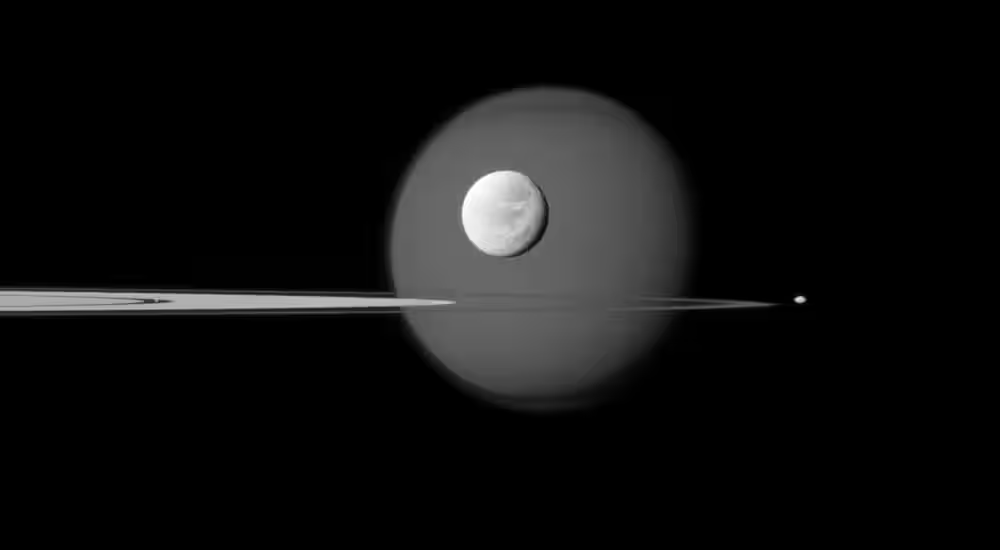
Saturn’s largest moon, Titan, is in the background of this image; in the foreground is the icy moon Dione. The much smaller moons Pandora and Pan sit near Saturn’s bright rings, which slice through the center of the image.
NASA / JPL-Caltech / Space Science Institute
This moon, however, met a tragic end when it ventured too close to Saturn, crossing the planet’s Roche limit, the point at which the planet’s gravity becomes too strong for a moon to maintain its integrity. Once inside this critical zone, Chrysalis was shredded by Saturn’s powerful gravitational forces, breaking apart into debris that eventually coalesced into the magnificent rings we see today.
The Roche Limit and the Fate of Chrysalis
According to Universe Today, the concept of the Roche limit is key to understanding why the moon’s destruction was inevitable. All celestial bodies, from small moons to massive planets, have a Roche limit, a distance at which the tidal forces from the larger body exceed the gravitational pull holding the smaller body together. If a moon gets too close, it will break apart. For icy moons like Chrysalis, the Roche limit is typically around 1 to 1.5 times the radius of the planet. For Saturn, this would have meant that Chrysalis was doomed to fall apart when it ventured too close.
In their study, the researchers modeled the elliptical orbit of Chrysalis, which would have brought it within this destructive range at certain points. Their simulations show that while some of the moon’s fragments might have escaped Saturn’s gravity, a significant portion of them would have formed the early, larger version of Saturn’s rings.
How Saturn’s Rings Evolved
The study also suggests that Saturn’s rings could have been much larger than they are today. During the initial formation, the rings may have extended much farther, potentially large enough for ancient dinosaurs, like Titanosaurs, to have seen them in the sky. Over millions of years, the rings would have slowly shrunk, largely due to gravitational interactions with Saturn’s larger moons, such as Titan. Titan’s gravity may have influenced the size and shape of the rings, stripping away portions of them and shaping their current structure.
One of the most fascinating aspects of this theory is that the largest fragments of Chrysalis may have had a significant role in shaping Saturn’s moons. These fragments could have collided with nearby moons, creating impact craters that provide further evidence of their violent past. The researchers are keen to explore this possibility further, as it could shed new light on the geological history of Saturn’s moons.
Credits: NASA/JPL-Caltech/Space Science Institute
Implications for Planetary Science and Exoplanets
While this new study primarily focuses on Saturn, it has significant implications for planetary science as a whole. By understanding how Saturn’s rings formed, scientists can gain deeper insights into the processes that shape other planetary ring systems, both in our solar system and around exoplanets. In fact, several exoplanets have been found to possess ring systems, some even larger than Saturn’s.
One particularly intriguing example is the exoplanet J1407b, often referred to as “Super-Saturn.” Located approximately 434 light-years from Earth, J1407b’s ring system is estimated to be 200 times larger than Saturn’s. By studying Saturn’s rings and the possible role of ancient moons like Chrysalis, researchers can better understand how these colossal ring systems could form and evolve on distant planets, providing valuable clues for the study of exoplanetary atmospheres and environments.
A Step Closer to Unraveling Saturn’s Mysteries
This research, presented at the 57th Lunar and Planetary Science Conference, represents a significant step forward in unraveling the mysteries of Saturn’s rings. While many questions remain unanswered, such as what happened to the largest fragment of Chrysalis and how it might have influenced the development of Saturn’s moons, the findings present a compelling case for the ancient moon theory. With continued research, scientists hope to answer these lingering questions and further enhance our understanding of planetary formation in the solar system and beyond.
The study not only adds to our knowledge of Saturn’s rings but also brings us closer to understanding the processes that shape planets and moons throughout the universe. As technology improves and new discoveries are made, future generations will likely look back on this theory as a pivotal moment in our quest to comprehend the cosmos.
This article has been fact checked for accuracy, with information verified against reputable sources. Learn more about us and our editorial process.
Last reviewed on .
Article history
- Latest version
Cite this page:
- Posted by Karan Das