LHC Detects Quark‑Gluon Plasma Diffusion Wake, Revealing a New Window on the Big Bang
New study of quark‑gluon plasma at the LHC uncovers fresh insights into the primordial matter that existed just after the Big Bang.
Researchers operating the Large Hadron Collider (LHC) have captured fresh insights into the infant universe by tracking the motion of an exotic state of matter under extreme conditions. The results, appearing in Physical Review Letters, deliver refined measurements of the quark‑gluon plasma, the scorching, dense medium that filled space moments after the Big Bang.
Recreating the Birth of the Cosmos in the Laboratory
Before protons and neutrons coalesced, the cosmos consisted of a rapidly expanding soup of fundamental particles the universe was still in that primordial phase. To probe this early epoch, scientists generate comparable conditions inside the LHC, where smashing heavy nuclei together produces temperatures far hotter than any stellar core.
These ultra‑energetic collisions free quarks and gluons from their usual confinement inside atomic nuclei, allowing physicists to observe how these constituents behave in an unbound state. Although the resulting plasma exists for only a fleeting instant, its characteristics encode clues about the forces that shaped the nascent universe.
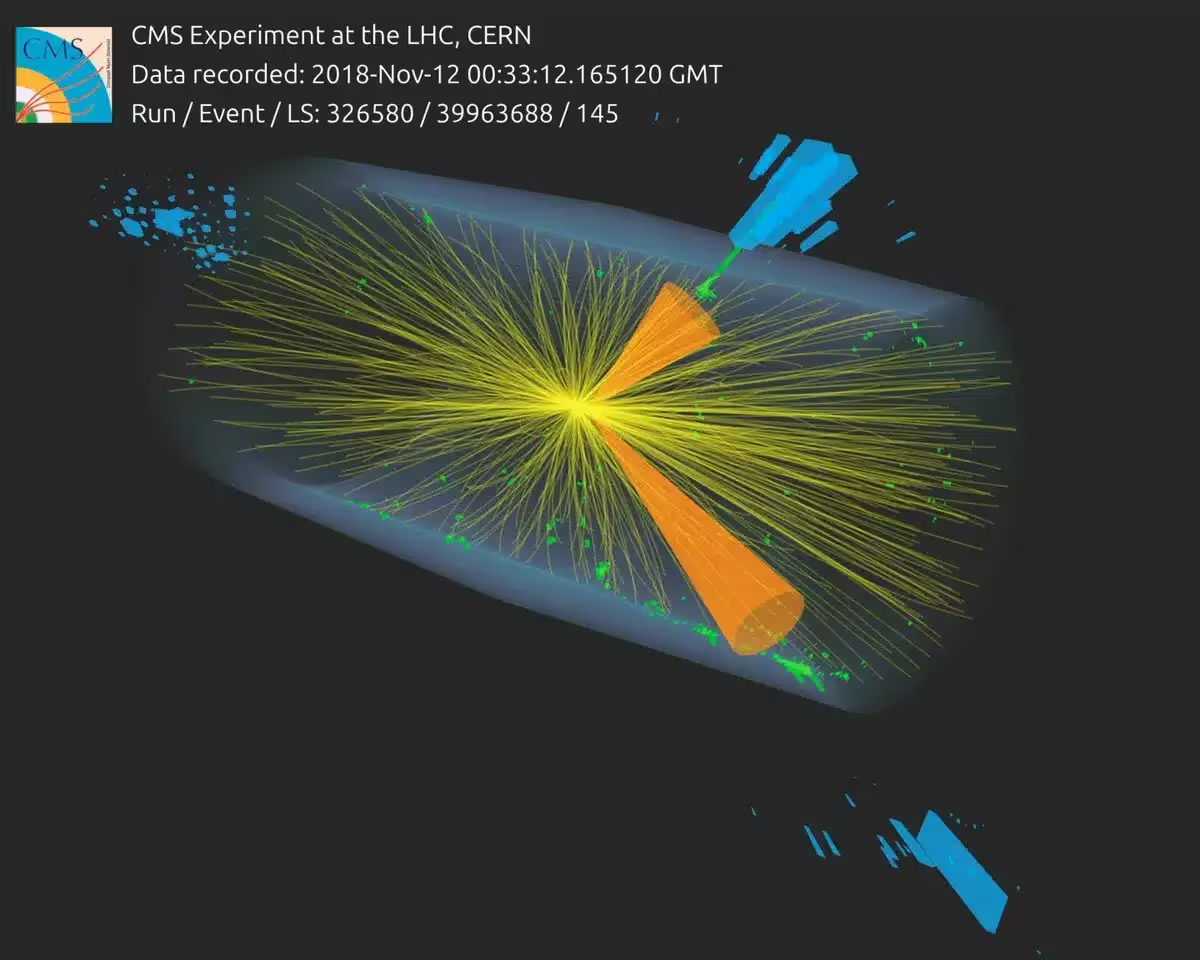
A central focus of the new study is the quark‑gluon plasma diffusion wake, a disturbance pattern generated as high‑energy particles blaze through the medium. By quantifying this wake, scientists can map how energy and momentum disperse throughout the plasma.
The team analyzed collision data collected at the LHC to characterize the plasma’s response to such perturbations, offering a more nuanced picture of the internal dynamics of this transient cosmic material.
Unveiling the Plasma’s Internal Flow Patterns
The diffusion wake functions much like the ripples left by a boat moving through water, providing measurable signatures that reveal how the quark‑gluon plasma transports momentum and energy.
Scientists from the University of Illinois Chicago (UIC) led the interpretation of these signals. Team leader Raghunath Pradhan highlighted the broader impact of the observations.
“Observing and quantifying the quark‑gluon plasma diffusion wake opens the door to the new precision characterization of the properties and dynamics of the quark‑gluon plasma, and promises new insights into the evolution of the early universe,” team leader Raghunath Pradhan of the University of Illinois Chicago (UIC) said in a statement.
These measurements move the field beyond merely confirming the plasma’s existence; they begin to chart its behavior at a deeper level. By dissecting how the medium moves, transfers energy, and reacts to passing particles, researchers can reconstruct conditions that prevailed less than a microsecond after the Big Bang.
The results, detailed in Physical Review Letters, add a new piece to decades of work aimed at deciphering the strongest forces in nature. The study blends observations from the world’s most powerful accelerator with theoretical frameworks designed to describe matter under extreme pressure and temperature.
Decades of Pursuing the Universe’s First Instants
Since the realization that the cosmos began as an ultra‑hot, compact fireball, scientists have strived to replicate and analyze those conditions on Earth.
The LHC, operated by the European Organization for Nuclear Research (CERN), now serves as a premier venue for this endeavor. By propelling particles to near‑light speeds, the collider creates fleeting bursts of temperature that echo the early universe’s environment.
Each experimental run refines our understanding of how fundamental matter transitioned from a free‑quark state to the atoms, stars, and galaxies that dominate the current universe. The diffusion‑wake technique introduces a novel avenue for probing how the quark‑gluon plasma conveys energy and reacts to external disturbances.
Looking ahead, additional measurements at the LHC and other high‑energy facilities may expand this methodology, enabling comparisons across varied collision setups and sharpening models of the universe’s infancy. Such investigations could illuminate the pathway from a quark‑gluon sea to the structured cosmos we observe today.
By extracting minute traces from terrestrial particle collisions, scientists continue to unlock the physical processes that forged the universe billions of years ago.
This article has been fact checked for accuracy, with information verified against reputable sources. Learn more about us and our editorial process.
Last reviewed on .
Article history
- Latest version
Reference(s)
- Anonymous, “Observation of the jet diffusion wake using dijets in heavy-ion collisions.” Physical Review Letters, June 25, 2026 American Physical Society (APS), doi: 10.1103/g49y-8cjl. <https://journals.aps.org/prl/accepted/10.1103/g49y-8cjl>.
Cite this page:
- Posted by Farah Siddiqui