Hidden Oceans: Mini‑Neptunes May Conceal Vast Water Below Their Atmospheres, Evading JWST
A new study warns the James Webb Telescope might overlook hidden water on distant exoplanets, raising doubts about its detection limits.
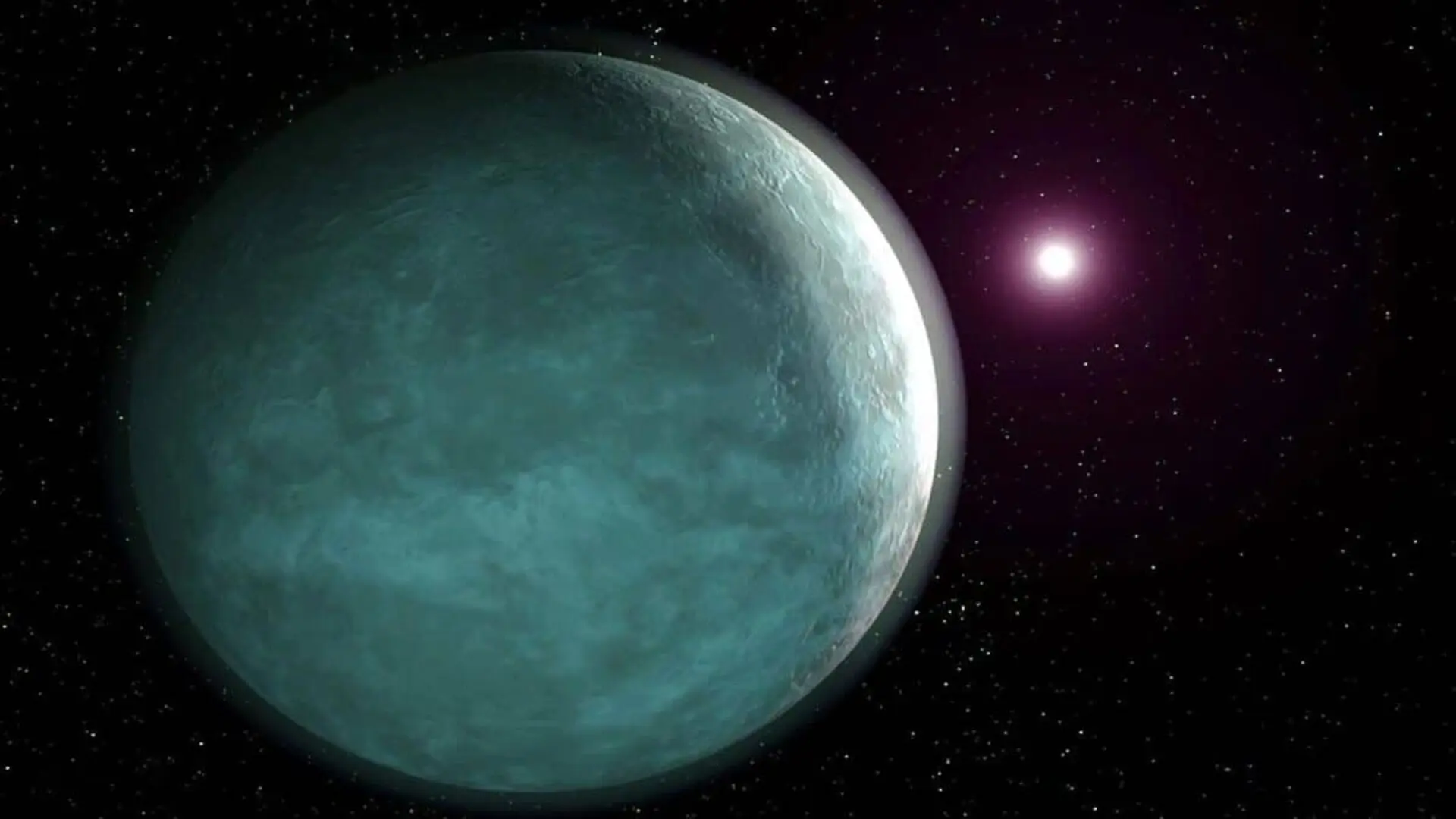
Mini‑Neptunes—planets a bit smaller than Neptune yet less dense than Earth—have long confounded astronomers because no analogue exists in our own Solar System. New modeling work suggests that many of these worlds could host oceans hidden beneath thick hydrogen envelopes, a reservoir that current telescopic techniques cannot detect.
Deep Oceans May Elude Atmospheric Surveys
The study, appearing in The Astrophysical Journal, challenges the common assumption that a planet’s atmospheric composition reliably mirrors its interior makeup. Researchers ran detailed simulations showing that, on planets with cooler outer layers or unusually high water inventories, water separates from hydrogen and settles into deeper strata because of its greater density.
“It’s very possible these planets are hiding much more water than their atmospheres let on,” said Caroline Piaulet‑Ghorayeb, a postdoctoral researcher at the University of Chicago and the study’s lead author.
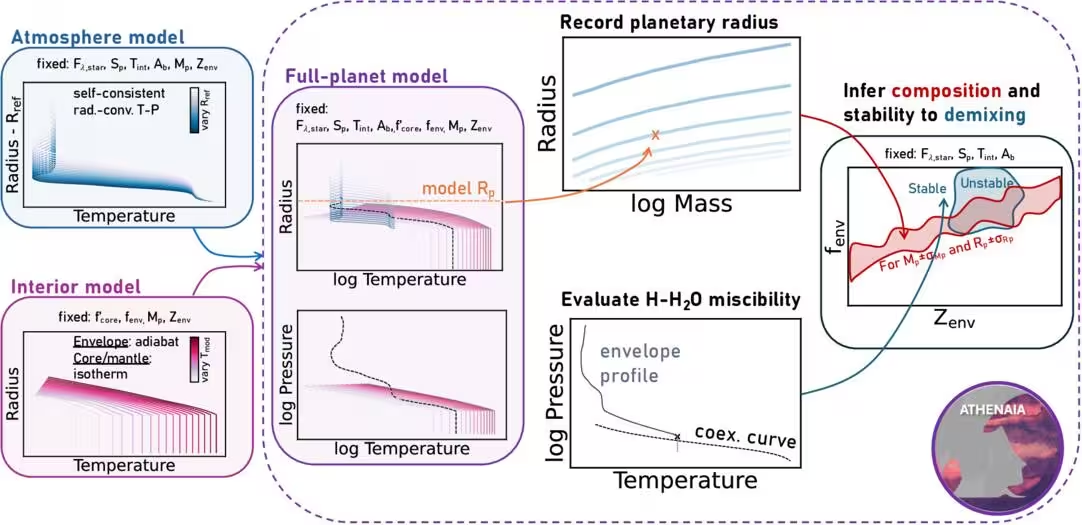
The authors stress that forthcoming observations from powerful telescopes will need to account for this hidden water component, as atmospheric spectra alone may underestimate a planet’s true volatile inventory.
James Webb Peers Atmospheres, Not Cores
The James Webb Space Telescope detects atmospheric gases by measuring starlight filtered through a planet’s limb during transit. This method has already revealed hydrogen, methane and carbon dioxide in a range of distant worlds.
Translating those atmospheric signatures into constraints on interior structure, however, remains a major hurdle.
“The challenge is, how do we extrapolate from what’s in the atmosphere to what the surface is like?” Piaulet‑Ghorayeb noted.
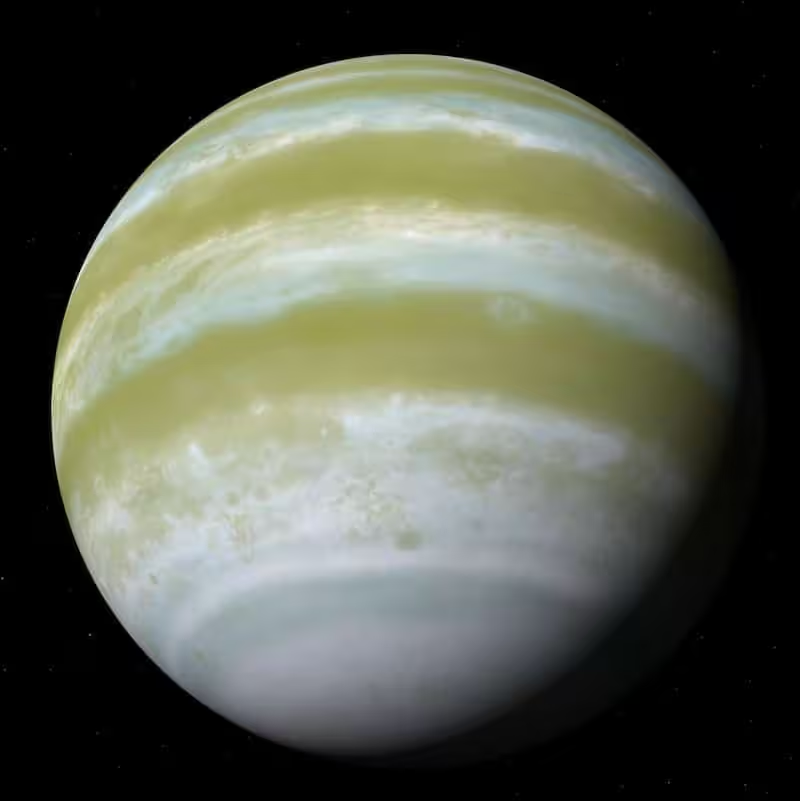
Water’s behavior under extreme pressure and temperature adds another layer of complexity. Depending on those conditions, it may appear as ice, liquid, gas or a supercritical fluid, each state influencing whether it remains mixed with hydrogen or sinks to depths beyond the reach of present‑day instruments.
TOI‑270 d: A Testbed for Hidden‑Water Scenarios
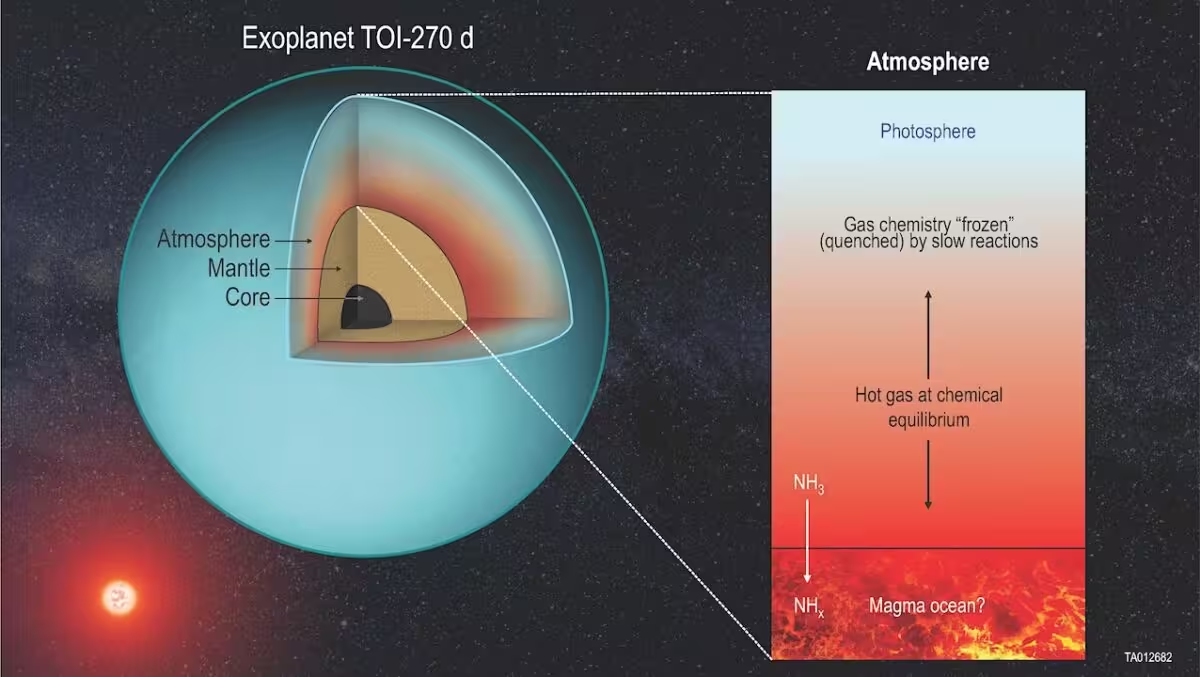
To validate their framework, the team focused on TOI‑270 d, a planet orbiting a star in the constellation Pictor. JWST observations have identified hydrogen, methane and carbon dioxide in its atmosphere—molecules that, under conventional models, would accompany abundant water.
Simulation results published in The Astrophysical Journal suggest that TOI‑270 d could belong to a class where water has migrated beneath the observable hydrogen layer, effectively cloaking a large fraction of its volatile content from spectroscopic surveys.
Another team member, Leslie Rogers, highlighted the difficulty of distinguishing water from mixed rock‑gas compositions: “Water has an intermediate density, so it could be mimicked with a mix of rock and gas. We’re trying to get any constraint we can for this problem.”
This article has been fact checked for accuracy, with information verified against reputable sources. Learn more about us and our editorial process.
Last reviewed on .
Article history
- Latest version
Reference(s)
- “Caroline Piaulet-Ghorayeb | Department of Astronomy and Astrophysics | The University of Chicago.” <https://astrophysics.uchicago.edu/people/profile/caroline-piaulet-ghorayeb/>.
- Cermak, Alicia. “TOI-270 d - NASA Science.”, January 31, 2020 NASA <https://science.nasa.gov/exoplanet-catalog/toi-270-d/>.
- anijem, “Leslie Rogers.”, November 9, 2018 University of Chicago <https://news.uchicago.edu/profile/leslie-rogers>.
Cite this page:
- Posted by Farah Siddiqui