First Lab Simulates Black Hole Energy Extraction Using Synthetic Ultra-Fast Rotation
Scientists build a lab setup mimicking black‑hole energy extraction, using a time‑modulated device that boosts electromagnetic waves.

A team at the CUNY Graduate Center has demonstrated a laboratory technique that mimics the exotic energy‑extraction process once thought possible only near a rapidly spinning black hole. By engineering a “synthetic” rotation through precise, time‑varying modulation of an electronic resonator array, the researchers achieved effective speeds that surpass conventional mechanical limits, opening a new experimental window onto the Penrose‑Zel’dovich mechanism.
From Black‑Hole Theory to Laboratory Reality
More than half a century ago, Sir Roger Penrose proposed that particles entering the ergosphere of a rotating black hole could tap the hole’s rotational energy. Physicist Yakov Zel’dovich later suggested that waves interacting with a sufficiently fast rotating object might undergo similar amplification. Directly testing these ideas has long been impossible because the required angular velocities cannot be produced with ordinary machinery.
Creating the Illusion of Ultrahigh Rotation
Instead of physically spinning a component, the CUNY Advanced Science Research Center built a circular lattice of electronic resonators whose properties are switched on a rapid, travelling schedule. Although the hardware stays fixed, the moving modulation pattern makes electromagnetic waves behave as if they were encountering an object rotating at superluminal speeds.
“Our method introduces a novel wave–matter interaction where waves with specific angular momentum draw energy from a time‑engineered rotation, leading to broadband selective amplification,” explained Andrea Alù, distinguished professor of physics and director of the Photonics Initiative at CUNY.
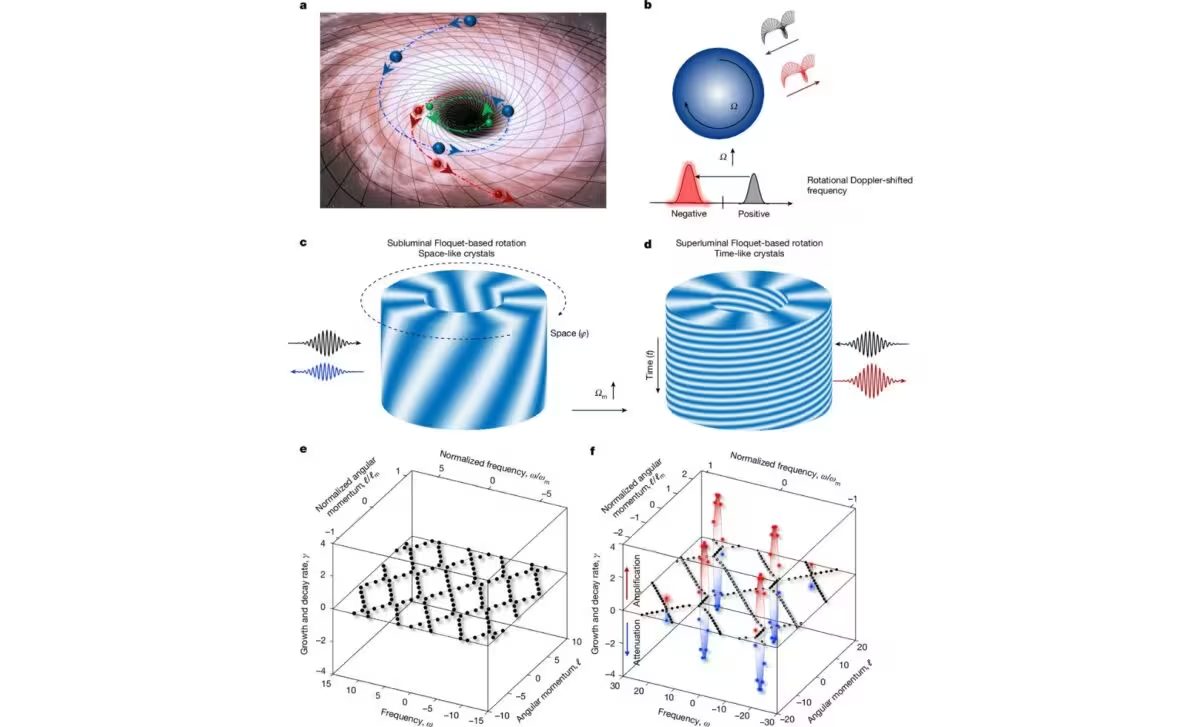
The Nature article details how the synthetic rotation reached effective superluminal velocities, allowing the team to observe angular‑momentum‑selective amplification of orbital waves. Co‑lead author Hady Moussa noted that the amplified waves “reproduce the essential physics of the Penrose‑Zel’dovich process.” The phenomenon emerged from non‑Hermitian and parametric dynamics within a space‑time‑structured medium built from the time‑modulated resonators.
Implications for Wave Physics and Beyond
Lead author Hadiseh Nasari emphasized that the experiment translates concepts of extreme rotational dynamics from abstract theory to a controllable platform, paving the way for investigations that span astrophysics, photonics, and quantum science.
Central to the work was the question of whether stationary devices could make electromagnetic waves behave as though they were interacting with an ultrafast rotating body and thereby extract energy. The experiments confirmed that waves possessing the right rotational mode were indeed amplified after passing through the engineered system.
By employing metamaterials whose temporal properties are deliberately varied, the researchers generated an effective motion without any physical displacement of the apparatus. This strategy reproduces effects akin to rotational Doppler shifts through spatio‑temporal modulation, offering a versatile toolbox for controlling light‑matter interactions.
According to a CUNY announcement released, the approach could be extended to photonic and quantum platforms, potentially enabling new techniques for manipulating light, processing information, and exploring wave phenomena inspired by extreme astrophysical environments. While practical applications in communications, optics, and photonics remain speculative, the study provides a concrete foundation for future technological development.
This article has been fact checked for accuracy, with information verified against reputable sources. Learn more about us and our editorial process.
Last reviewed on .
Article history
- Latest version
Reference(s)
- “homepage Andrea Alu.” <http://www.alulab.org/>.
- Nasari, Hadiseh. “Observation of Floquet rotational super-radiance - Nature.”, July 8, 2026, pp. 1-9. Nature, doi: 10.1038/s41586-026-10725-y. <https://www.nature.com/articles/s41586-026-10725-y>.
- “Hady Moussa.” <https://scholar.google.com/citations?user=NzFLl24AAAAJ&hl=en>.
- “Hadiseh Nasari.” <https://scholar.google.com/citations?user=2NxxPqYAAAAJ&hl=en>.
- <https://asrc.gc.cuny.edu/headlines/2026/07/a-black-hole-theory-comes-to-life-in-the-lab/>.
Cite this page:
- Posted by Farah Siddiqui