New AI Study Shows 35,000 Faint Pulsars
Scientists reexamined a mysterious signal from the Milky Way’s crowded core, uncovering evidence that revives a previously disputed explanation.
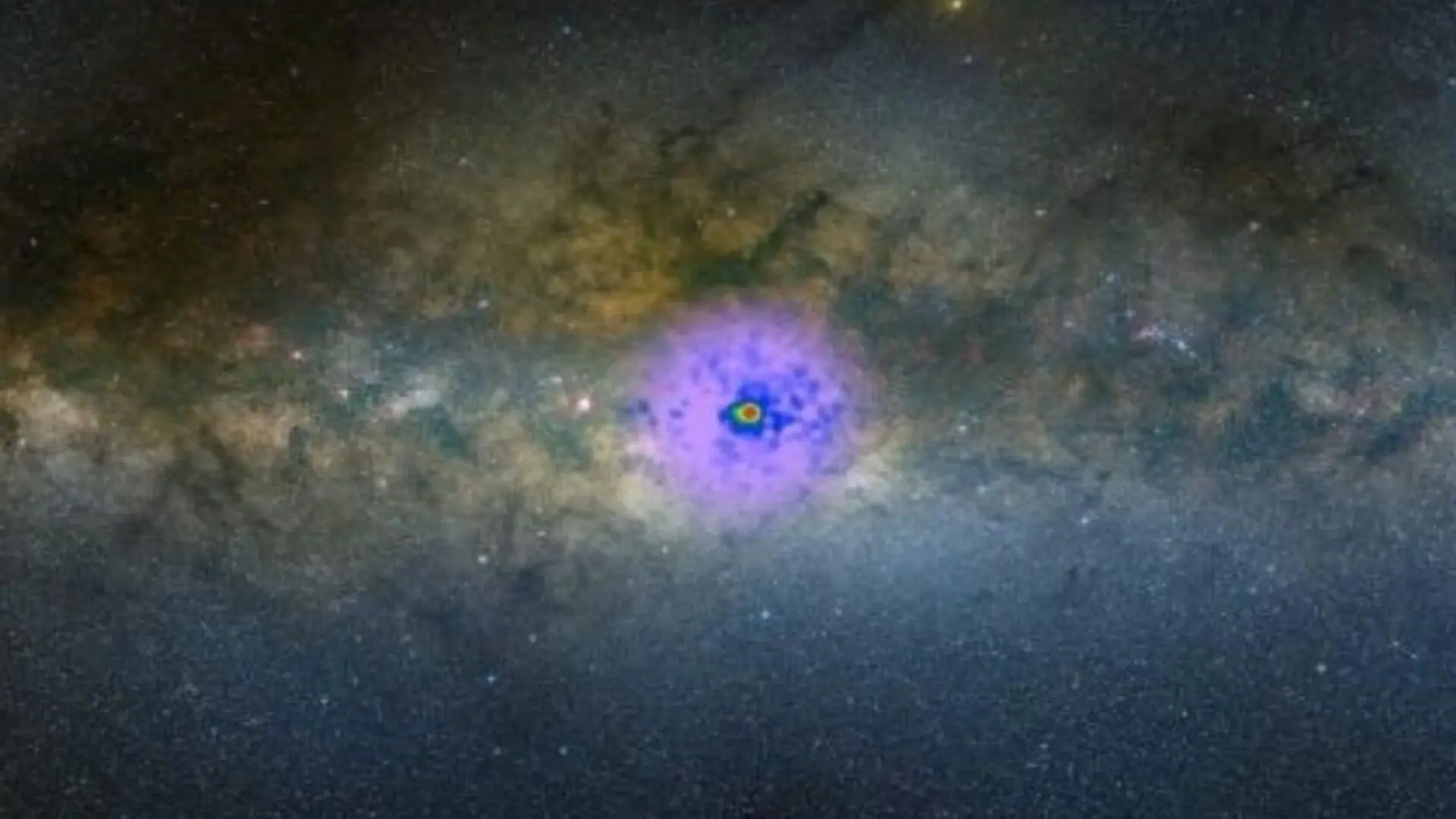
A fresh machine‑learning investigation has reignited the discussion over the diffuse gamma‑ray glow that envelops the Milky Way’s core. By simultaneously analysing where each photon arrives and how energetic it is, the researchers found that the hypothesis involving dark‑matter particle annihilation remains viable for the phenomenon known as the Galactic Center Excess.
The excess appears as a faint, roughly spherical halo stretching across several thousand light‑years around the galaxy’s center. Two competing explanations have dominated the debate: the self‑annihilation of yet‑unknown dark‑matter particles, and a hidden swarm of rapidly rotating neutron stars called millisecond pulsars.
Separating these possibilities is notoriously difficult because the Galactic Center is one of the brightest and most crowded regions in the gamma‑ray sky, where many sources overlap. An international collaboration led by scientists at the University of Vienna and Lawrence Berkeley National Laboratory tackled the problem with a neural‑network system trained on more than one million simulated gamma‑ray observations.
Energy‑Resolved Analysis Changes the Landscape
Earlier statistical studies tended to support the millisecond‑pulsar scenario but omitted a crucial piece of information: the energy carried by each detected photon. The new model incorporates both spatial coordinates and photon energies, offering a more complete test of the competing ideas. The results, published in Physical Review Letters, show that adding energy data substantially reshapes the conclusions.
“Interpreting the signal is particularly difficult because the Galactic Center is an exceptionally bright and crowded region of the gamma‑ray sky,” said Florian List, a study author and researcher at the University of Vienna.
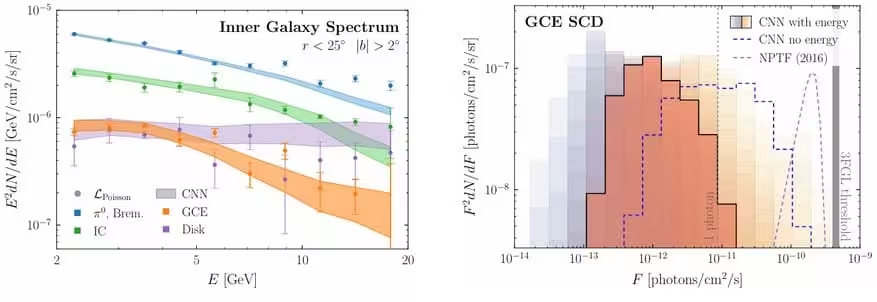
Prior analyses suggested that the glow could be explained by relatively bright, unresolved point sources, bolstering the case for millisecond pulsars. The new study, however, indicates that such sources would need to be far dimmer than previously assumed.
Tens of Thousands of Ultra‑Faint Pulsars Would Be Required
If the excess originates from millisecond pulsars, the calculations now imply that at least 35,000 of these objects would have to be packed near the Milky Way’s center. This figure vastly exceeds the few hundred to a few thousand pulsars posited by earlier work, and each individual pulsar would have to emit at an extraordinarily low level.
“Our new analysis shows that the sources would have to be so faint that they would be almost indistinguishable from the emission expected from annihilating dark matter,” said Nick Rodd, a study author and scientist at Lawrence Berkeley National Laboratory.
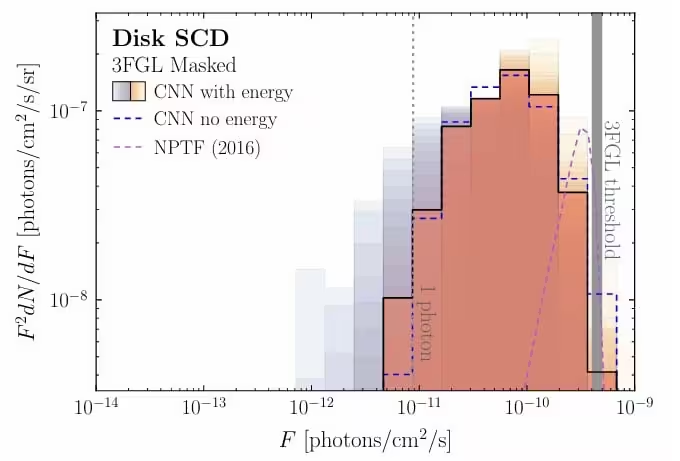
The overlap between the expected signal from a massive population of dim pulsars and the signature of dark‑matter annihilation makes it challenging to rule out either scenario. While the pulsar hypothesis is not discarded, the requirement for an enormous number of barely detectable objects weakens one of the strongest arguments that previously favored a non‑dark‑matter explanation.
Dark Matter Remains a Viable Candidate
The investigation does not claim that dark matter definitively powers the Galactic Center Excess. Instead, it demonstrates that earlier evidence supporting unresolved point sources is insufficient to eliminate the dark‑matter possibility.
“The origin of the Galactic Center Excess is one of the longest‑running debates in astrophysics,” List said. “Our work does not show that dark matter is responsible for the signal. However, it suggests that it is still too early to rule out this possibility.”
When photon energy is taken into account, the picture shifts dramatically. Should pulsars be the source, the glow would require an unprecedented tally of extremely faint objects, leaving dark‑matter explanations firmly on the table.
This article has been fact checked for accuracy, with information verified against reputable sources. Learn more about us and our editorial process.
Last reviewed on .
Article history
- Latest version
Reference(s)
- List, Florian., et al. “Energy Distribution of the Galactic Center Excess’s Sources.” Physical Review Letters, vol. 136, no. 23, June 12, 2026 American Physical Society (APS), doi: 10.1103/dkcq-6y4f. <https://journals.aps.org/prl/abstract/10.1103/dkcq-6y4f>.
- “Nick Rodd | LBNL Theory.” <https://www-theory.lbl.gov/?page_id=12106>.
Cite this page:
- Posted by Farah Siddiqui