Ancient Gold Rings in Thailand Bear 2,000-Year-Old Indian Astronomical Inscription
2000‑year‑old gold rings unearthed at a Thai burial site include a plain band and one with an Indian‑astronomy inscription, shedding new light on the Iron Age.
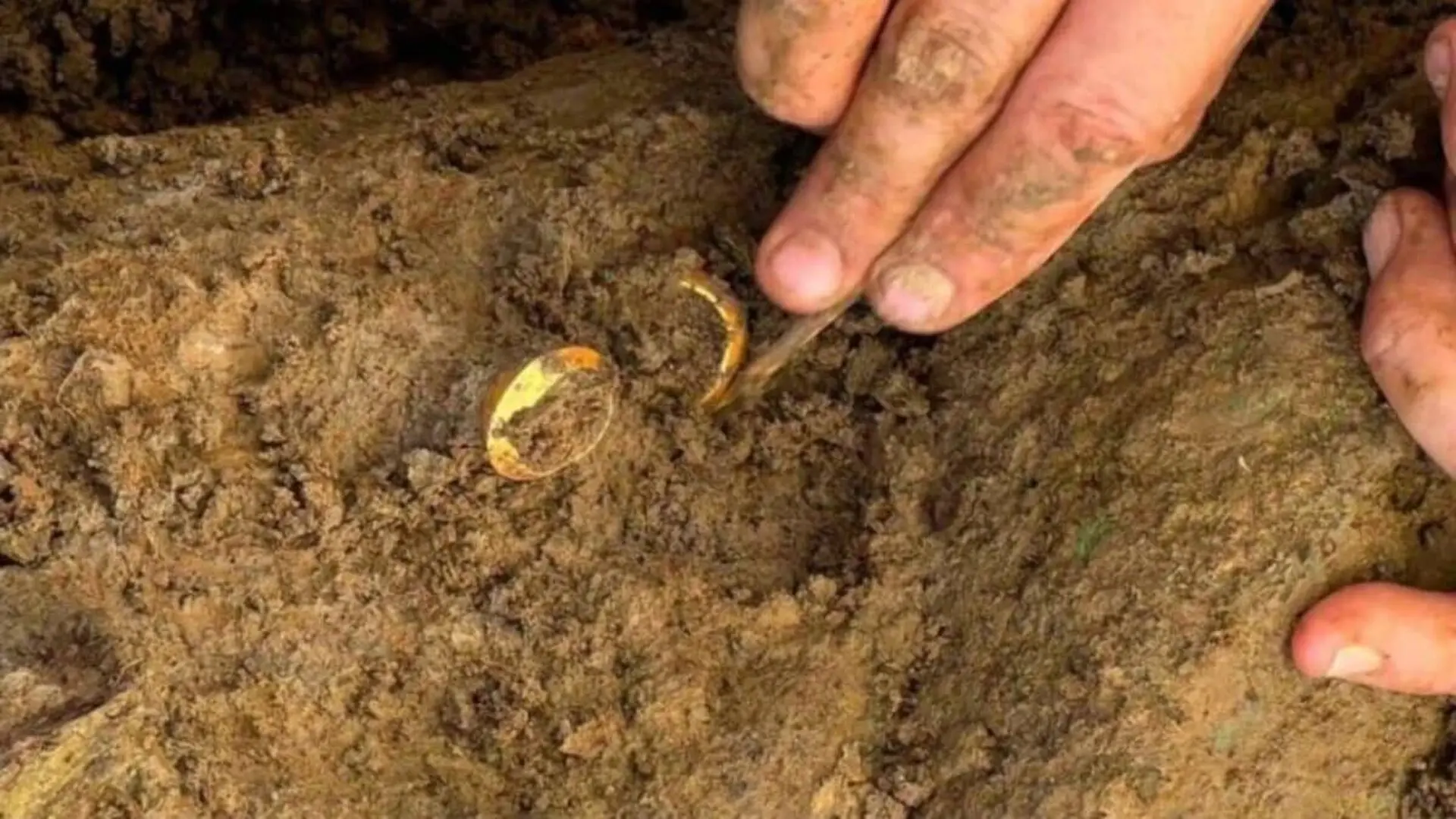
Excavations at the recently identified Don Yai Thong burial ground in Phetchaburi province have yielded two gold bands dating to roughly two millennia ago, one of which bears a script linked to ancient Indian astronomy. The artifacts were found alongside human remains as part of a broader investigation that has already recovered nine skeletons and a variety of objects since work began in February 2026.
These discoveries shed fresh light on a community that inhabited western Thailand during the late prehistoric, or Iron Age, period. Items such as gold adornments, bronze drums, glass beads, ceramic vessels and bronze containers have emerged from the site, while the atypical layout of the interments has attracted particular scholarly interest.
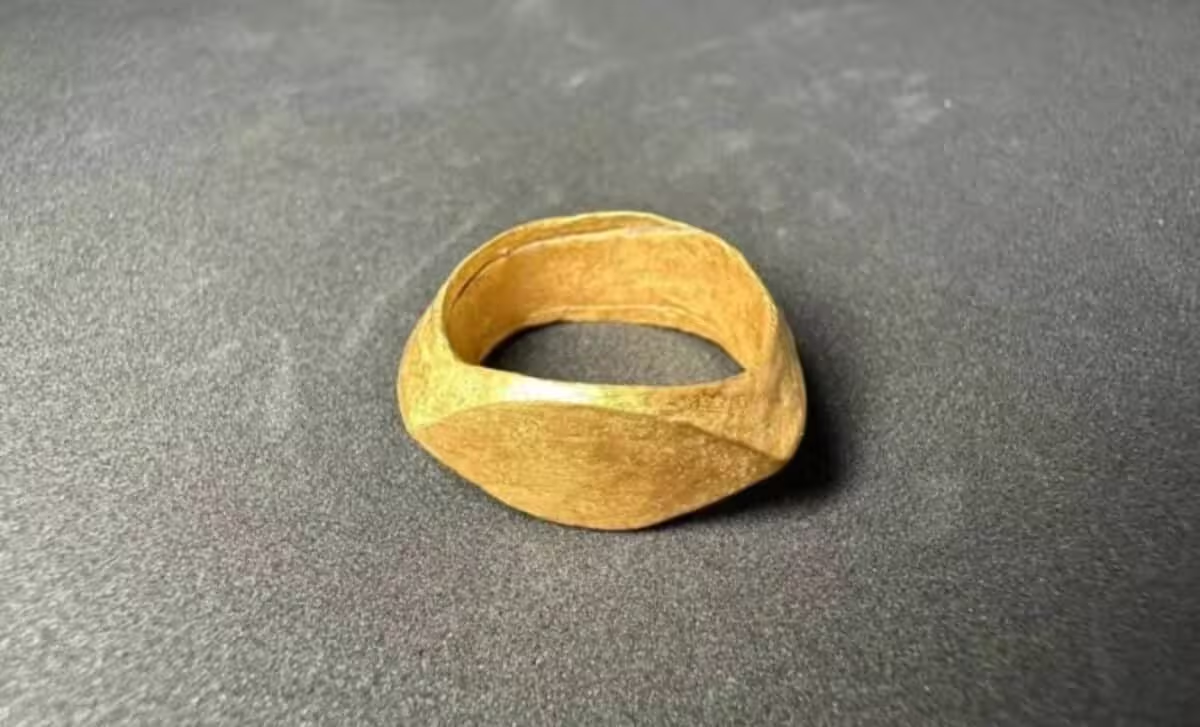
Thailand’s Fine Arts Department reports that the two gold bands were uncovered with skeletal material during the ongoing dig. One band is a plain, undecorated circle, whereas the second displays characters thought to belong to the Brahmi script, an ancient Indian writing system that served as a foundation for many Southeast Asian alphabets.
Script on Ring Connects to Ancient Indian Star Lore
Preliminary analysis suggests the inscription reads “pusarakhitasa,” interpreted as “protected by Pushya.” Pushya is recognized in Indian astronomical tradition as one of the most favorable zodiac signs.
The Associated Press notes that specialists propose the owner may have been a merchant belonging to the Vaishya tier of the historic Indian caste hierarchy, a group traditionally linked to trade, farming and craftwork. The rings were found in remarkable condition, adding to a growing assemblage of objects recovered at Don Yai Thong, situated about 130 km (80 mi) southwest of Bangkok.
The site came to light earlier this year after locals discovered fragments of bronze drums in a rice field. Systematic digging started on 9 February and has since produced six bronze drums, nine human skeletons, gold ornaments, glass beads, pottery and additional bronze vessels.
Radiocarbon and typological dating place the finds between 1,500 and 2,000 years ago, while the broader occupational horizon at Don Yai Thong spans roughly 1,500 to 2,500 years. Researchers describe the material culture as indicative of a community that practiced elaborate mortuary rites.
Among the interred individuals, one set of remains appears to belong to a child under twelve years of age. Archaeologists also recovered the jaw and teeth of a large herbivore—likely cattle or buffalo—though further analysis is needed to determine whether the animal was part of a ritual burial tradition.
Uniform Burial Orientation Highlights Distinctive Ritual Pattern
All nine skeletons uncovered at Don Yai Thong share a consistent positioning: heads oriented toward the northeast, with bronze artifacts placed above the cranial region. Fine Arts Department Director‑General Phnombootra Chandrajoti emphasizes that this burial layout is uncommon among Thai archaeological sites.
The inaugural burial examined featured an array of gold accessories—including rings, bangles, earrings and pendants—suggesting the individual held a high social rank and that the community engaged in complex funerary offerings.
A more recent interment contained a bronze object resembling a gong, alongside glass beads, ceramic fragments, fired clay pieces and a complete bovine jaw. While the presence of animal remains may point to ritual sacrifice, researchers caution that definitive conclusions await further study.
#tamizhi#brahmi#thaisignetring#tamil#ancienttamil#tamilnadu#TVKVijay
This graphic from the Centre for History and Archaeological Research (CHAAR) represents a fascinating and highly significant alternative reading of the Phetchaburi ring. It directly challenges the… pic.twitter.com/cQopDm3O6x— முனைவர் இராசவேங்கடம் (@natureisgoat) July 8, 2026
The juxtaposition of richly adorned graves with those that may represent lower‑status individuals raises questions about social hierarchy within the community. While the Fine Arts Department links the inscribed bands to a possible Vaishya merchant, other burials contain gold ornaments that signal elite standing.
Excavation activities have been paused due to heightened flood risk during the monsoon season. The team intends to retrieve the remaining skeletal material and artifacts before proceeding with conservation and scientific testing.
The Bangkok Post reports that researchers plan 3‑D scanning of the burial area and will send charcoal samples abroad for precise dating. Scholars from Guangxi, China, have expressed interest in collaborative work, noting the cultural resonance of bronze drums across southern China, Vietnam, Thailand and Malaysia.
Prior to formal preservation efforts, officials aim to showcase the artifacts to the public for a brief period of three to five days. Discussions are also underway with Phetchaburi provincial authorities to develop a permanent exhibition featuring the items recovered from Don Yai Thong.
This article has been fact checked for accuracy, with information verified against reputable sources. Learn more about us and our editorial process.
Last reviewed on .
Article history
- Latest version
Reference(s)
- “Archaeologists find gold rings around 2,000 years old in Thailand.”, July 6, 2026 AP News <https://apnews.com/article/thailand-phetchaburi-gold-rings-archaeological-dig-95f42060c51f62cc4c4b3346c0f0e549>.
- “https://twitter.com/natureisgoat/status/2074880534040416479/photo/1.” <https://t.co/cQopDm3O6x>.
- Reporters, Post. “Ancient burial site yields more finds.”, June 29, 2026 Bangkok Post <https://www.bangkokpost.com/thailand/general/3278439/ancient-burial-site-yields-more-finds>.
Cite this page:
- Posted by Hassan Raza