The Internet Helped Name a New Deep-Sea Species Living on Sunken Wood
Scientists have identified three new species of chitons from deep and tropical oceans, including one found more than five kilometers down, whose name was chosen with help from the public.
Far below the ocean’s surface, life continues quietly. There is no sunlight, little food, and crushing pressure. Still, many organisms manage to survive, often in ways that scientists are only beginning to understand.
One surprising habitat is sunken wood. When trees wash into the ocean and sink, they eventually reach the seafloor. There, the wood becomes a rare source of food. It attracts bacteria first, then worms, crustaceans, and molluscs that depend on this temporary resource.
A new study shows that these sunken logs can even support species that science has never seen before.
Three New Species From Distant Seas
In research published in Biodiversity Data Journal on 06 February 2026, marine biologists described three new species of chitons. Chitons are marine molluscs with eight overlapping shell plates that help them bend and cling to surfaces.
The new species were found far apart. One lives on deep-sea wood near Japan. Another was collected near Madagascar in the Indian Ocean. The third comes from waters off Papua New Guinea.
Together, these discoveries highlight how unevenly the ocean has been studied. Some regions and habitats remain largely unexplored, even today.
Getting to Know Chitons
Most people have never heard of chitons. Those who have might recognize them as small, armored animals stuck tightly to rocks along the shore.
But chitons are more diverse than they appear. Some live in shallow water. Others survive thousands of meters below the surface. They feed in different ways, from grazing on algae to preying on other animals.
Because they occupy so many niches, chitons can tell scientists a lot about how marine ecosystems function.
A Discovery More Than Five Kilometers Deep
One of the most striking finds in the study comes from the deep Pacific Ocean. Scientists discovered a new chiton species living on a piece of wood at a depth of 5,506 meters.
The site lies east of the Ogasawara Trench, off the coast of Japan. At this depth, the seafloor is cold, dark, and starved of organic material.
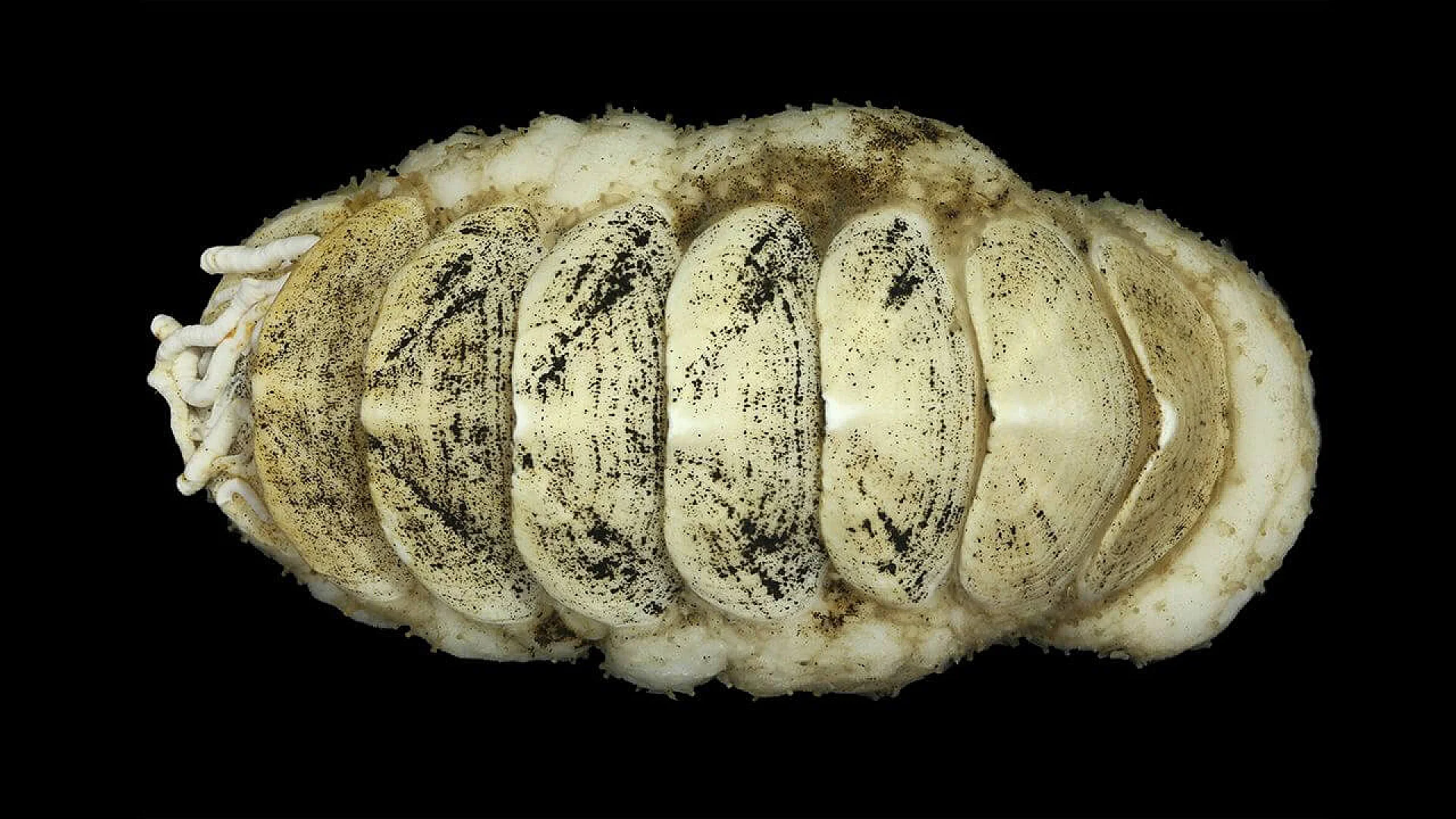
The species belongs to a rare group of chitons that only live on sunken wood. It has been named Ferreiraella populi.
Life Built Around Sunken Wood
Species in the genus Ferreiraella are specialists. They are not found on rocks or reefs. They live only on wood that has fallen to the deep seafloor.
Ferreiraella populi grows to about 25 millimeters long. It has a pale shell and a broad, fleshy edge surrounding its plates. Its body structure reflects a life spent clinging to decaying timber.
Because sunken wood is temporary, these species likely live in small, isolated populations. That makes them especially vulnerable to disturbance.
A Name Chosen by Thousands of People
Unlike most newly described species, Ferreiraella populi was not named quietly by scientists alone.
The research team invited the public to suggest names through an online competition connected to an educational video about species discovery. More than 8,000 suggestions were submitted.
After reviewing the entries and following formal naming rules, the researchers chose “populi,” a Latin word meaning “of the people.”
The name reflects the unusual process behind it and the role of public interest in supporting taxonomy.
Why Open Naming Matters
Taxonomy often happens behind the scenes. New species are described in technical journals and rarely noticed outside specialist circles.
By involving the public, the researchers aimed to make species discovery more visible. The competition helped explain how scientists decide whether an organism is truly new and how names are formally assigned.
The study shows that public engagement can coexist with careful scientific standards.
A Small Chiton Near Madagascar
The second new species, Notoplax madagascariensis, was found off the coast of northwestern Madagascar. It was collected from depths between 87 and 257 meters.
This species lives near sponges, which provide shelter and food. Such habitats are common but poorly studied in this region.
The chiton is small, less than 15 millimeters long, with a sculptured shell and a thick girdle covered in tiny spines.
Expanding the Map of Marine Life
Records of chitons from the western Indian Ocean are limited. Many earlier reports were incomplete or uncertain.
The discovery of Notoplax madagascariensis provides clear evidence that this group extends into waters where it was previously undocumented.
It also helps scientists better understand relationships within a larger chiton group whose evolutionary history is still being resolved.
A Carnivorous Chiton From the Pacific
The third new species described in the study is Placiphorella granulosa. It was found off Papua New Guinea, from shallow coastal waters down into deeper zones.
This species belongs to a rare group of chitons that do not graze. Instead, they are carnivorous.
They ambush small animals using specialized teeth, rather than scraping surfaces like most chitons do.
Built for Hunting
Placiphorella granulosa has a distinctive shell covered in granules. Its feeding structure includes mineralized teeth shaped for grasping prey.
These features separate it from closely related species found elsewhere in the Pacific.
The species shows how flexible chiton evolution can be, even within a group often thought to be simple and uniform.
How the Scientists Studied the Animals
The specimens were collected during several research expeditions. Some samples came from French voyages in 2009 and 2010. Others were retrieved in 2024 using the Japanese submersible Shinkai 6500.
Once on land, the animals were photographed and examined under powerful microscopes. Scanning electron microscopy allowed researchers to see fine details of shells and teeth.
These details are critical for distinguishing one species from another.
Adding DNA Evidence
Whenever possible, the team also analyzed DNA. They focused on a mitochondrial gene commonly used to identify animal species.
Genetic data were successfully obtained for two of the three species and deposited in public databases. For the Madagascar species, DNA barcoding was difficult, but additional genomic data were collected using other methods.
Combining physical traits with genetic evidence strengthens confidence in the findings.
Why These Discoveries Matter
Each new species adds to a growing picture of life in the ocean. Even familiar groups like chitons continue to surprise researchers.
The study highlights habitats that deserve more attention, especially sunken wood and sponge-associated communities.
It also shows that targeted exploration can reveal species that broad surveys might miss.
What We Still Do Not Know
All three species are known from only a few specimens. That makes it hard to estimate their population sizes or ranges.
Scientists do not yet know how widely these chitons are distributed or how resilient they are to environmental change.
Further exploration will be needed to answer those questions.
A Larger Story Beneath the Surface
More than a thousand chiton species have already been described, yet new ones are found every year. This steady pace suggests that much of marine biodiversity remains undocumented.
The three species described in this study are small discoveries, but they point to a much larger story.
They remind us that even today, the ocean continues to reveal new life, sometimes with help from the people watching from shore.
The research was published in Biodiversity Data Journal on February 06, 2026.
This content has been reviewed by subject-matter experts to ensure scientific accuracy. Learn more about us and our editorial process.
Last reviewed on .
Article history
- Latest version
Reference(s)
- Chen, Chong. “Ocean Species Discoveries 28–30 — new species of chitons (Mollusca, Polyplacophora) and a public naming competition.” Biodiversity Data Journal, 06 February 2026, doi: 10.3897/BDJ.14.e180491. <https://doi.org/10.3897/BDJ.14.e180491>.
Cite this page:
- Posted by Divya Iyer