Why Evolution Turns Unrelated Creatures Into Crabs and the Secrets of Carcinization
Researchers show diverse crustaceans repeatedly develop a compact crab-like shape, a convergent evolution pattern known as carcinization.
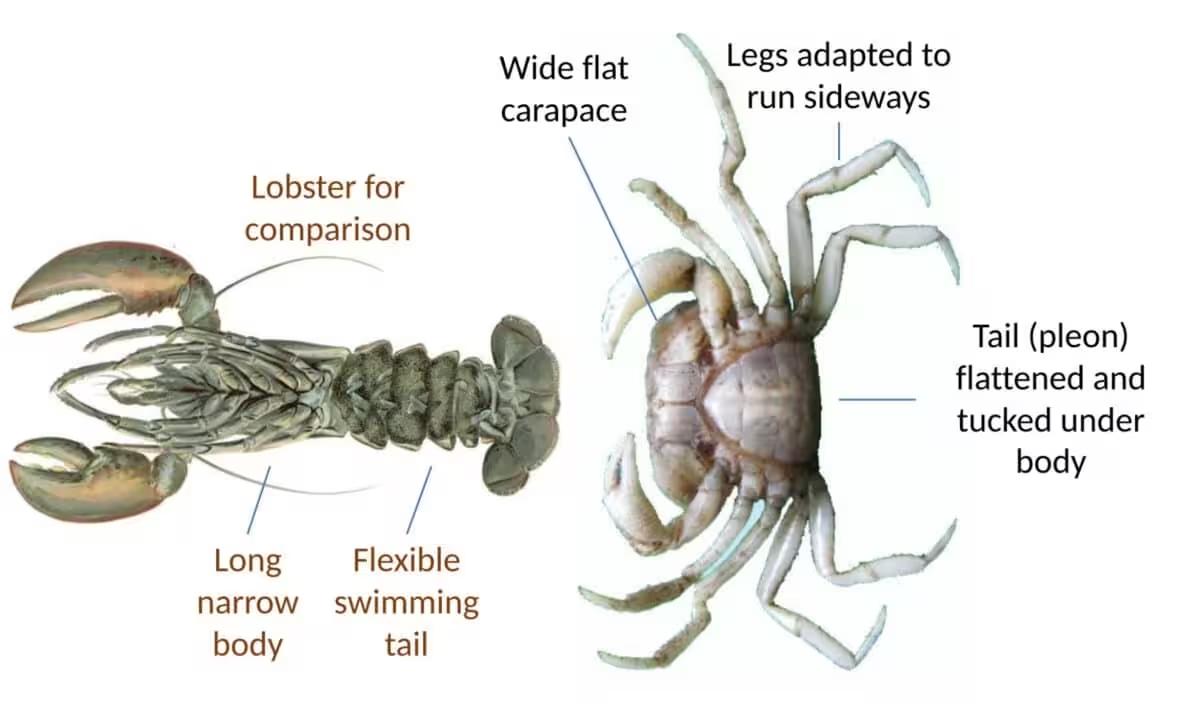
A flattened, wide-bodied form with a tucked abdomen is not exclusive to true crabs. Independent crustacean lineages have arrived at a similar silhouette, illustrating how distinct evolutionary routes can converge on comparable solutions.
Such convergences do not imply an inevitable march toward a crab shape. Rather, organisms sharing habitats encounter analogous pressures, prompting parallel adaptations that stem from a mix of ecological context, developmental constraints, historical happenstance, and shifting environments.
Repeated Emergence of a Crab‑Like Blueprint
The concept of “carcinization” – rooted in the Greek karkinos, the source of terms like carcinoma and carcinogen – was introduced by zoologist Lancelot Alexander Borradaile in 1916 to label this recurring evolutionary pattern.
A 2017 study published in the Biological Journal of the Linnean Society demonstrated that crab‑like morphologies have arisen multiple times within the Anomura clade, which encompasses hermit crabs, king crabs and squat lobsters.
This phenomenon fits within the broader framework of convergent evolution: birds and bats both achieve flight with mechanical wings despite distant ancestry, and both groups are warm‑blooded even though their lineages diverged before endothermy evolved.
Thus, the crab silhouette serves as a recurring evolutionary answer rather than a predetermined endpoint, offering a natural laboratory to probe how separate lineages converge on similar forms.
Locomotion and Mitochondrial DNA Illuminate Crab Origins
An eLife‑reviewed preprint suggests that the characteristic sideways gait of true crabs originated once, evolving from a forward‑moving ancestor near the base of the Eubrachyura lineage.
Complementing the locomotor insight, a January 2026 article in Animal Cells and Systems examined 42 mitochondrial genomes from Anomura, including three newly sequenced species, to refine phylogenetic relationships and test patterns linked to carcinization.
Time‑calibrated analyses placed key divergence events for newly sampled lithodid and pagurid lineages around the Eocene‑Oligocene transition, a period the authors propose as a fertile backdrop for diversification and morphological innovation.
Together, these genomic and locomotor data reinforce the 2017 finding that crab‑like designs emerged repeatedly within Anomura, allowing scientists to integrate shape, genetic information, and movement to dissect which traits recur, which remain unique, and which still elude a single explanatory model.
Fossil Record and Internal Anatomy Add Layers of Complexity
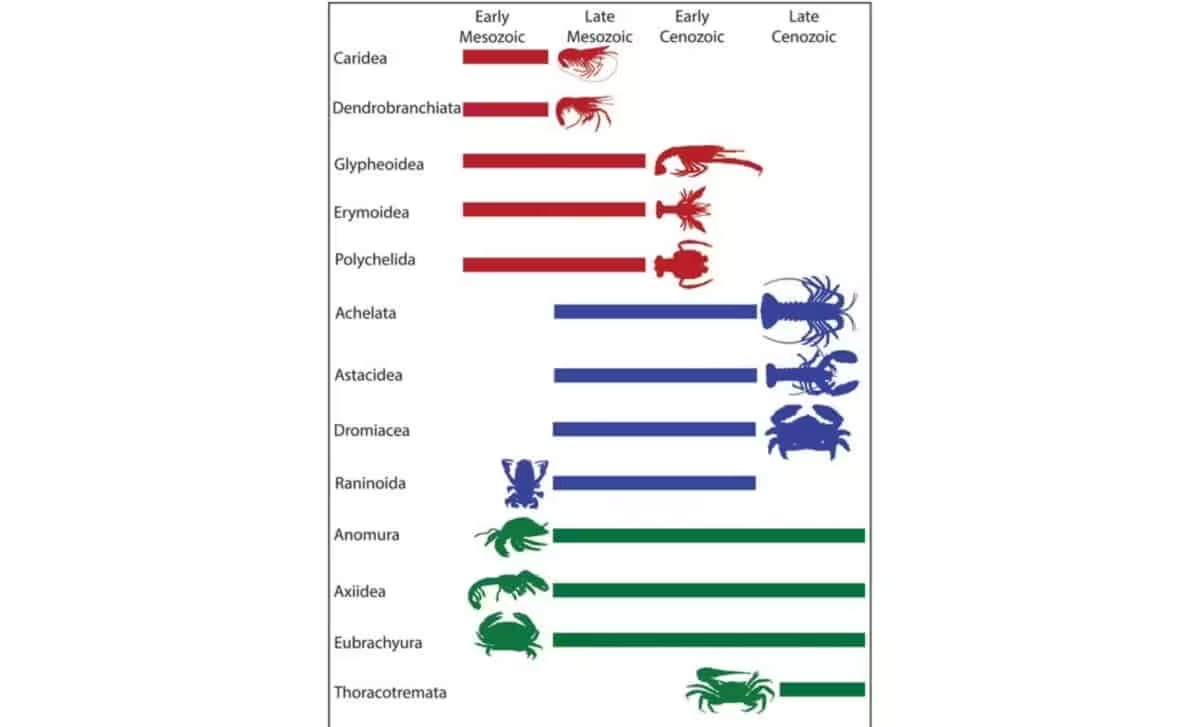
A February 2026 paper in the Journal of Crustacean Biology cataloged 4,225 fossil decapod species, spanning 1,284 genera and 193 families, providing a broad temporal framework for crustacean evolution.
The study identified diversity peaks during the Late Jurassic, Late Cretaceous, Eocene, and Miocene, and highlighted trends such as carcinization and its reversal (decarcinization) that hinge on improved fossil documentation.
Beyond external form, a 2017 investigation linked crab‑like exteriors to internal systems—nervous and circulatory structures—revealing both shared features and distinct organ morphologies across lineages.
“Some of the internal anatomical characters studied herein are structurally dependent on the external characters of a crab‑like habitus. Since morphological coherence can also exist between internal anatomical structures, the coherence chains which can be traced back to the external characters of a crab‑like habitus are relatively complex in some cases (indirect coherences).”
In this context, “habitus” refers to the overall body shape. While hermit crabs lack a crab‑like habitus, researchers argue that heavily spined king crabs derived from hermit‑crab ancestors.
Collectively, evidence from external morphology, internal anatomy, mitochondrial genomes, locomotor patterns, and an extensive fossil record underscores carcinization as a compelling example of repeated evolution—one that resists reduction to a single, universal driver.
This article has been fact checked for accuracy, with information verified against reputable sources. Learn more about us and our editorial process.
Last reviewed on .
Article history
- Latest version
Reference(s)
- <https://academic.oup.com/biolinnean/article-abstract/121/1/200/3089703>.
- Hadid, Rania. “Scientists Uncover 120-Million-Year-Old Gliding Dinosaur That Hunted Birds.”, June 5, 2026 Indian Defence Review <https://indiandefencereview.com/120-million-year-old-dinosaur-hunted-birds/>.
- “Study suggests crabs’ iconic sideways walk evolved from common ancestor.”, April 21, 2026 eLife <https://elifesciences.org/for-the-press/81901af4/study-suggests-crabs-iconic-sideways-walk-evolved-from-common-ancestor>.
- Hwang, Hee-seung. “Comparative phylomitogenomic analyses provide insights into adaptation and carcinization in Anomura.”, vol. 30, no. 1, pp. 13 PubMed Central (PMC), doi: 10.1080/19768354.2025.2607863. <https://pmc.ncbi.nlm.nih.gov/articles/PMC12798672/>.
- <https://academic.oup.com/jcb/article/46/1/ruag007/8498769?login=false>.
- Amiri, Arezki. “Buried for a Century, Scientists Revive Spanish Flu Genome From 107-Year-Old Lung.”, August 25, 2025 Indian Defence Review <https://indiandefencereview.com/buried-for-a-century-scientists-revive-spanish-flu-genome-from-107-year-old-lung/>.
Cite this page:
- Posted by Linda Wilson