Man’s ’ ‘Gold’ Find Is Actually a 4.6 Billion-Year-Old Meteorite From Space
Scientists crack the mystery of an indestructible red rock from Australia’s gold fields after it survived saws, acid, drills, and a sledgehammer.
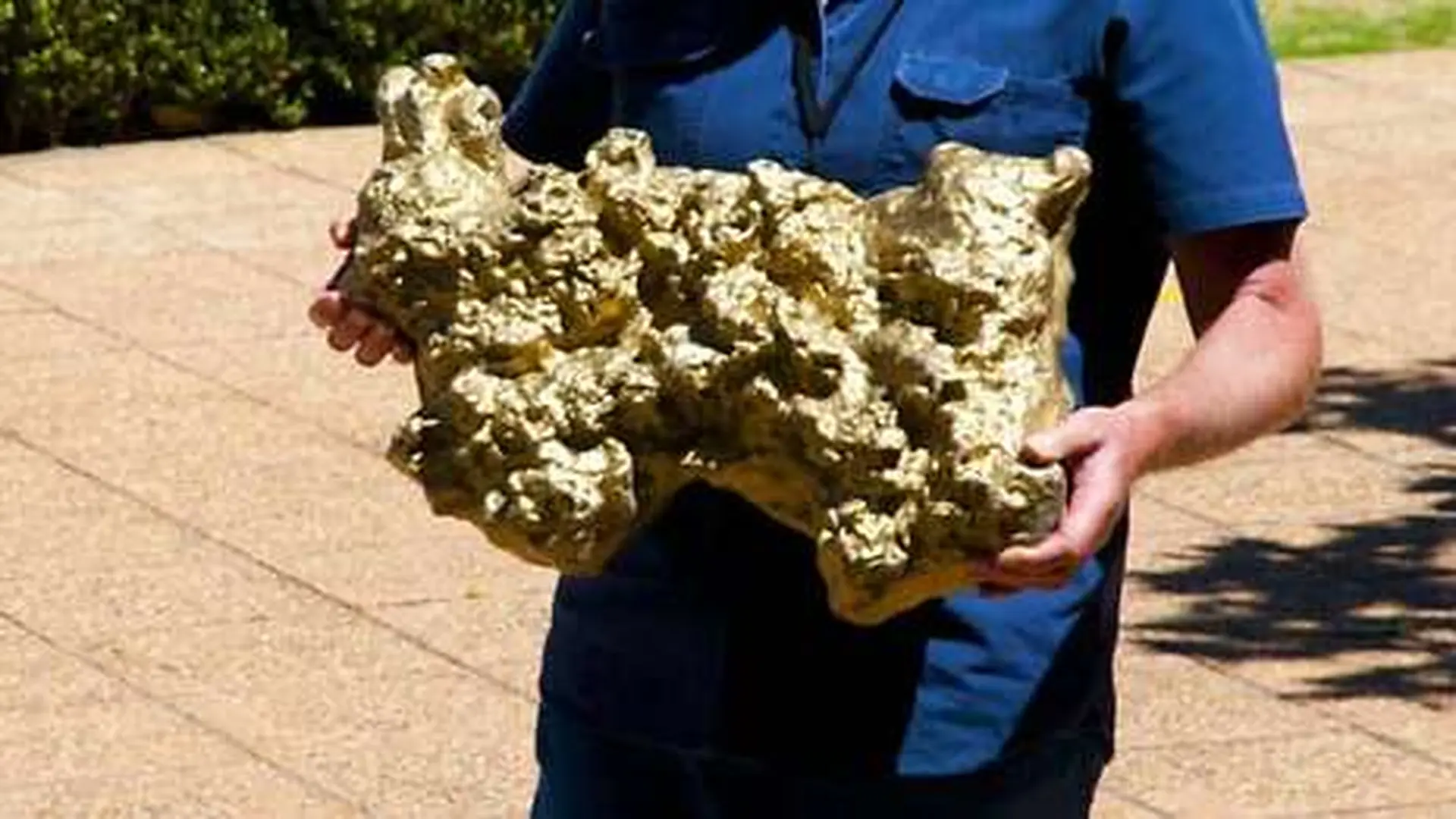
A heavy, reddish stone unearthed in the clay of Maryborough Regional Park in 2015 has been confirmed as a 4.6‑billion‑year‑old meteorite, making it one of the most uncommon finds in Victoria’s gold‑rich region.
A Gold‑Seeker’s Unexpected Treasure
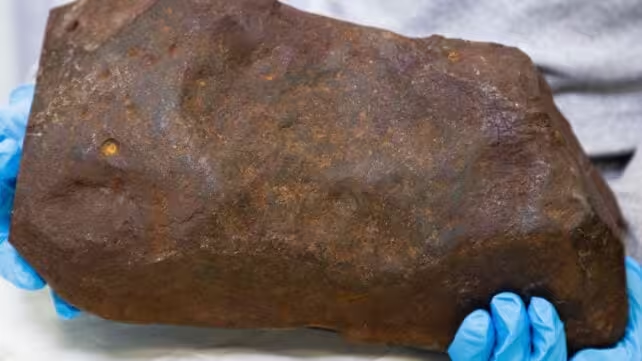
While sweeping a metal detector across the yellow earth outside the small Victorian town of Maryborough, local resident David Hole heard a strong beep, dug up a shoebox‑sized rock with a pitted, dimpled surface, and immediately assumed it concealed a gold nugget. The stone felt unusually dense, prompting Hole to test it with a rock saw, an angle grinder, a drill, acid baths, and even a sledgehammer, yet none of the methods altered its exterior. The mystery remained unsolved for years as the rock sat untouched on his property.
Museum Investigation Reveals a Cosmic Origin
In 2018 Hole took the specimen to the geology department of Melbourne Museum, where staff routinely examine public submissions that claim to be meteorites. Geologists Dermot Henry, a veteran of 37 years at the museum, and Bill Birch inspected the object and quickly noted its sculpted texture—a pattern of tiny dimples known as regmaglypts that form when an object ablates while entering Earth’s atmosphere. Weighing 17 kilograms and measuring 38.5 × 14.5 × 14.5 centimetres, the rock’s mass was inconsistent with any ordinary terrestrial stone of that size, steering the experts toward a meteoritic explanation.
Cutting Through the Exterior to Reveal Chondrules
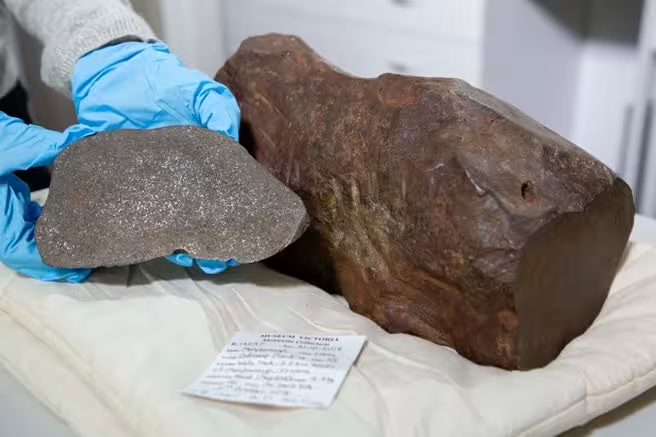
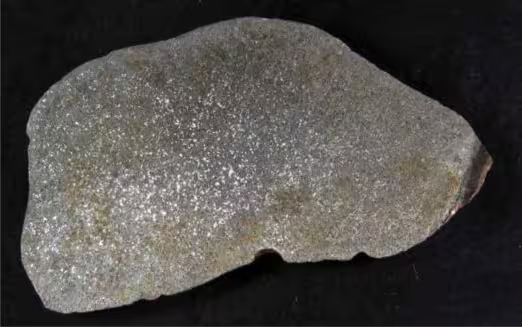
A diamond‑tipped saw was employed to slice the dense shell, exposing a network of microscopic, spherical droplets called chondrules. These structures form when dust particles in the early solar system’s protoplanetary disk are rapidly heated and then cooled under microgravity conditions, and they never occur in Earth‑formed rocks. Their presence confirmed the stone as a chondrite, a type of meteorite that preserves primitive material from the solar system’s birth.
Laboratory analysis classified the fragment as an H5 ordinary chondrite. The “H” denotes a high iron content—about 25‑30 percent by weight—while the “5” indicates the rock experienced significant thermal metamorphism, partially recrystallizing its chondrules while still part of a larger parent asteroid. Further mineralogical tests identified the iron‑nickel alloys kamacite and taenite, along with trace amounts of native copper, explaining the strong response on Hole’s metal detector.
Ancient Birth, Relatively Recent Arrival
The meteorite originated roughly 4.6 billion years ago, predating Earth’s final assembly, most likely within the asteroid belt between Mars and Jupiter. Collisions in that region can eject fragments onto Earth‑crossing trajectories, a process believed to have delivered this rock to the Victorian landscape long before Hole’s discovery.
Carbon‑14 measurements carried out at the University of Arizona, using cosmogenic isotopes that accumulate in space‑exposed rocks and decay after atmospheric entry, suggest the meteorite landed between 100 and 1 000 years ago. Historical accounts from the Maryborough district record several fireball sightings between 1889 and 1951, offering a plausible, though unconfirmed, link to the rock’s terrestrial descent.
A Rarity Among Victoria’s Gold Finds
Only 17 meteorites have been formally recorded in the state of Victoria, whereas the Goldfields region has yielded thousands of nuggets since the 19th‑century rush. The Maryborough specimen joins a short lineage that includes a 1995 iron‑nickel find at Willow Grove in Gippsland and the Ballarat meteorite—discovered in the 1860s but identified in 2002—considered a “fossil” meteorite because it was embedded in river gravels beneath basalt.
“Meteorites provide the cheapest form of space exploration,” said Henry, noting that such rocks carry clues about the age, formation, and chemistry of the solar system, as well as insights into Earth’s own history.
From Storage to Public Display
The stone now resides in the State Collection managed by Museums Victoria, alongside more than 400 other specimens such as the well‑studied Murchison meteorite. It is on public exhibit at Melbourne Museum, where it was featured during National Science Week and continues to attract visitors eager to see the rock that withstood a saw, grinder, acid, and sledgehammer before revealing its extraterrestrial nature.
This article has been fact checked for accuracy, with information verified against reputable sources. Learn more about us and our editorial process.
Last reviewed on .
Article history
- Latest version
Cite this page:
- Posted by Bilal Abbasi