Nobel Chemist Unveils MOF Device That Turns Desert Air Into Drinking Water
California field tests prove the material can extract water from dry air with sunlight, bringing the technology nearer to commercial use.
Omar Yaghi, a chemist born in Jordan and now a professor at the University of California, Berkeley, received the 2025 Nobel Prize in Chemistry for his work on metal‑organic frameworks (MOFs). These crystalline compounds consist of metal nodes linked by organic molecules, forming a network of nanoscopic pores that can be tuned to bind specific gases or liquids.
By adjusting the pore chemistry, MOFs can be deployed for tasks ranging from carbon capture to atmospheric water extraction. At the 2026 Lindau Nobel Laureate Meeting, Yaghi illustrated the scale of these materials, noting that a gram of MOF can hold a surface area equivalent to a football field compressed into a sugar‑cube‑sized volume.
A Childhood Drive Behind a Global Water Initiative
Yaghi linked his scientific ambition to memories of irregular water deliveries in his native Jordan, where municipal supplies arrived only once or twice a week. He explained at his Nobel banquet that his early fascination with how porous solids interact with moisture sparked the idea of harnessing MOFs to mitigate water scarcity.
According to ZME Science, MOFs behave more like molecular scaffolds than solid blocks, their high void fraction enabling efficient molecular capture. Yaghi describes the design strategy as “reticular chemistry,” likening it to “Lego chemistry” where discrete building units are assembled into structures absent from nature.
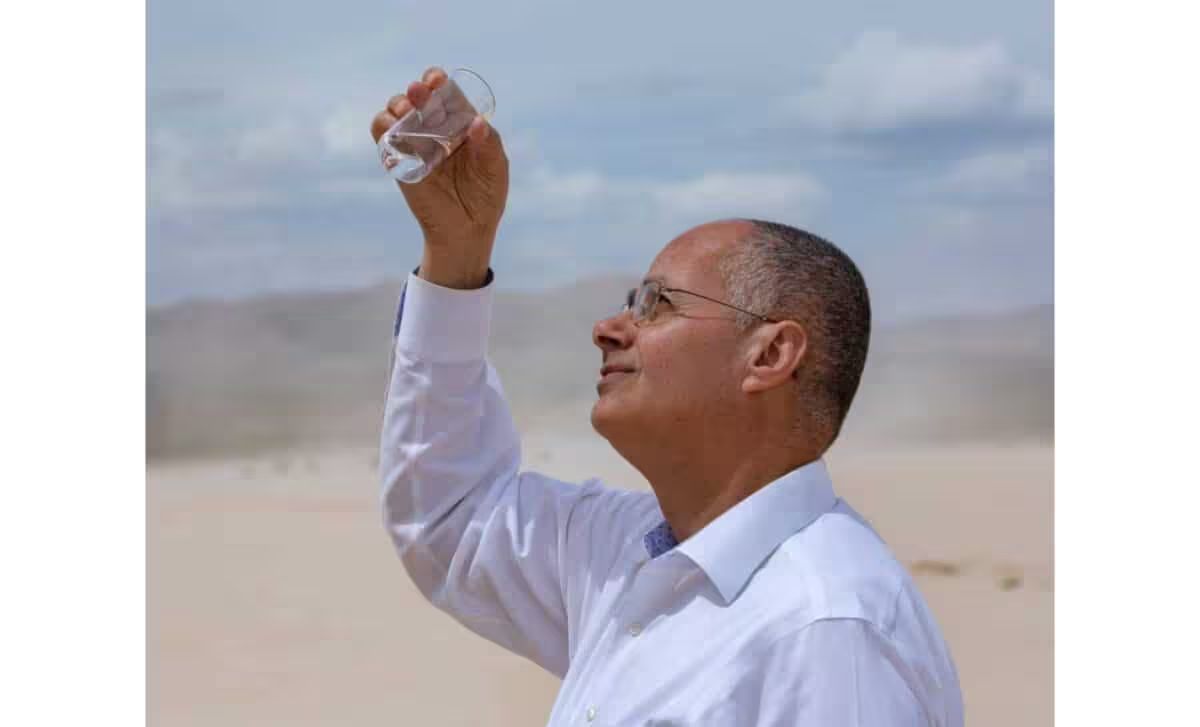
“I saw how this MOF could pull water from desert air and turn it into clean drinking water,” Yaghi told the audience.
The Science Behind Atmospheric Moisture Harvesting
MOFs do not soak up water like a sponge; instead, water molecules adhere to the internal surfaces of the pores. Initial adsorption occurs at high‑energy sites, after which molecules aggregate into clusters, chains, and eventually a continuous network inside the framework.
Berkeley researchers mapped each adsorption stage, enabling them to tweak the organic linkers for faster water release. Yaghi noted that this work began in 2022 and that a commercial‑ready version is now available.
The harvesting device operates on a diurnal cycle. During cooler, humid nights the MOF cartridge is exposed to ambient air, allowing water vapor to enter the pores. Sunlight heats the material by day, prompting the bound water to desorb as vapor, which is then condensed into liquid. Yaghi emphasized the sheer volume of atmospheric moisture, saying:
“We’ve got a lot of water in the air. We have more water in the air than in our rivers on our planet.”
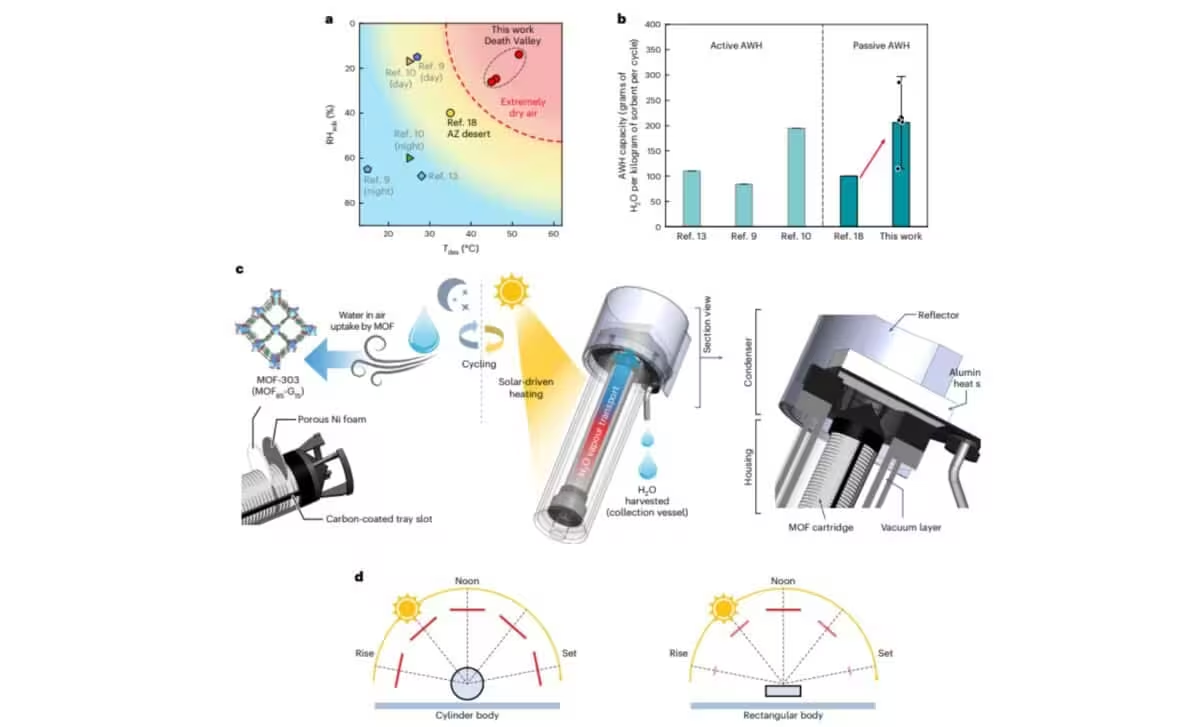
The first major field test was reported in 2017, when MIT and Berkeley teams built a solar‑driven unit using MOF‑801. That prototype generated up to 2.8 L of water per kilogram of MOF each day, even at relative humidities as low as 20 %.
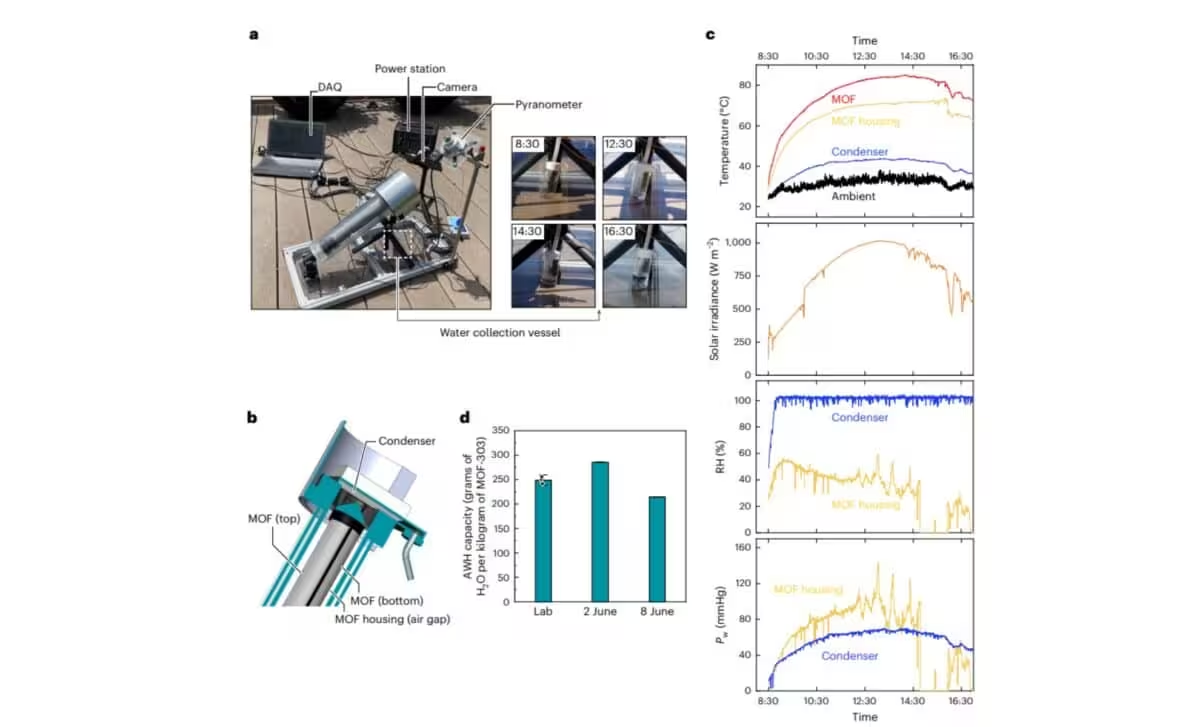
Later iterations introduced MOF‑303, an aluminum‑based framework. A passive MOF‑303 system tested in both Berkeley and California’s Death Valley in 2023 yielded 285 g of water per kilogram of MOF per day in the milder climate and 210 g/kg/day under the harsh desert conditions, relying solely on sunlight.
Scaling Up: From Lab Bench to Market
Testing in Death Valley exposed the technology to extreme conditions: temperatures from 21.9 °C to 60.7 °C and relative humidity between 9.4 % and 36 %. According to the study, no prior atmospheric water harvester had demonstrated operation under such harsh parameters using only solar energy.
Yaghi explained that the MOF can capture moisture at 10 % humidity and release it when heated to about 45 °C, crediting graduate student Nikita Hanikel for pivotal contributions.
To bring the concept to consumers, Yaghi founded Atoco. The firm markets atmospheric water harvesters that employ reticular materials to generate potable water where conventional infrastructure is lacking. Small‑scale units are advertised to produce roughly 150 L per day, while larger, container‑sized systems aim for up to 1,000 L daily using low‑grade thermal energy.
Yaghi highlighted that the water obtained is “the most ultra‑pure water” because the MOF also acts as a filter; his team demonstrated this by drinking the harvested liquid. He added that the materials have been engineered to function outside controlled laboratory settings, tolerating rugged environments.
The most robust peer‑reviewed field data to date appear in a 2023 Nature Water article describing the Death Valley trials. Yaghi indicated that newer performance metrics exist, but they have not yet been published in a scientific journal.
Transitioning from passive prototypes to large‑scale commercial units introduces additional hurdles. Consistent, low‑cost MOF production, durability through repeated wet‑dry cycles, resistance to dust, heat, and contaminants, and economic viability are all critical factors. While laboratory and field demonstrations confirm that MOFs can harvest water from arid air, the ultimate test will be whether the technology can be deployed affordably and reliably for communities that lack dependable drinking‑water supplies.
This article has been fact checked for accuracy, with information verified against reputable sources. Learn more about us and our editorial process.
Last reviewed on .
Article history
- Latest version
Reference(s)
- “75th Lindau Nobel Laureate Meeting | Lindau Mediatheque.”, July 9, 2026 Lindau Nobel Mediatheque <https://mediatheque.lindau-nobel.org/meetings/2026>.
- Andrei, Mihai. “A Nobel Winning Chemist Is Trying to Pull Drinking Water from Desert Air.”, July 6, 2026 ZME Science <https://www.zmescience.com/science/news-science/a-nobel-winning-chemist-is-trying-to-pull-drinking-water-from-desert-air/>.
- “Nobel Prize in Chemistry 2025.” NobelPrize.org <https://www.nobelprize.org/prizes/chemistry/2025/yaghi/speech/>.
- “Omar M. Yaghi - Lectures | Lindau Mediatheque.” Lindau Nobel Mediatheque <https://mediatheque.lindau-nobel.org/recordings/43057>.
- “23MOFwaterdevice.” <https://yaghi.berkeley.edu/pdfPublications/23MOFwaterdevice.pdf>.
Cite this page:
- Posted by Bilal Abbasi