Space Radiation Accelerates Liver Aging, Offering Clues for Anti‑Aging Therapies
Study finds deep‑space stress mimics accelerated aging, hinting at new therapies for astronauts and Earth patients.

Living beyond Earth’s protective shield may reveal crucial insights into how the human body ages. A recent paper in GeroScience shows that the combination of space‑borne radiation and weightlessness provokes molecular shifts that mirror accelerated aging, highlighting new risks for upcoming Mars voyages while pointing to potential targets for age‑related therapies. The work suggests that the same pathways endangering astronaut health could eventually help scientists slow the functional decline of organs as people get older.
Space Exposure Accelerates Age‑Related Liver Alterations
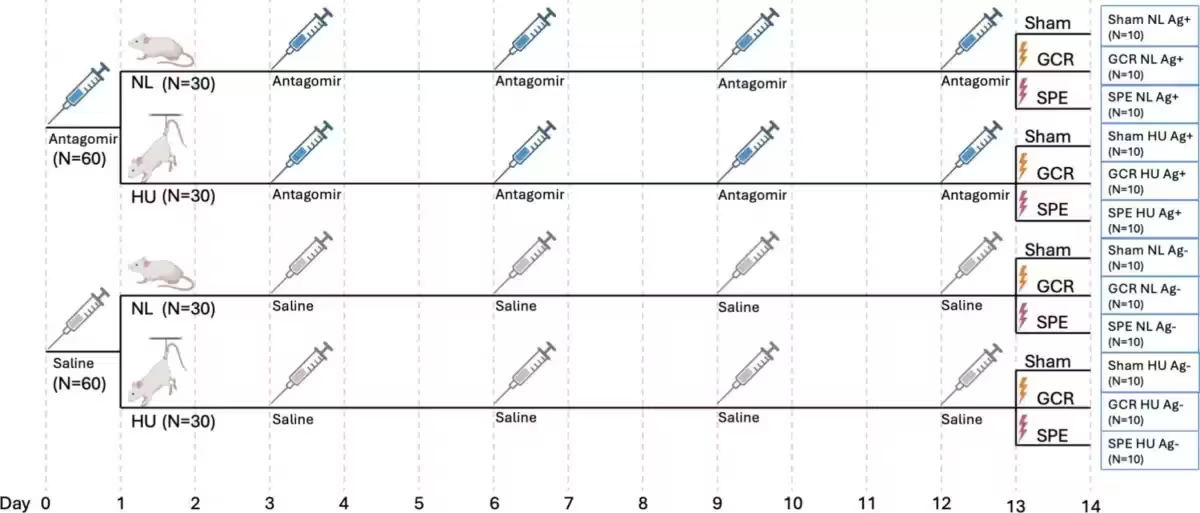
Researchers from the University of Central Florida and partner institutions recreated a deep‑space scenario using rodents. The protocol paired 14 days of simulated microgravity with doses of galactic cosmic radiation and solar particle event radiation delivered at the NASA Space Radiation Laboratory, approximating the cumulative dose an astronaut might encounter on a Mars mission.
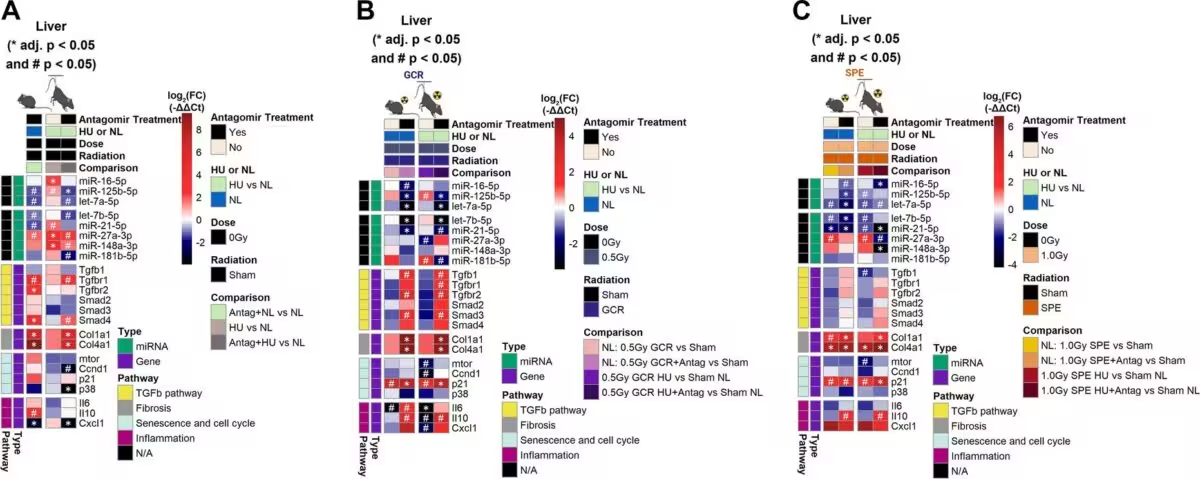
Analysis of the animals’ livers revealed extensive genetic remodeling. The investigators documented heightened cellular senescence, inflammatory signaling, and fibrosis—processes strongly linked to age‑associated organ deterioration. Even brief exposure to the simulated environment was enough to trigger pathways usually observed much later in life, raising concerns that prolonged spaceflight could progressively compromise liver function and, by extension, systemic health.
“We focused on the liver because it is one of the major metabolic organs in our body,” says Michal Masternak, a professor of medicine and director of the College of Medicine’s aging and space‑medicine program. “What we found was that just 24 hours after radiation exposure, there are many genetic changes in the liver that are remarkably similar to what happens during aging. We can assume that if someone were in space much longer, the damage could be much greater.”
Human Astronaut Data Mirrors Laboratory Findings
The animal work was cross‑checked against genetic information from participants in the NASA Twins Study and crew members of the Inspiration4 flight. Although the rodent experiments examined liver tissue and the astronaut datasets derived from blood, both sets displayed overlapping molecular signatures. This convergence strengthens the idea that the changes seen in the simulated experiments also occur in humans during actual spaceflight.
The shared patterns highlight molecular routes that could become therapeutic targets for safeguarding crew members on future long‑duration missions. The study, appearing in GeroScience, adds to a growing body of evidence that radiation plus microgravity elicit predictable biological responses that may eventually be mitigated.
“We’ve got this raw data from human studies, and they show that some of these changes are similar,” Masternak says. “That tells us we’re identifying useful molecular targets that one day could help protect astronauts during long‑duration space missions.”
Targeting Tiny RNAs for Future Therapies
To test whether the adverse changes could be mitigated, the team investigated antagomirs—synthetic molecules that bind specific microRNAs and modulate their activity. Because microRNAs regulate networks involved in inflammation, fibrosis and cellular aging, blocking selected candidates may blunt the harmful cascade triggered by space conditions. Although still at an early experimental phase, the approach offers a blueprint for interventions that could preserve organ health on long‑term missions and, by extension, for treating age‑related disorders on Earth.
Space as a Rapid‑Aging Test Bed
A major obstacle in gerontology is the long timescale required to observe organ decline. The accelerated timeline imposed by radiation and microgravity provides a shortcut: researchers can witness age‑associated molecular events within days rather than years. This “fast‑forward” model could accelerate discovery of early biomarkers and therapeutic windows that are otherwise hidden in conventional studies.
“Very often when we study different aging processes, it takes time,” he says. “Even in humans, it’s almost impossible because it would take decades. But if we see some acceleration of aging in space, then we can translate it to human studies. We can observe processes happening much faster, understand them better and eventually use that knowledge to improve the health of people here on Earth.”
Seeking the First Sparks of Human Aging
Modern aging research views the process as a web of interdependent systems—liver, immune, cardiovascular and others—that deteriorate together. Damage in one organ can cascade throughout the body. By pinpointing the earliest molecular triggers that light up during space exposure, scientists hope to intervene before irreversible injury sets in. If future human studies confirm these animal results, the insights gained for astronaut protection could reshape treatment strategies for chronic, age‑linked diseases, extending functional lifespan for millions.
“Our understanding of aging is very complex,” Masternak says. “Aging isn’t simply wrinkles or cosmetic changes. It’s the gradual and cascading failure of multiple organs and biological systems that happen at the same time. By understanding what starts that process and where it happens, we have a better chance of preventing many diseases before they develop. That is one of the biggest outstanding questions.”
This article has been fact checked for accuracy, with information verified against reputable sources. Learn more about us and our editorial process.
Last reviewed on .
Article history
- Latest version
Reference(s)
- Hayslip, Natalie., et al. “Space radiation and microgravity as models of accelerated aging: modulation of hepatic miRNA-TGF-β networks associated with senescence and fibrosis.” GeroScience, June 23, 2026 Springer Science and Business Media LLC, doi: 10.1007/s11357-026-02365-x. <https://dx.doi.org/10.1007/s11357-026-02365-x>.
Cite this page:
- Posted by Aisha Ahmed