How a 500‑km Icy World Keeps a Thin Atmosphere That Shouldn’t Exist
New observations of a distant object beyond Neptune reveal an unexpected atmosphere, reshaping theories on which worlds can hold one.
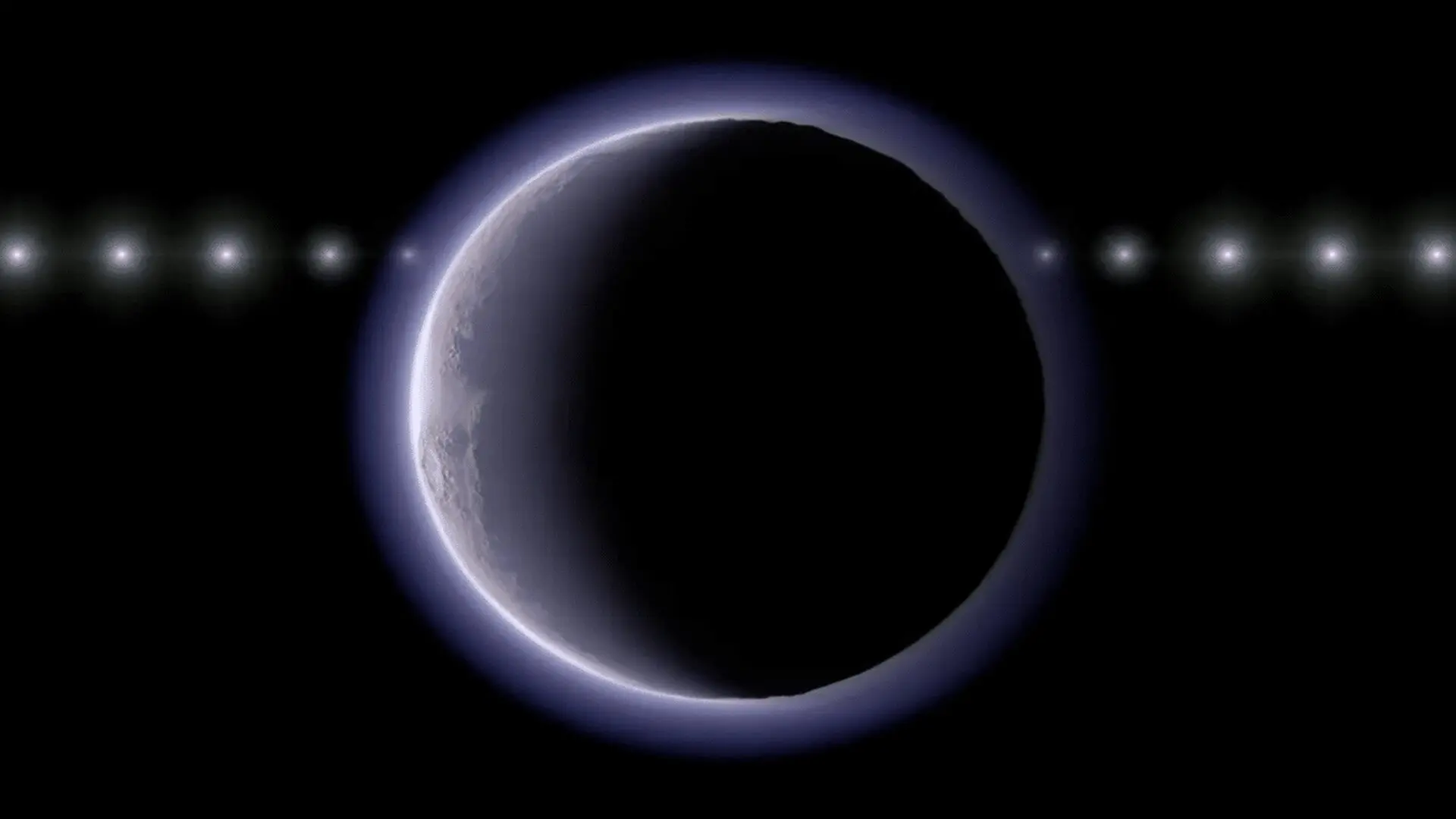
A distant, icy body orbiting past Neptune has revealed an unexpected gaseous envelope, a finding that challenges current ideas about the atmosphere‑forming potential of small worlds in the outer Solar System. The discovery, reported in Nature Astronomy, forces scientists to rethink how these remote objects evolve.
Surprising Atmosphere Around a Tiny Kuiper Belt Body
The object, catalogued as (612533) 2002 XV93, belongs to the trans‑Neptunian population that resides in the Kuiper Belt beyond Neptune’s orbit. It follows the same 2:3 resonance with Neptune that defines Pluto’s class of plutinos. With a diameter of roughly 500 km (310 mi), it is a fraction of Pluto’s size, making the detection of any gaseous layer all the more remarkable.
On 10 January 2024 the body occulted a background star, allowing astronomers to record a gradual dimming of the starlight rather than an abrupt disappearance. That subtle signature indicated a thin atmosphere enveloping the object.
The occultation campaign was coordinated by Ko Arimatsu of the National Astronomical Observatory of Japan and involved both professional telescopes and amateur observers at four sites across Japan. By combining the data, the team refined the size estimate for 2002 XV93 and confirmed the presence of a faint gaseous sheath.
Extremely Thin Air Compared With Earth and Pluto
Pressure measurements suggest a surface pressure of only 100–200 nanobars, translating to a layer five to ten million times less dense than Earth’s atmosphere. Even Pluto’s tenuous atmosphere, averaging about 10 millibars, is orders of magnitude thicker.
The puzzle deepens because earlier observations with the James Webb Space Telescope found no surface ices of nitrogen, methane or carbon monoxide on 2002 XV93—volatile compounds that normally fuel Pluto’s atmosphere when heated. Surface temperatures are estimated between 40 K and 50 K, far too low for water or carbon‑dioxide ice to sublimate.
These contradictions leave current atmospheric models unable to explain how a small, frigid body could retain any gas at all.
Competing Scenarios for a Transient Envelope
Scientists have outlined two leading hypotheses, each with significant shortcomings. One possibility is that a recent impact by a comet‑like projectile liberated volatile gases, creating a temporary atmosphere. However, the weak gravity of the object would allow the gas to escape in roughly a thousand years—a fleeting interval on cosmic scales, implying a lucky observational window.
The alternative explanation invokes cryovolcanism, where subsurface reservoirs of frozen volatiles erupt and replenish the thin envelope. The mechanism that could power such activity on an object of this size and temperature remains unknown.
“This discovery suggests that the traditional idea that global dense atmospheres form only around larger planets must be revised,” said Arimatsu’s team in their research paper.
Future JWST Observations Could Reveal Composition
Determining the chemical makeup of the atmosphere is the next priority. Follow‑up measurements with the James Webb Space Telescope may detect nitrogen, methane or carbon monoxide despite earlier surface scans that found none.
Continued monitoring will also test the longevity of the gas layer. A steady decline would support the impact‑induced scenario, while a stable or increasing pressure would favor ongoing cryovolcanic activity.
Either outcome would reshape our understanding of how atmospheres can arise and persist on distant, icy remnants of the Solar System.
Implications for Small Worlds Beyond Neptune
The presence of an atmosphere around (612533) 2002 XV93 widens the scope of bodies that may host active processes. For years Pluto stood as the sole example of a Kuiper Belt object with a measurable atmosphere; this plutino suggests that similar surprises could await other small, distant bodies.
As astronomers record more stellar occultations and deploy next‑generation instruments to probe the far reaches of our planetary system, additional unexpected characteristics may emerge, prompting a reassessment of atmospheric formation and survival at the Solar System’s outer edge.
This article has been fact checked for accuracy, with information verified against reputable sources. Learn more about us and our editorial process.
Last reviewed on .
Article history
- Latest version
Reference(s)
- Arimatsu, Ko. “Detection of an atmosphere on a trans-Neptunian object beyond Pluto - Nature Astronomy.”, May 4, 2026, pp. 1-8. Nature, doi: 10.1038/s41550-026-02846-1. <https://www.nature.com/articles/s41550-026-02846-1>.
Cite this page:
- Posted by Aisha Ahmed