Scientists Measure Black Hole Spin and Gravity Directly for First Time via Gravitational Waves
Scientists decode hidden details from the final vibrations after a black‑hole merger, revealing new insights missed in earlier observations.
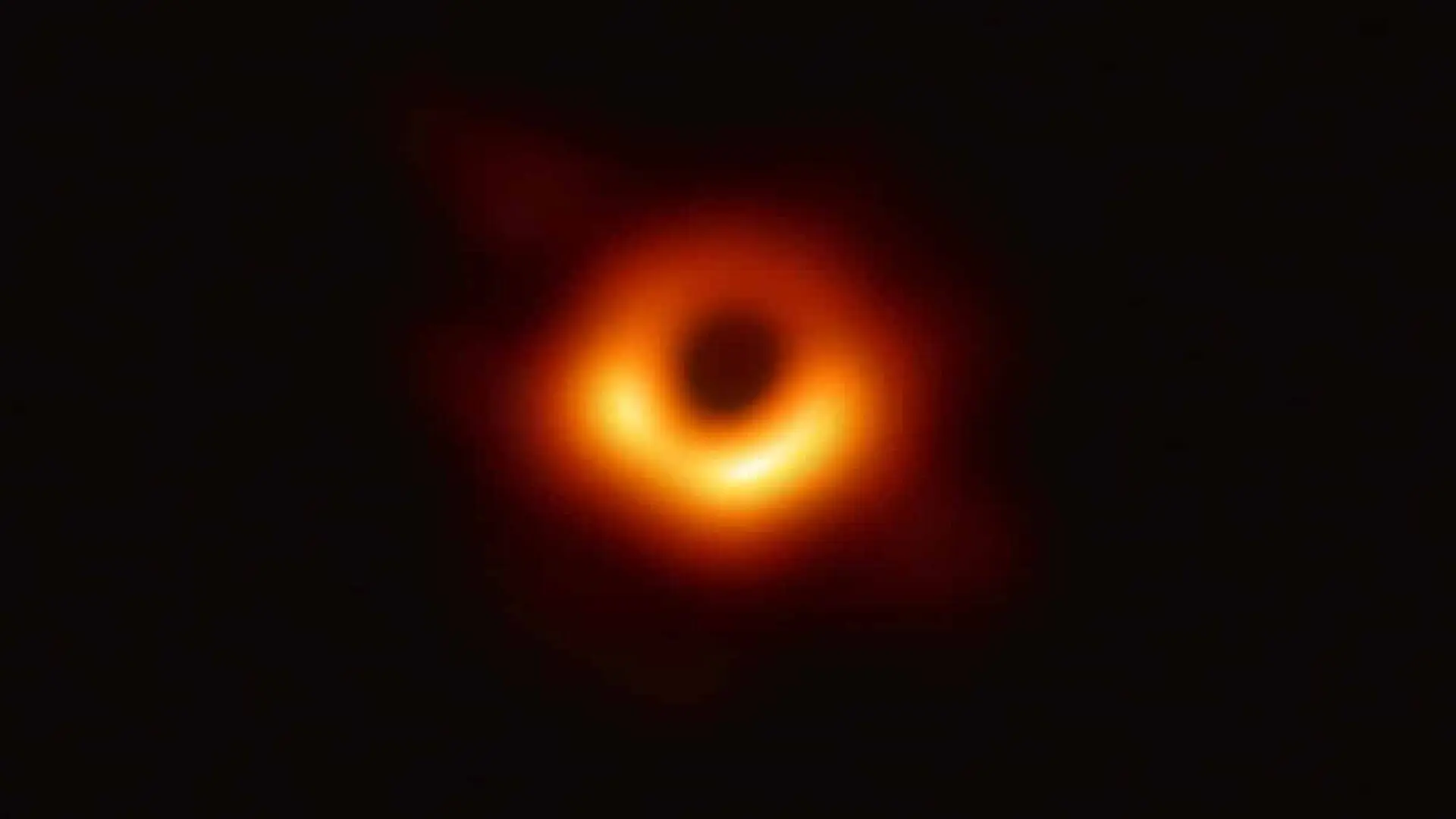
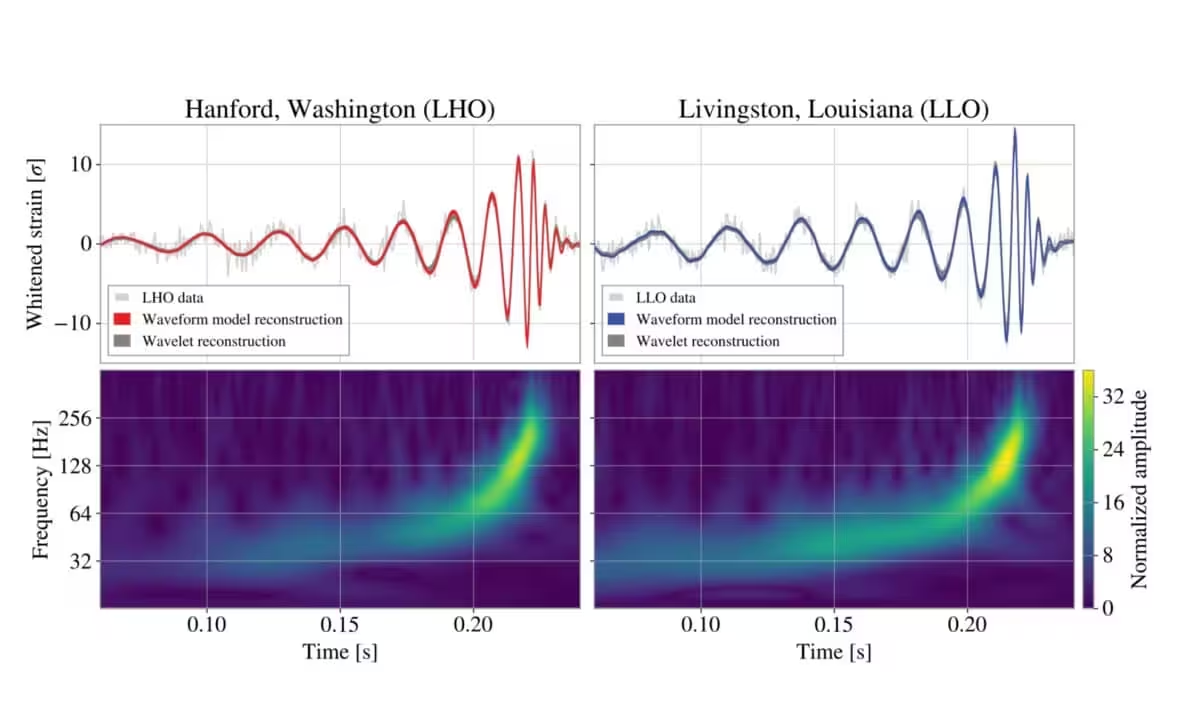
In early January 2025 a gravitational‑wave burst swept across the United States, arriving at the twin LIGO observatories in Washington and Louisiana within fractions of a second. The signal, designated GW250114, originated from the coalescence of two stellar‑mass black holes weighing roughly 34 and 32 solar masses.
Compared with the landmark GW150914 event that inaugurated gravitational‑wave astronomy in 2015, GW250114 was about three times louder, allowing scientists to extract subtle details that had been obscured in earlier detections.
Direct Estimates of Horizon Spin and Surface Gravity
A collaboration of researchers reported the inaugural direct measurements of two fundamental attributes of a black‑hole’s event horizon: the angular frequency of its rotation and the strength of its surface gravity.
Because the event horizon marks the point of no return for any form of radiation, conventional telescopes cannot capture its image. Instead, the team examined the gravitational‑wave imprint produced as the two black holes merged, a method highlighted by ZME Science as a way to infer horizon properties directly from the waveform.
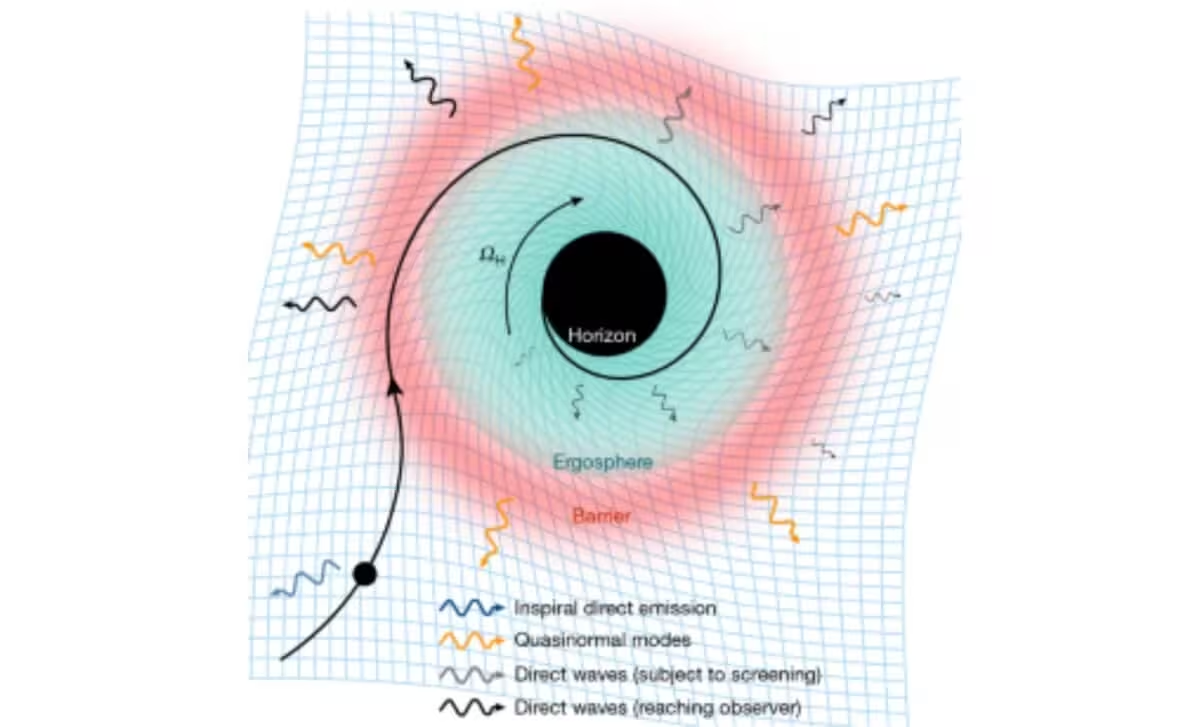
Ringdown Analysis Reveals Faint Direct Wave
After the merger, the remnant black hole vibrates briefly before reaching equilibrium, a phase known as the “ringdown,” analogous to the resonant sound of a struck bell.
Within this decaying signal, investigators identified a weak, rapidly diminishing component called a direct wave. Theory had long predicted its presence, but previous detectors lacked the sensitivity to separate it from background noise.
Neil Lu of the ANU Centre for Gravitational Astrophysics (CGA) and the ARC Centre of Excellence for Gravitational Wave Discovery (OzGrav) explained:
“We captured the final acoustic imprint of the black holes’ collision. Hidden inside that imprint is a minor contribution, the direct wave, which had eluded clear interpretation until now. Our refined analysis extracts this piece and yields fresh insight from just outside the event horizon.”
The research suggests that direct waves arise in the immediate vicinity of the newly formed horizon, where intense frame‑dragging forces both infalling material and spacetime itself into a swift rotation.
Observations Confirm Einstein’s Predictions
The findings offer a stringent test of general relativity in the most extreme gravitational environment known, probing whether Einstein’s equations hold true just outside a black‑hole horizon, a regime where novel physics has long been anticipated.
For GW250114, the measured rotation rate and surface gravity matched the values expected for a spinning black hole under Einstein’s framework. Co‑author Ling Sun remarked:
“This work sheds light on phenomena such as frame dragging, where a rotating black hole pulls the surrounding spacetime along with it. In the innermost region, the dragging is so intense that nothing can stay still relative to a distant observer.”
GW250114’s exceptional proximity, power, and frequency placement within LIGO’s most sensitive band made it uniquely suited for this analysis, allowing the direct wave to be isolated from the broader signal. Sun added:
“The excitement lies in the fact that gravitational waves are now bringing us within reach of the black‑hole horizon—a region that once seemed inaccessible to direct observation.”
This article has been fact checked for accuracy, with information verified against reputable sources. Learn more about us and our editorial process.
Last reviewed on .
Article history
- Latest version
Cite this page:
- Posted by Aisha Ahmed